
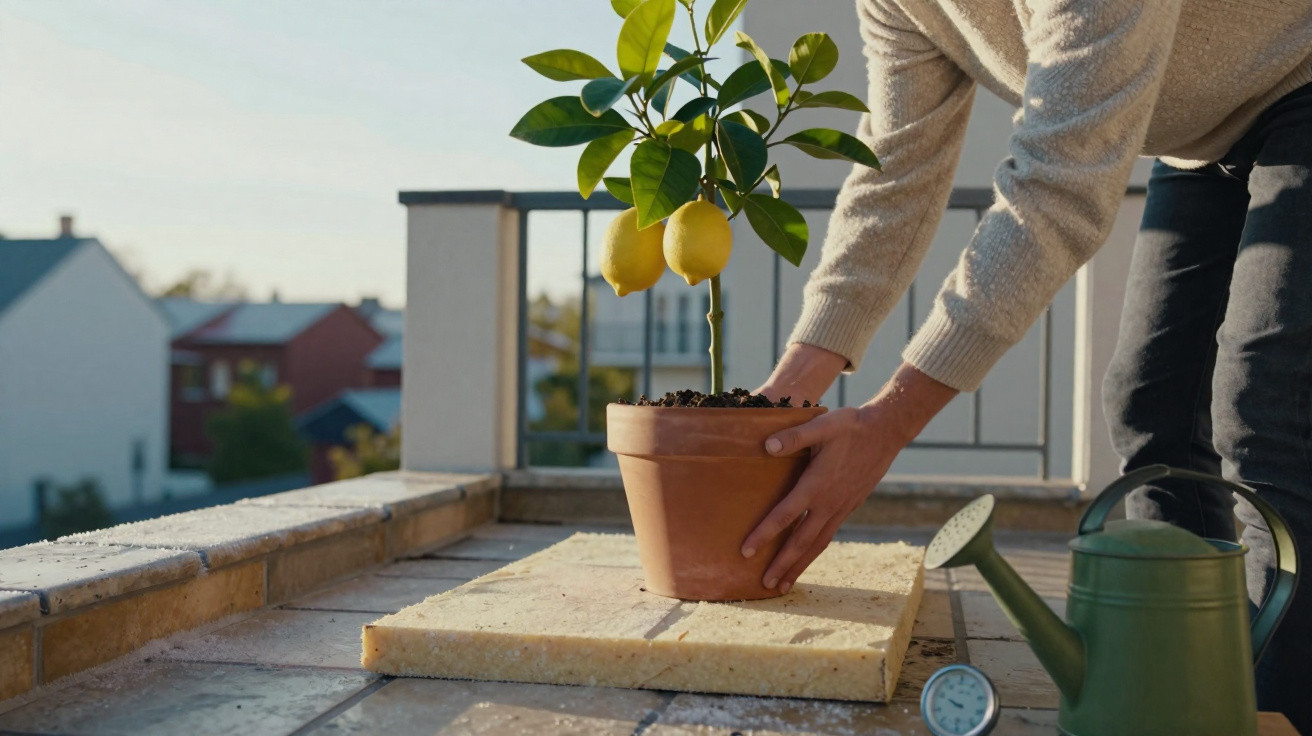
Spring often makes hobby gardeners feel safe far too soon. The days turn milder, the potted lemon tree looks fit and healthy, and everything seems to signal the start of the season. Then late frost hits - and it frequently arrives not from the air, but quietly from below via a balcony or terrace. One unremarkable item placed beneath the pot interrupts that cold shock and can, quite literally, save the tree.
Why a potted lemon tree suddenly deteriorates in March
Anyone keeping a lemon tree in a container knows the pattern: February looks fine, then in March leaves start browning, shoots dry out and the plant suddenly appears unwell. Many people blame lack of water or a fungus. Often, however, the real cause is a single freezing night.
A common sequence looks like this:
- Mild temperatures in the daytime; sun on the balcony; the tree pushes fresh green growth.
- At night, temperatures drop to -1 to -3 degrees, with clear skies.
- Concrete or stone underfoot holds the cold and passes it straight into the base of the pot.
- The root zone freezes in patches; delicate root hairs die off.
From the outside, you usually only notice days later: foliage turns dull, leaves curl, and entire branches look as if they have been scorched. In many cases, the canopy suffers more than the visible trunk. Put simply, once the roots are compromised, the tree can no longer take up water.
"Late frost on a potted lemon tree often kills the roots first - not the leaves."
The underestimated enemy: a cold bridge through the balcony floor
Agricultural scientists have been pointing this out for years: in a pot, cold does not only come from the air - it also rises powerfully from the surface underneath. Concrete balcony slabs and tiled floors can act like a cooling plate, dragging the compost temperature down.
These positions are especially risky:
- A balcony or terrace with tiles or a concrete surface
- Stone slabs laid directly on the ground
- Metal or stone stands without an insulating layer
During the day the surface may warm up, but at night it loses heat quickly. The cold then creeps up from underneath into the pot. This “temperature shock” tends to hit citrus plants far harder than many native shrubs and trees.
Invisible protection: the insulating plate under the pot
The good news is that this cold bridge can be broken with a tiny yet highly effective detail: an insulating plate placed directly beneath the pot.
Which materials work best
The most suitable options are materials that trap air and conduct heat poorly:
- A sturdy polystyrene board (for example, from packaging)
- A thick cork or wooden plant pot saucer/stand
- Rigid insulation board from a DIY shop
- A waterproof camping mat folded into several layers
The plate should:
- Be at least 2 to 5 centimetres thick
- Extend slightly beyond the pot edge (1–2 centimetres)
- Cover the entire base so nothing sits directly on the cold surface
"A simple insulating board under the pot cuts off the icy contact with the ground - often the deciding difference between continued growth and total loss."
How to keep drainage working
Some people avoid using plates because they worry water won’t be able to drain away. It’s easy to prevent that:
- Cut three corks in half lengthways.
- Place the halves in a triangle under the pot base.
- Put the insulating plate underneath.
This creates a thin air gap between pot and plate. Drainage stays clear, waterlogging is avoided, and the pot still benefits from warm insulation. Five minutes of DIY, virtually no cost - and far less risk on frosty nights.
How much frost can a lemon tree actually tolerate?
Lemon trees are considered frost-sensitive, but for short periods they can cope with more than many people expect. Well-established specimens can briefly handle around -6 to -7 degrees, provided the root area stays protected.
A typical protection combination:
- An insulating plate beneath the pot as the foundation
- Light horticultural fleece around the canopy and pot
- A position close to a house wall, ideally south-facing
Fleece typically adds about a three-degree buffer. Combined with insulation under the pot, this is enough in many areas to get through the critical nights in March and April.
Protection until the Ice Saints: how to combine the measures
The insulating plate should stay under the pot until mid-May. Late frosts can occur up to the so-called Ice Saints, and warm days followed by very cold nights are particularly deceptive.
When forecasts look especially risky, a layered approach is worthwhile:
- Plate under the pot - keep it in place continuously until mid-May.
- Horticultural fleece - only drape over the canopy when frost nights are predicted.
- Improve the location - move it against a sheltered house wall, preferably under a roof or canopy.
- Lift the pot slightly - for example, with pot feet or brick pavers if the ground is extremely cold.
- Insulate the pot wall - a second “jacket” of bubble wrap, covered with hessian, gives the roots extra protection.
Important: the root ball should not be soaking wet before a frosty night. Fully saturated compost cools more strongly and is more likely to damage roots. Slightly moist is ideal; wet is risky.
Common mistakes that cost lemon trees their lives in spring
Many losses are not caused by extreme, prolonged frost, but by small oversights during the transition into the warmer season. The most frequent include:
- Placing the pot directly on stone or tiles
- Protecting only the canopy with fleece while ignoring the root area
- Bringing the plant out of winter quarters too early without any backup protection
- Heavy watering ahead of an announced cold snap
- Constantly moving it back and forth, which stresses the plant
If you keep these points in mind and add the discreet insulating plate underneath, the tree’s chances of getting through spring rise dramatically - especially for young or newly repotted lemon trees.
How to tell whether the roots have already been damaged
Sometimes you only suspect a problem once the frost has long passed. Several signs suggest the roots have taken a hit:
- New shoots suddenly wilt even though the compost is still slightly damp
- Leaves darken and drop without a prolonged yellowing phase
- Entire branches stay bare while other parts of the canopy start growing
In these cases, it’s worth checking the pot carefully. If the compost smells musty and fine roots are mushy or black, frost combined with wet conditions has likely done the damage. Then all you can do is keep it drier, prune back and be patient - and, going forward, consistently insulate from below.
Why the effort is worthwhile - for other container plants too
The insulating-board trick is not limited to lemon trees. Many Mediterranean container plants react just as badly to cold root zones, including:
- Olive trees
- Bay trees in pots
- Fig trees in containers
- Grapevines in large pots
If you already have insulation boards or spare cork at home, you can upgrade several pots at once. The plates are almost completely hidden under the container, don’t spoil the look or daily use, and quietly buffer every unexpected cold snap.
In the end, when it comes to a potted lemon tree, it’s often not the most dramatic winter protection that decides between life and death - it’s this small detail at ground level. If you block the frost coming from below, you’ve taken the single most important step towards a tree that sets fresh flowers and fruit year after year.

Comments
No comments yet. Be the first to comment!
Leave a Comment