
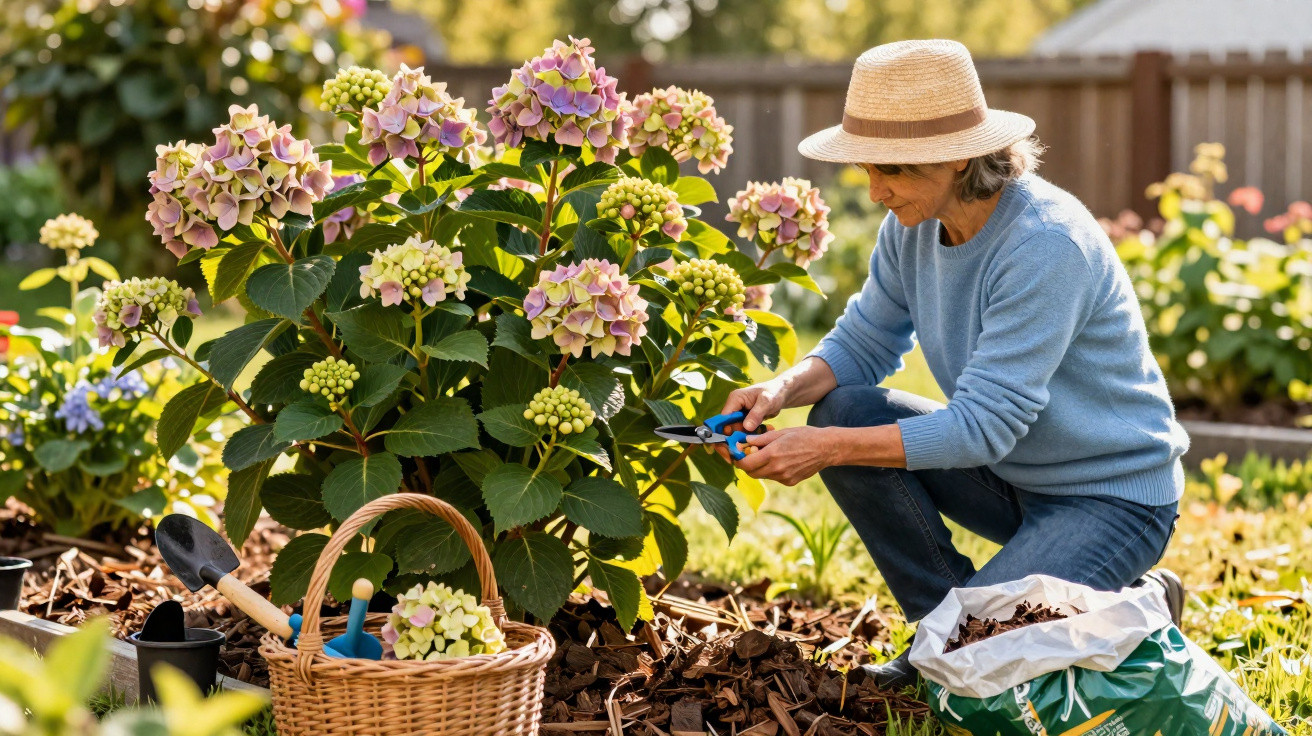
Many keen gardeners dutifully water and feed their hydrangeas, then still wonder why the flowering becomes poorer each year. British gardening star Monty Don swears by a straightforward March routine that hardly anyone bothers with - yet it can be the difference between “quite nice” and “Wow, what a shrub!”
Why March is the month that decides your hydrangea flowers
Hydrangeas have a reputation for being easy-going: they’ll grow in partial shade, tolerate a fair bit, and still look good. Even so, they can be surprisingly sensitive to cutting at the wrong time. Pick up the secateurs when you shouldn’t, and you can unintentionally remove the very flowers you’re hoping for.
The key point is this: many classic bigleaf hydrangeas (Hydrangea macrophylla - the familiar round “mophead” balls) bloom on what gardeners call old wood. In other words, the buds for the next season are already formed on last year’s stems and sit there through winter.
So if you “tidy up” in autumn or in the depths of winter and strip off the old flower heads aggressively, you often cut just above those overwintering buds. The shrub may look neat, but in summer it produces only a handful of blooms - if any.
"The right moment isn’t winter, but late March, once the worst frosts have passed and the buds are visibly swelling."
That is exactly where Monty Don’s approach comes in: he leaves the dry, papery flower heads on the plant throughout winter. He only reaches for the secateurs in March - and then removes only what genuinely needs to go.
Monty Don’s pruning technique: gentle deadheading instead of a hard cut
Monty Don makes a clear distinction between deadheading and a true prune. Deadheading means taking off only the spent flower heads; pruning means removing entire stems, or large portions of them.
His main rule for mophead hydrangeas in March is:
"Cut each faded flower head off directly above the top pair of strong buds - not lower."
This gets rid of the brown heads and any frost-damaged tips, while keeping the buds underneath completely intact. Those buds are exactly what will push on into new growth and later carry the season’s flower heads.
If you want a quick, practical way to run through it in early spring, the method works well as a checklist:
- Wait for mild, frost-free weather in March.
- Check whether the buds are swelling and easy to see.
- Look at each spent flower head one by one.
- With sharp secateurs, cut just above the top pair of strong buds.
- Remove completely any dry, dead, or extremely thin stems right down to their base.
- Leave strong, green stems in place - they’ll carry this season’s flowers.
It’s this exact difference - not “lopping everything off to the same height”, but treating each head individually - that typically leads to noticeably better flowering. Many gardeners are simply too severe and take far more off than they realise.
When a harder prune is acceptable
Some hydrangeas become oversized over the years or get bare and twiggy in the middle. In that situation, Monty Don advises planning heavier work not in spring, but straight after flowering in late summer.
At that point you can:
- remove a portion of the oldest stems close to ground level every two to three years
- reshape the shrub without cutting away next season’s buds
If, by contrast, you cut a hydrangea back hard in January or February, you often destroy the very buds that should have become summer flowers.
The underestimated helper: Monty Don’s mulch trick for strong buds
The second part of Monty Don’s hydrangea routine doesn’t happen in March at all, but in the middle of winter. When the shrub is little more than bare branches, he turns his attention to the root zone - and applies a generous layer of mulch.
He consistently uses well-rotted organic material, such as:
- mature compost from the garden
- mushroom compost
- bark mulch, ideally pine, which gently acidifies the soil
"Around each hydrangea, apply a mulch layer about five to ten centimetres thick - thick enough to make a difference."
What matters most is how and when the mulch goes down:
- Choose the timing: pick a mild day in January or early March, when the ground is not frozen and not completely waterlogged.
- Weed first: clear the area around the shrub thoroughly.
- Keep the crown clear: don’t bury the base of the stems in mulch, so nothing rots.
- Apply the mulch: spread it 5–10 cm deep, in a circle roughly 30–50 cm out from the plant.
The benefit is twofold: the mulch insulates the shallow roots against sharp temperature swings and drying out, while the material gradually works into the soil and improves its structure over time.
What to avoid when mulching
A common mistake is piling fresh material right up against the stems - for example, uncomposted woodchips or fresh lawn clippings. That can lead to rotting, nitrogen being tied up in the soil, and weaker plants.
“Mounding up” mulch directly around the stems also causes problems. Moisture lingers, the bark softens, and fungal diseases can take hold easily. Mulch should always be spread with a little space around the plant’s crown.
Common mistakes that cost you flowers
Sparse hydrangea flowering is often down to the same familiar errors. Once you know them, you can correct course quickly:
| Mistake | Result |
|---|---|
| Hard pruning in winter | Flower buds are removed, so there are few (if any) blooms in summer |
| Unsuitable mulch material or too much piled against the stems | Rot, fungal problems, and a weakened plant |
| Cutting back too late in spring | Newly growing buds are damaged |
| Waterlogging around the roots | Root damage, smaller flowers, yellowing leaves |
| Full sun without enough moisture | Wilting leaves and scorched flower edges |
Which hydrangea types need a different approach
The gentle March deadheading method is mainly suited to hydrangeas that flower on old wood - classic mophead hydrangeas and many lacecap types.
However, there are varieties that behave differently, for example:
- panicle hydrangeas (Hydrangea paniculata)
- smooth hydrangeas (Hydrangea arborescens, such as ‘Annabelle’)
These types produce their flowers largely on fresh, new wood. With them, you can be bolder with the secateurs in late winter. Many gardeners cut panicle and smooth hydrangeas back more firmly in February or early March to encourage strong new shoots with large flower panicles.
Before you cut, it’s worth taking a quick look at the label or doing a fast variety check. If you know whether your hydrangea blooms on old or new wood, you’ll prune with far more confidence.
Practical tips for everyday gardening
For busy gardeners who don’t want to live by the calendar at the edge of the border, Monty Don’s method can be turned into a simple routine:
- Plan a mulching day in January and work through all shrubs one after another.
- In March, pick a mild weekend to go over the hydrangeas and remove only the spent heads above the buds.
- If you’re unsure about the type, err on the side of cutting too little rather than too much.
If you stick with it for two or three years, you’ll often see clear changes: the shrub becomes denser, sturdier, and far more willing to flower. Some people even report that hydrangeas that previously “sulked” suddenly start blooming reliably every year again.
Why the extra effort pays off
Hydrangeas can be touchy about pruning at the wrong time, yet they cope surprisingly well if everything else is right. Once you’ve got the combination of cautious March cutting and well-timed mulching into your routine, you can avoid costly replacements and pointless experiments with specialist feeds.
That small bit of extra work in late winter and early spring pays you back several times over in peak season: longer flowering, sturdier flower heads that don’t collapse after the first heavy shower, and shrubs that keep performing in the same spot for many years.
Comments
No comments yet. Be the first to comment!
Leave a Comment