
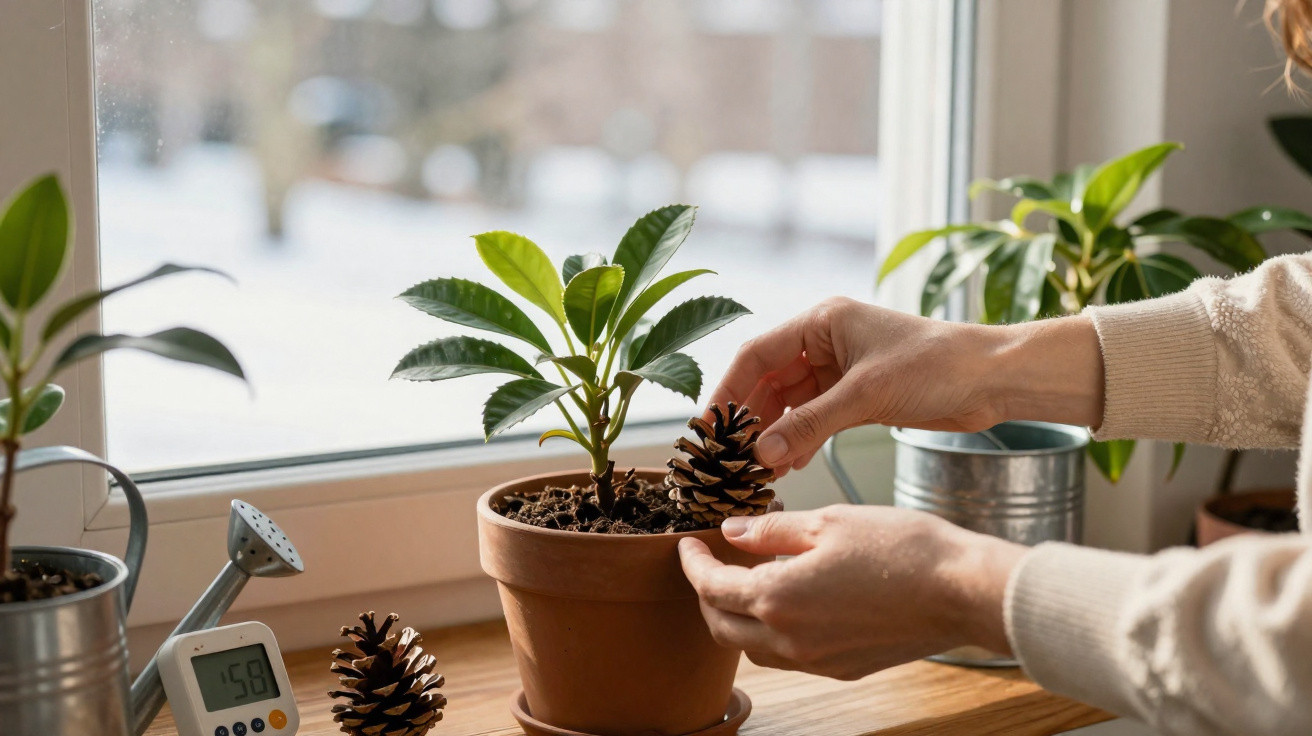
When radiators are clanking away and it’s freezing outside, the indoor climate can become completely wrong for Monstera, Ficus and the rest. Leaves start to droop, the top of the compost looks dry, and worry often leads to watering far too often. That’s exactly when the roots begin to suffer in silence. A simple pine or spruce cone placed on the potting mix can do far more here than an expensive liquid feed sitting in the cupboard.
Heating and winter dormancy: why your plants react so sensitively right now
During winter, most houseplants slow their metabolism down. Sap moves more sluggishly, growth stalls, and the roots take up less water. At the same time, central heating dries the leaves out. At first glance, that can look like a lack of water - but very often it isn’t.
If you only notice that the surface of the compost is dry and immediately reach for the watering can, you can unknowingly set off a risky experiment. Water collects at the bottom of the pot and the roots end up sitting in wet compost. With too little oxygen between the substrate and the base of the pot, a waterlogged zone develops where rot-causing bacteria can thrive.
“Too much water in winter usually harms houseplants more than brief dryness - the roots effectively suffocate.”
Common warning signs of root trouble include:
- Leaves turning yellow and soft even though you’re watering regularly
- Compost smelling musty or rotten
- Stems looking glassy and suddenly collapsing
- A white or greenish crust forming on the surface
This is where an unassuming natural item comes in - one many people walk straight past on a stroll: a cone from pine, spruce or fir.
Small cone, big effect: how a fir cone balances your compost
A dry cone isn’t just decorative, like a tiny patch of woodland on top of the pot. It also acts as a natural moisture regulator right at the surface.
The idea is straightforward: place the cone on top of the substrate without burying it. Its woody structure absorbs excess moisture from the upper layer of compost and then releases it gradually back into the air. That creates a buffer between the room air and the compost.
“The cone works around the clock as a quiet helper: it soaks up excess moisture and keeps the surface of the pot healthy and well-aerated.”
This reduces the risk of fungi, algae and bacteria establishing themselves on - and just beneath - the surface crust. The top layer stays looser, the base of the plant doesn’t dry out completely, and it also isn’t left constantly wet.
Natural moisture gauge: what the cone scales tell you
Cones are small masterpieces of nature. Their scales respond to humidity: they open when it’s dry and close when it’s damp. You can use that same behaviour in your plant pots.
How to read your “cone sensor”:
- Scales closed or pressed tightly together: there’s still plenty of moisture in the pot and the surrounding air. Watering now pushes things further towards waterlogging.
- Scales wide open: the air and the upper compost layer are fairly dry. At this point, it’s worth doing a finger test deeper down in the substrate.
A cone won’t replace checking moisture around the roots, but it does provide a dependable visual cue. If you also use a finger or a wooden stick to see whether the compost is dry several centimetres down, you’ll get the amount and timing of watering far more accurate.
Protection against an unsightly crust on the compost
There’s another helpful side effect: in winter, many pots develop a white or greenish film. This is often limescale and fertiliser salts; in damp corners, it can also be algae. That crust seals the surface like a lid, making it harder for the compost to “breathe”.
By drawing moisture away from the surface, the cone removes part of what these deposits rely on. The top of the substrate stays looser and more permeable, noticeably easing the strain on roots and the pot’s micro-organisms.
Step by step: how to prepare cones for your plant pots
Cones collected in woodland or a park look harmless, but they can sometimes carry unwanted extras: insects, larvae or fungal spores. A few simple steps will make them suitable for indoors.
- Collect: on a walk, only pick up dry, open cones. Avoid anything damp, mouldy or badly damaged.
- Clean: use an old toothbrush or a small hand brush to remove loose soil, needles and any tiny creatures.
- Dry and “disinfect”:
- dry in the oven at around 90 °C for 20–30 minutes, or
- leave on a warm radiator for a few days.
This kills off most insects and fungal spores. 4. Let them cool: never place hot cones straight onto the substrate, as the heat can damage roots. 5. Position: put one larger cone in the middle of the pot. For bigger pots, spread two to three cones across the surface.
The result is a natural “mulch” that looks like forest floor while also helping to manage moisture at the surface.
Winter care: what your plants still need besides the cone
A cone helps you avoid watering mistakes, but overall winter care still matters. Treating plants as if it’s summer can trigger stress responses.
Adjust your watering
- Water less often and with more intention, rather than frequently out of habit.
- Let the compost dry out several centimetres down before watering again.
- Tip away any water from the cachepot or saucer after 20 minutes, so a permanent puddle doesn’t form.
Reassess the location
- Move plants a few centimetres away from radiators.
- Shift pots closer to the window, without letting leaves touch the cold glass.
- Open curtains during the day so plants receive as much light as possible.
If you also wipe the leaves now and then with lukewarm, soft water, you’ll remove dust and improve how much light the plant can use.
Which plants benefit most from the cone trick
In general, many houseplants cope well with a cone on the surface, as long as they don’t require extremely wet conditions. These tend to benefit the most:
- classic foliage plants such as Monstera, Ficus and Philodendron
- indoor palms, dragon trees and rubber plants
- Mediterranean container plants overwintering indoors that prefer drier conditions
With very moisture-loving types such as some ferns or bog plants, it’s best to trial it cautiously. In pots with only succulents or cacti, a cone can also sit on the surface; there it mainly serves as a visual watering reminder: as long as the scales are still half-closed, restraint is wise.
Why this woodland trick often beats pricey high-tech gadgets
Digital moisture meters, watering systems, smart pots - the market for plant accessories is booming. A simple cone can look old-fashioned at first. Even so, it offers something electronics often don’t: it combines visual feedback, surface moisture regulation and decoration in one free, natural item.
Seeing the scales makes you question your watering in real time. Instead of watering by the calendar, you respond to the plant, the substrate and the cone. That more mindful approach noticeably reduces common winter damage.
So, if you bring home a few good-looking, dry cones on your next woodland walk, you’re not only adding a touch of nature to your home. Between radiator and windowsill, you create a small, self-regulating microclimate that helps houseplants get through the cold season - without specialist feed or an expensive gadget.

Comments
No comments yet. Be the first to comment!
Leave a Comment