
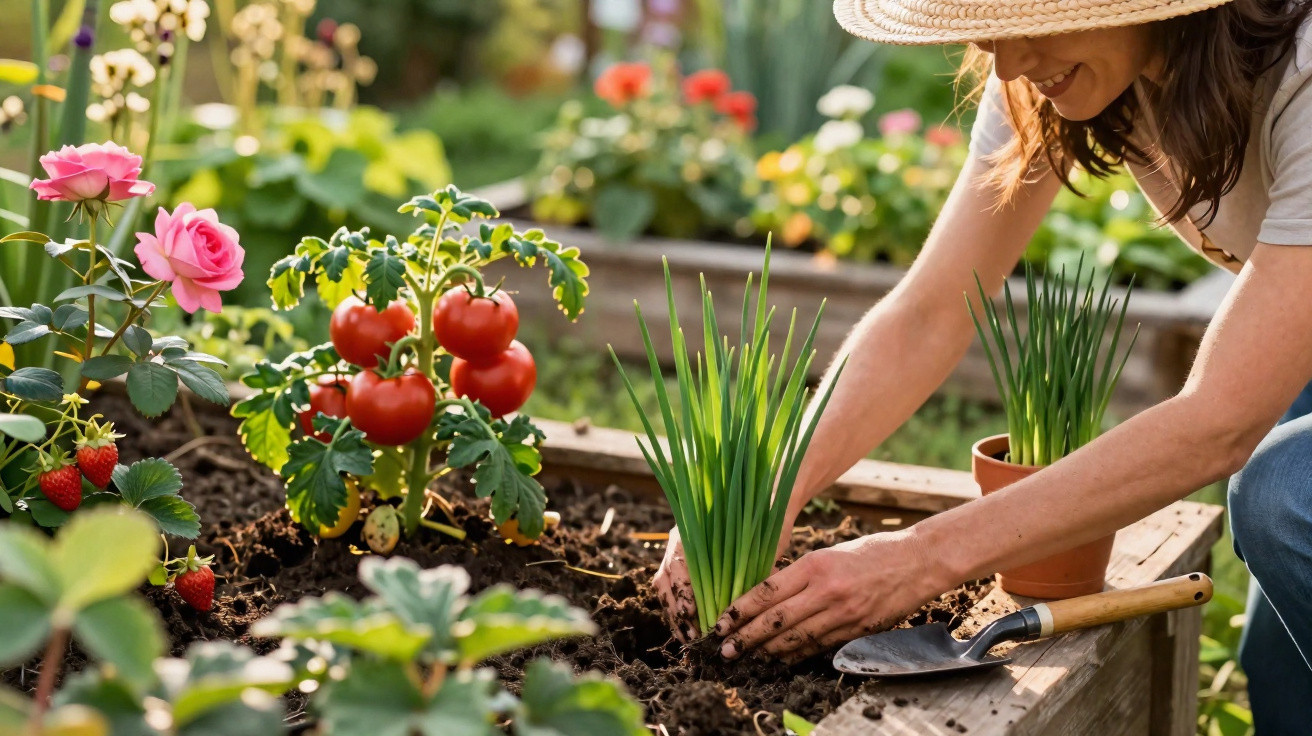
Right in the middle of this search is a herb almost everyone recognises, yet hardly anyone uses with real intent: chives. What usually ends up finely snipped into scrambled eggs can, in a garden bed, act as a quiet bodyguard for vegetables, berries and roses. Planted in the right places, this tough perennial forms a kind of protective belt, helping to confuse pests and slow down disease.
Why chives are far more than a culinary herb
Chives (Allium schoenoprasum) are part of the onion family, cope well with winter, and return with fresh growth year after year. Their roots sit only a few centimetres below the surface. That shallow root zone is exactly what makes chives such an effective companion plant: they do not crowd tomatoes, strawberries or roses, because those plants draw much of their moisture and nutrients from deeper in the soil.
The plant releases sulphur-containing substances into the air and the soil. To us, these compounds smell pleasantly of onion and garlic, but many pests find the scent reliably off-putting. At the same time, the effect is mildly antifungal.
"Chives create a natural protective canopy in the bed: fewer aphids, fewer fungal problems, more beneficial insects."
Chives also bring visual appeal and real value for wildlife. From late spring, the violet flowers open, providing nectar and pollen that attract bees, hoverflies and other pollinators. Hoverfly larvae, in turn, consume large numbers of aphids-so you get a double benefit for plant protection.
How chives help against pests and fungi
A key active compound is allicin, which is characteristic of onion and garlic relatives. It is responsible for the strong aroma and, according to the observations of many gardeners, can help hold back several common nuisances, including:
- aphids on roses, tomatoes and peppers
- certain types of mites
- carrot fly in the carrot bed
- some beetles on cucumbers
- slugs and snails near strawberries
There are also antifungal effects. Chives are not a substitute for consistent garden management, but they can noticeably take the edge off problems. In particular, gardeners often mention support with:
- black spot on roses
- scab on apple trees
- certain leaf-spot issues and rot diseases on strawberries
In UK-style temperate gardens, planting from April is a good option. Individual clumps are best spaced around 25 to 30 centimetres apart. This keeps air moving between plants and helps them dry quickly after rain-another helpful factor in reducing fungal pressure.
These 13 plants benefit especially from chives
Things get particularly interesting when you combine chives deliberately with other crops. Many plants take advantage of chives’ protective “shield” and respond with healthier foliage or improved harvests.
| Plant | Benefit of pairing with chives |
|---|---|
| Tomatoes | Fewer aphids and mites, a more stable microclimate in the soil |
| Carrots | The scent confuses carrot fly; the root crop is less disturbed |
| Strawberries | Slugs are partly discouraged; fungal problems may decrease |
| Lettuce | Delicate leaves are less frequently attacked by sap-sucking insects |
| Cucumbers | Helps against certain beetles and aphids on tender shoots |
| Peppers | Leaves often show less chewing and sap-sucking damage |
| Broccoli | Aphid and flea beetle pressure can drop noticeably |
| Roses | Fewer aphids on buds; fungal diseases slowed |
| Tulips | Bulbs seem less attractive to voles |
| Apple trees and berry bushes | Light support against fungal diseases around the canopy |
| Grapevines | Additional protection for sensitive grapes |
| Aromatic herbs such as basil, coriander | Shared defence against sap-suckers; a strongly flavoured harvest mix |
| Parsley in a pot | A practical kitchen pairing that complements well in the root zone |
Across all these pairings, the difference in rooting depth matters. Tomatoes, cucumbers, peppers, vines and fruit trees pull water and nutrients from deeper layers, while chives mainly use the top few centimetres. That means there is little competition, and the plants work well together.
Positioning chives correctly in the bed
In a vegetable garden, chives are well suited to the edges of beds or tucked into gaps between crops. A practical layout looks like this:
- a small clump every 30 to 40 centimetres between tomatoes, lettuce, carrots or strawberries
- along the edge of mixed-crop beds as a living, scented barrier
- beside path edging, where the plant also adds a neat decorative line
Around roses, a ring of three to five clumps works well, each placed about 30 centimetres from the base of the rose. That way, the rose’s main root zone stays undisturbed while the chives can release their aromatic compounds in all directions.
In an orchard, it is worth creating a broader band of chives around the drip line-the area beneath the outer edge of the canopy where the branches end. Rainwater collects and drips there, and that is exactly where leaves and young fruit are often most vulnerable to fungal infections. A low “veil” of scent and sulphur compounds rising from the soil can act like a natural filter in that zone.
Combinations in pots and on the balcony
Even with only a balcony or terrace, you can use the same effect. Chives grow happily in larger pots and planters, as long as the compost stays evenly moist and the container has a drainage hole.
Successful pot combinations
- Large tub with peppers, carrots and chives: peppers in the centre, carrots as a low “carpet”, chives planted around the edge.
- Wide balcony boxes with basil, coriander, parsley and chives: a practical kitchen planter with both flavour and protective value.
- Patio roses with clumps of chives placed alongside: a compact, low-effort pairing to help with aphid pressure.
Not every plant enjoys this neighbour. Legumes such as beans and peas can be sensitive when grown alongside onion-family plants in mixed planting. Mediterranean herbs such as thyme, rosemary or lavender prefer drier, poorer soils-conditions that do not suit the consistently moist compost chives need. For those plants, it is better to use separate containers.
Low-maintenance and long-lasting - keeping chives vigorous
Once established, chives can remain part of the garden for many years. Key points for healthy, strong clumps are:
- a sunny to partially shaded position
- humus-rich, moderately fertile soil that does not dry out
- regular cutting back: harvest leaves and flowers before the blooms fully fade
- dividing clumps every few years to maintain vigour
If you leave all flowers to finish, you will get plenty of seed and self-sown young plants, but you should expect some spread. That can be desirable-for example in more naturalistic gardens-or you can remove part of the flower heads early to keep things contained.
How chives influence mixed planting
Mixed planting is built on combining plants with different needs and different strengths. Chives contribute several useful elements: they deter, they attract beneficial insects, and they exploit different soil layers from neighbouring plants. In a bed, that creates a small community in which each species plays a role.
In day-to-day gardening it looks simple: a small tuft by a tomato stake, a ring around a rose, and a few clumps scattered through a strawberry patch. Over the season, those small effects add up to noticeably less stress in the garden-for both the gardener and the plants.
If you are planning a new layout or reshaping an existing bed, a few pots of chives can make a real difference. Three or four well-placed clumps in the right setting can achieve more than yet another attempt with sprays-and you also end up with fresh snips for the kitchen.
Comments
No comments yet. Be the first to comment!
Leave a Comment