
Many money trees (also known as the jade tree or jade plant) don’t die from some mysterious plant virus, but from very ordinary care mistakes: too much water, too little light, or the wrong pot. If you spot the warning signs early and respond in a targeted way, you can usually steady the plant again within a few weeks.
Warning signs: how a sick money tree shows trouble
A money tree communicates through its leaves and through the smell of the compost. If you look closely - and have a quick sniff - you can often see what’s going wrong before it becomes serious.
- Soft, squishy leaves and stems: a strong indicator of waterlogging and the start of root rot.
- Sunken, shrivelled leaves: typically points to a lack of water.
- A musty, mouldy smell from the pot: the compost has stayed wet for too long and roots are dying back.
- Very dry compost pulling away from the edge of the pot: the root ball has dried out completely.
- White, cotton-like deposits on leaves and shoots: suggests mealybugs or other sap-sucking pests.
"A struggling money tree sends clear signals early on - if you take them seriously, you can often save it without much difficulty."
First aid: what you should do straight away
Before you reach for the watering can or fertiliser, pause for a moment and work through it calmly. Rushing tends to cause more harm than good here.
Isolate the plant and check it calmly
If your money tree is close to other houseplants, move it somewhere on its own first. That reduces the risk of passing pests to the rest of your plants. Then take your time inspecting the leaves, stems, compost surface and the underside of the pot.
Too much water: stop immediately and check the roots
Overwatering is the most common cause of death. Here’s what to do:
- Stop watering completely, straight away.
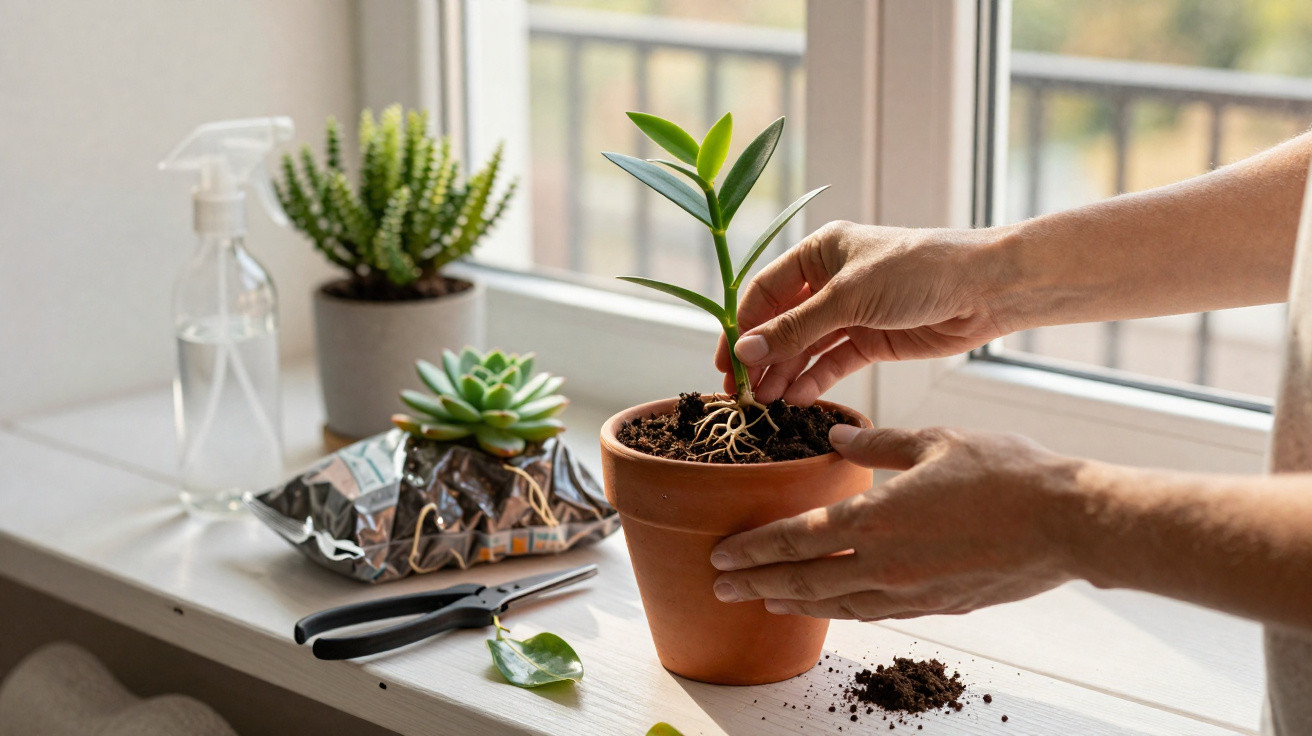
- Carefully tip the pot over and ease the plant out.
- Gently shake off loose compost or loosen it with your fingers.
- Examine the roots: pale, firm roots are healthy; black or mushy sections need removing.
- Cut away all rotten parts with clean, disinfected scissors.
- Leave the root ball out in the open for 12–24 hours, ideally somewhere airy but out of direct sun.
This “drying shock” can feel extreme, but it stops rot from spreading further.
Drought stress: rehydrate slowly from below
If the root ball is bone-dry and the leaves are limp, the money tree does need water - just not poured on in one go.
- Fill a bowl or larger container with water.
- Stand the whole pot in it so water can be drawn up through the drainage holes.
- Leave it there for 30–60 minutes, depending on pot size.
- Lift the pot out and allow it to drain thoroughly.
- Only put it back in place once the surface feels evenly moist.
This approach avoids the top becoming soaking wet while the centre of the compost remains dry.
Pest control: getting rid of mealybugs and others
White, cottony clusters in leaf joints or along the stem are almost always mealybugs. Don’t let them establish themselves for weeks.
- Wipe affected areas with a cotton pad soaked in alcohol (about 70%).
- Repeat after 7–10 days to catch newly hatched insects.
- If the infestation is heavy, use a suitable pest treatment or insecticidal plant soap.
Repotting properly: fresh compost, better odds
After waterlogging - or when the compost is very old and compacted - the best fix is often a full restart in a new, free-draining mix.
Step-by-step guide to a clean restart
- Remove the plant from its pot and loosen most of the old compost from the roots.
- Cut away any rotten or foul-smelling root sections completely.
- Let the roots dry for 12–24 hours.
- Choose a pot with drainage holes, ideally terracotta - it allows moisture to evaporate more easily.
- Add 2–3 cm of drainage at the bottom (expanded clay, gravel or coarse grit).
- Mix a very free-draining compost, for example:
- 50% cactus/succulent compost or standard houseplant compost,
- 25% coarse sand,
- 25% perlite or lava grit.
- Position the plant and press the compost in lightly - firm it, but don’t compact it like concrete.
- Don’t water at all for four to five days, so any cuts on the roots can callus over.
"With a money tree, the compost can be the difference between life and death: the looser and more free-draining it is, the better the chances of survival."
Watering correctly: less really is more
A money tree stores moisture in its thick leaves and stems. Compost that stays damp all the time harms it far more than a brief dry spell.
The simple finger test
Push your finger about 2–3 cm into the compost:
- If it still feels slightly moist, don’t water.
- If it’s dry and crumbly, you can water.
As a rough guideline:
| Season | Watering rhythm (guide) |
|---|---|
| Spring / Summer | every 10–15 days |
| Autumn | every 2–3 weeks |
| Winter (kept cool) | about once a month |
In a very hot summer on a bright, warm windowsill the interval can be shorter; in a cooler bedroom it’s usually longer.
Light, position and feed: the conditions for a comeback
The best spot by a window or on the balcony
A money tree thrives in bright light. It tends to do best:
- at a south- or west-facing window with plenty of daylight,
- with a little protection from harsh midday sun in midsummer,
- away from direct heat from radiators and away from cold draughts.
In very dark rooms the shoots become long and weak, the plant softens, and it can topple easily. In the darker months, a plant LED can help encourage sturdy new growth.
Only feed strong plants
A money tree that’s just been rescued and is still weak needs rest, air and good watering practices - not fertiliser. Wait until you see new, firm leaves developing, and only then begin feeding.
- From March to September, use a succulent or cactus fertiliser every three to four weeks.
- Dilute it more than the bottle recommends.
- Skip fertiliser entirely in winter and whenever the plant is struggling.
Too much feed can scorch fine roots and make the plant more vulnerable to disease.
Preventing relapse: keeping a money tree stable long-term
If you’ve already put in the effort to rescue your money tree, you’ll want to avoid going through it again. A few simple rules reduce the risk noticeably.
- Use only pots with drainage holes.
- Never plant without a drainage layer.
- Plan watering less often rather than too frequently.
- Inspect the plant regularly from all sides, including the undersides of leaves.
- If growth is strong, move up one pot size every two to three years.
Fresh, glossy leaves and a firm stem are signs the plant is recovering. That turnaround can take several weeks - or even two or three months - and with succulents, patience is part of good care.
Background knowledge: why money trees react so badly to excess water
The money tree comes from relatively dry regions of South Africa. There, short bursts of rain are followed by long dry periods. Its thick leaves and stems act as water stores built precisely for that pattern.
Indoors, many people accidentally recreate constant rain: frequent watering, too little light, tight plastic pots without drainage. That upsets the plant’s natural balance. If you keep its native habitat in mind, it becomes obvious why airy compost, restrained watering and plenty of light work so well.
Practical everyday tips for living with a money tree
Finally, a few quick ideas that make day-to-day care easier:
- Keep a small watering can just for succulents so you don’t accidentally add too much “by feel”.
- Set the pot on a saucer filled with gravel - excess water can drain away without the base sitting in water.
- Once a month, wipe the leaves with a slightly damp cloth so more light reaches the surface.
- If the plant is very top-heavy, consider pruning it: the cut shoots can be rooted easily as cuttings.
If you stick to these points, a plant that looks like a lost cause can often become an impressive indoor woody succulent again - one that lasts for many years and may even turn into your favourite plant in the living room.

Comments
No comments yet. Be the first to comment!
Leave a Comment