
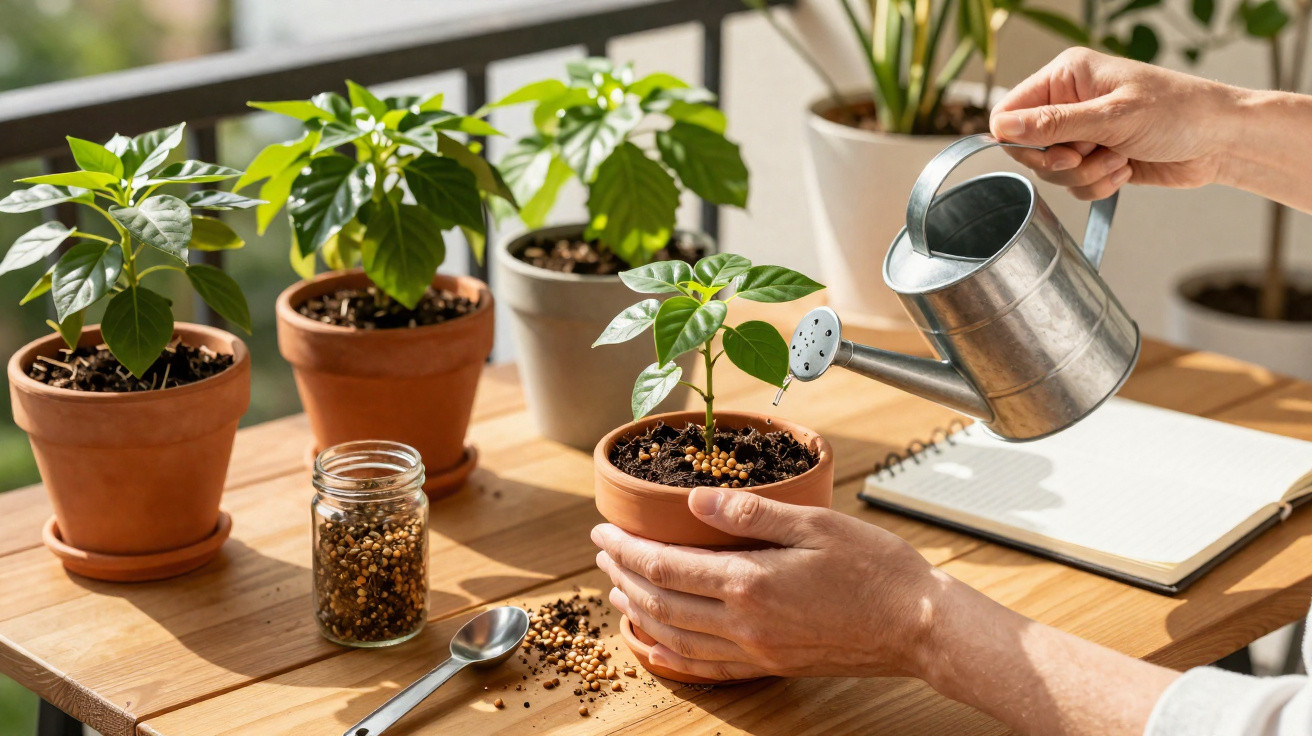
A pale, leggy basil plant stretches towards the window as though it’s pleading for rescue. Beside it, a neat geranium is pushing out fresh buds, as if it’s running on hidden reserves. The third plant, a peace lily, simply looks… worn out. Same light, same room, same person looking after them - yet their lives couldn’t be more different.
The reason usually isn’t affection or effort. It’s nutrition. What we often think of as “good compost” in a pot is really just a starting allowance, and within a few months it’s used up. After that, your plant is trying to get by in a small amount of exhausted compost. You keep watering, you keep turning the pot, you even talk to it (be honest) - and still the progress grinds to a halt.
Some houseplants fade away slowly and silently, while others turn into a jungle. The space between those outcomes is exactly where feeding can be either surprisingly straightforward - or a quiet saboteur.
Why fertiliser matters more in pots than in the ground
In a border, roots can roam, bargain for resources, and pick up nutrients from surrounding soil. In a pot, it’s more like spending your whole life in a studio flat with one cupboard of food. Once the cupboard is bare, there’s nowhere else to shop. That’s why container plants so often go from thriving to drooping without any obvious disease.
In that small, closed world, fertiliser isn’t an indulgence - it’s the grocery run. When feeding is steady and balanced, growth can look almost easy: fresh leaves, flowers that keep returning, and colours that stay deep rather than fading out. When feeding is erratic or too concentrated, salts build, roots scorch, leaves yellow, and the plant gradually slips from thriving into merely coping.
A balcony gardener in London once showed me two matching troughs of petunias. They were planted on the same day, in the same light, using the same shop-bought compost. One trough received a liquid feed every 10 days from spring through to late summer. The other got nothing beyond what was in the compost at planting time. By August, the fed petunias were a thick cascade of purple. The unfed ones looked like the sorry remnants on a clearance shelf: spindly, sparse, and half bare.
Nothing about his approach was specialist. He used an ordinary all-purpose liquid fertiliser from the supermarket, mixed into a watering can. That tiny, repeatable habit delivered roughly twice the flowers and kept the display going for an extra month. No apps, no tracking, no fuss - just a background routine that did its job while he got on with his summer.
Research from horticultural institutes tells the same story with more technical wording. With standard compost, potted plants typically run through available nutrients in about 6–8 weeks. After that, nitrogen, potassium, and micronutrients fall away steadily. What you see is slower growth, smaller leaves, and fewer flowers. What you don’t see is a weaker root system and a plant that becomes much easier to knock off course with heat, a missed watering, or even being moved.
Once you start thinking of fertiliser as small, regular “snacks” rather than occasional “vitamin shots”, it becomes far less daunting - and oddly relatable.
Pot feeding is essentially a three-part equation: what you use, how frequently you apply it, and how gentle you keep it. Most people fixate on the first part (the product) and overlook the other two. That’s why so many bottles end up forgotten in the shed.
Frequency is where results really change. A little, often, tends to beat a lot, rarely. Plants don’t enjoy banquets followed by famine. In containers - where salts can accumulate quickly - roots cope best with a steady trickle they can actually use. Gentle feeding might mean diluted liquid fertiliser, slow-release pellets, or organic additions that release nutrients gradually rather than all at once.
The principle is straightforward: a pot is a closed system. What you add stays there until the plant absorbs it or watering shifts it around. Overfeed, and the compost becomes harsh. Feed slowly, and the pot turns into a stable pantry. That’s when foliage fills out, flowers repeat, and your watering effort finally starts to feel worthwhile.
Practical, low-stress fertilising methods anyone can keep up
For most people, the simplest approach is adding a weak liquid feed to your normal watering during the growing season - every second or third watering. Same watering can, same loop around the flat or balcony. You measure a capful (or dose) into the can and stir. If the label recommends one cap per litre, consider using half a cap instead and feeding a bit more regularly. It’s less like giving an occasional blast and more like turning watering into a gentle nutrient drip.
If you’re prone to forgetting (which is most of us), slow-release granules or pellets worked into the top layer of compost can be a quiet lifesaver. Sprinkle, lightly scratch them in, then water - and they break down over weeks or months. You won’t see an overnight transformation, but you do get a dependable baseline that keeps plants moving along, especially on balconies where watering already feels like another task. It’s as close as plant care gets to “set it and mostly forget it”.
On a grey, rainy afternoon in Manchester, I watched a friend repot her snake plant. She slid the root ball out, shook away some tired compost, and then did something beautifully simple: she folded a small handful of worm castings into the fresh mix. No precision, no scales - just a casual “about this much”.
Three months later, that same snake plant had thicker, glossier leaves and even produced a tentative flower spike - something many people never see indoors. The only differences were slightly richer compost and one diluted liquid feed during summer. No timetable stuck to the fridge, no self-reproach when life got hectic - just a couple of easy feeding habits added to what she was already doing.
Examples like this aren’t miracles. They’re what happens when roots get a little more than the bare minimum. Each new leaf is a kind of quiet vote of confidence: the plant expects conditions to stay good, so it invests in growth rather than simply hanging on.
A common mistake is overreacting when something looks wrong. Leaves start yellowing, so people reach for fertiliser like an emergency energy drink. The plant is already stressed, the roots take a hit from the concentration, and things look worse. Then the fertiliser gets blamed, rather than the dose. Let’s be honest: nobody truly keeps this up every day like a perfect logbook.
A calmer strategy is to match feeding to the plant’s natural speed. Fast growers and heavy bloomers (tomatoes, petunias, basil) generally benefit from regular feeding throughout their active season. Slow growers (succulents, snake plants) need much less - often monthly at most - and typically none in winter. If you’re unsure, feed less and observe. Pale new growth, sluggish progress, and reduced flowering usually mean “more food, please”. Brown tips or crisp edges soon after feeding often mean “too strong”.
Everyone knows the feeling of walking past a once-happy plant that’s now sulking, and feeling a little guilty each time. Fertiliser isn’t a cure-all, but it can quietly determine whether a plant has enough reserves to recover from underwatering, repotting shock, or a cold week on a windowsill. Think of feeding as supporting resilience - not as a punishment when the plant is already struggling.
“Plants in pots live on our schedule, not nature’s. When we feed them little and often, they stop surviving like hostages and start behaving like they’re actually at home.”
To keep it manageable, turn feeding into small cues rather than big projects. Write your usual dilution on the watering can. Store the liquid feed next to the plant mister. Choose one weekday each month to scratch slow-release pellets into outdoor pots. Tiny prompts reduce the mental effort.
- Use half-strength liquid feed more often rather than full strength rarely.
- Don’t fertilise when the compost is bone dry - water first, feed next time.
- Stop feeding most plants in late autumn and winter when growth slows.
- Flush pots with plain water every few months to reduce salt build-up.
- Keep a separate routine for cacti and succulents: less fertiliser, less often.
Letting your plants tell you what they need
After a season of feeding, something subtle tends to change: you stop staring at the bottle and start paying attention to the foliage. Basil that suddenly tastes sharper and weaker instead of rich and sweet is often asking for more nutrition. A geranium that grows plenty of leaves but refuses to flower may be getting too much nitrogen and not enough of everything else. A rubber plant that used to shine, then turns dull and produces slightly smaller leaves each time, is quietly signalling that its pantry is running low.
This is where it becomes nicely human again. You don’t need perfect knowledge of NPK ratios to spot that spider plant pups are shrinking, or that a chilli plant is flowering but dropping blooms before fruit sets. Modest, consistent feeding often changes those stories within a few weeks - not as instant magic, but as a gradual improvement you notice when you compare photos or remember what the plant looked like a month ago.
When fertilising becomes part of that quiet back-and-forth with your plants, it stops feeling like another chore. It becomes a way of noticing - of paying attention to the small green lives sharing your space. Some people will dive into compost teas and custom blends; others will rely on one trusted bottle under the sink. Either way can produce thriving pots on a windowsill that used to feel like a plant graveyard.
| Key point | Detail | What it means for you |
|---|---|---|
| Feed little but often | Use low, regular doses of liquid fertiliser | Lowers burn risk and supports steady growth |
| Match feeding to plant type | Heavy feeders vs slow-growing succulents need different rhythms | Prevents overfeeding and saves product |
| Combine liquid and slow-release | Granules in the compost plus light fertilised watering | Creates a simple “baseline” of nutrition that’s easy to maintain |
FAQ:
- How often should I fertilise my potted plants? For most leafy and flowering plants, every 2–3 weeks in spring and summer with a half-strength liquid feed works well. Slow growers like succulents are fine with monthly feeding at most.
- What’s better: organic or synthetic fertiliser? Both can work. Organic options (worm castings, seaweed, composted manure) release nutrients more slowly and can improve soil life. Synthetic liquids act faster and are easier to dose precisely.
- Can I fertilise in winter? Usually no. Most indoor plants slow down or semi-rest in winter. Feeding then can push weak, leggy growth. Resume in spring when you see fresh leaves and longer days.
- Why are my plant’s leaf tips turning brown after feeding? That often signals fertiliser burn or salt build-up. Switch to weaker solutions, flush the pot with plain water, and leave a gap before the next feed.
- Do new potting mixes already contain fertiliser? Many modern mixes include starter nutrients that last 4–8 weeks. After that, you’ll need to start a gentle feeding routine to keep growth going.
Comments
No comments yet. Be the first to comment!
Leave a Comment