
The soil is at last starting to warm, the garden centres are bursting with colour, and your feeds are filled with flawless borders and pots spilling over.
You’re standing there with your sleeves pushed up, looking at beds that seem… worn out. Again. Every spring brings the same dilemma: do you honestly want to begin all over, tray after tray of annuals, hole after hole, weekend after weekend?
A small, slightly guilty voice promises you’ll “keep on top of it this year”. You’ll water on schedule. You’ll deadhead every few days. You’ll swap out anything that pouts. And yet you already know how this plot usually ends by July.
Some gardeners quietly step off this seasonal treadmill. From the outside, their approach can look almost lazy. It isn’t.
Why perennial gardens feel calmer when everything else screams “hurry up”
If you walk through a garden built largely around perennials, the first thing that hits you often isn’t the blooms. It’s the tempo. The borders don’t look like they were slapped together last weekend. The planting feels interlaced and layered, as if the plants are responding to one another.
Because perennials return year after year from the same root system, they aren’t sprinting against the clock in the way annuals do. They spread, settle, and begin to bind the soil. Your role changes from constant replacing to light, thoughtful editing. Fewer panicked “I need 40 petunias before the shop shuts” runs. More unhurried mornings with a coffee, strolling and noticing what shifted overnight.
That doesn’t mean you sacrifice beauty. It means the beauty isn’t so brittle.
Think of a typical suburban plot built around “instant colour”. In April, the homeowner fills four heaped trolleys with annuals, spends a whole Saturday planting, gives up another day arranging containers, and still ends up back at the nursery in May to plug the gaps. By August, half the show is lanky or washed out. Some version of that cycle repeats every year.
Now imagine that same space rebuilt with a perennial backbone: coneflowers, salvias, daylilies, ornamental grasses, hardy geraniums. Year one takes more planning and, yes, a bit more digging. But the next spring, roughly 70–80% of the display comes up without you lifting a finger. You might add a few fresh notes, perhaps some seasonal colour in pots. The framework is already there, like old friends who turned up early.
Across five years, that change is massive-not only in hours you get back, but in how the garden feels to tend.
The reason it saves time is straightforward plant logic. Annuals burn everything in one intense season: shoot up fast, flower hard, set seed, and die. You pay for that drama with continuous attention and constant replacement. Perennials, by contrast, are playing for the long haul. Their strength sits underground, in roots that thicken and bank energy.
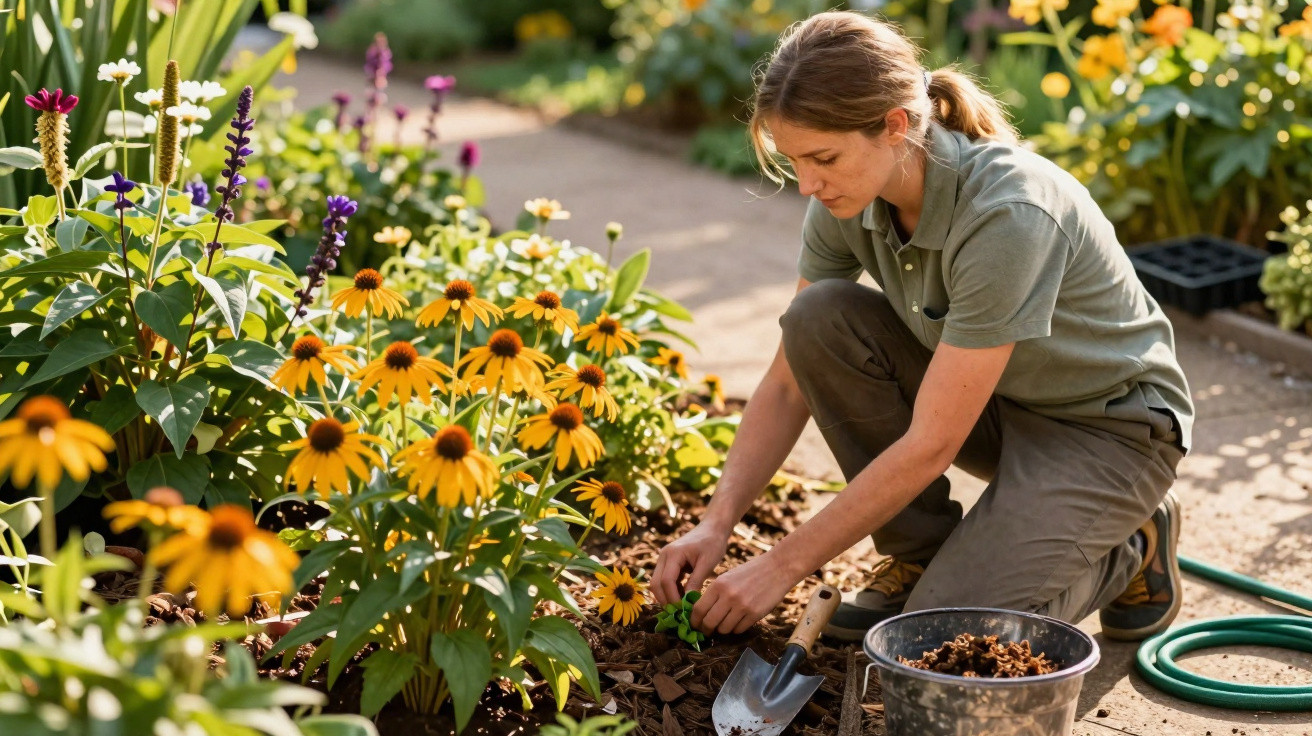
Once they’re established, many perennials slowly widen, taking up bare soil that would otherwise nudge you towards “just one more tray” of bedding plants. A clump of black-eyed Susans that took ten minutes to plant in year one might cover about 1 m² by year three. One well-aimed hour with a spade can repay you season after season.
The time you stop spending on replanting doesn’t disappear; it simply moves elsewhere. Less digging, more noticing. Less rushing around, more shaping and refining.
Practical ways to let perennials carry the workload
If your goal is for perennials to ease the seasonal load, start by designing in layers rather than isolated dots. Instead of buying one of everything that catches your eye, choose a small, dependable cast and repeat it. Front layer: low growers such as catmint or hardy geraniums. Middle layer: stalwarts like daylilies, echinacea, and phlox. Back layer: taller standouts and grasses.
Set them closer together than you think you should, so that when they mature they just about meet. Bare soil is what pulls you back to the garden centre every spring. When perennials knit into each other, weeds have less room, moisture holds better, and that persistent feeling of “this looks empty” gradually fades. You’re creating a living carpet, not a polka-dot patchwork.
One concentrated weekend of planting can wipe out years of seasonal scrambling.
There’s also a quiet mistake many people make: they shop for perennials the way they shop for annuals-on impulse, led by colour, with no real plan. Then they’re frustrated when the border looks messy, or flat at certain times of year. They blame the plants rather than the approach, and they swing back to high-maintenance annuals “for impact”.
Instead, pick perennials using three simple filters. First, match your conditions: light and soil. Dry sun, damp shade, and heavy clay each has plants that thrive there. Second, think like a calendar: aim for early-, mid-, and late-season interest. Third, consider character: do you prefer loose, meadow-like movement, or neat, rounded mounds? When plants suit both your reality and your taste, they tend to behave with far less supervision.
Let’s be honest: nobody truly manages all that every single day. Gardening has to slot around work, children, tiredness, and unpredictable seasons. Perennials are forgiving on the days you don’t have the energy to fuss.
One lifelong gardener told me, staring at her late-summer border, “I used to think hard work was the same as good gardening. The perennials taught me to get out of the way.” It stayed with me, because that’s what planting perennials really amounts to: a quiet agreement with time.
“A perennial garden is less a project and more a relationship. The plants remember what you did last year and answer back in their own language.”
To keep that relationship easy, a few perennial-friendly habits make a real difference:
- Start by switching just one bed from annuals to perennials, rather than tackling the whole garden at once.
- Keep annuals for containers or small pockets of quick colour, not as the main structure.
- For every “diva” you fall for, include at least one reliable workhorse perennial.
- Make peace with the idea that year one is about roots, not fireworks.
- Walk the garden more often than you weed it.
What a perennial-first garden really gives back over time
When you rely on perennials, your year reorganises itself. Spring becomes less about racing to fill holes and more about welcoming back familiar faces. You spot which clumps have doubled, where something needs dividing, and where the light has changed as a shrub has matured. The work feels lighter and more ongoing-less like dealing with emergencies.
On a warm June evening, rather than hauling soggy trays to the car, you might be cutting a handful of shasta daisies for the table and watching how the salvia hums with bees. That emotional change matters. Gardening starts to feel sustainable not only for your diary, but for your head. The outdoor space begins to fit the life you actually live, not the one in glossy catalogues.
And when a plant does fade or fail, it becomes part of a longer, slower story-not just another item on this year’s shopping list.
| Key point | Detail | What it means for you |
|---|---|---|
| Perennials reduce yearly replanting | They return from the same root system, often spreading over time | Fewer shopping trips, fewer weekends swallowed by mass planting |
| Layering plants reduces gaps | Low, medium, and tall perennials knit into a living carpet | Less weeding, less temptation to “fill holes” with short-lived colour |
| Plan by season, not only by colour | Choose plants for early-, mid-, and late-season interest | A garden that looks lively for months, with less effort from you |
FAQ:
- Do perennials really save that much time compared with annuals? Yes. Once they’re established, most perennials mainly need seasonal tidying and the occasional divide, while annual-heavy beds require full replanting and frequent replacements every year.
- Will my garden look boring if I rely mostly on perennials? Not if you design with layers and seasons in mind. Mix foliage textures, heights, and flowering times, then add a few annuals or bulbs as “sparkles” rather than making them the headline act.
- How long do perennials take to look full? In most cases they follow the “sleep, creep, leap” pattern: restrained in year one, clearly fuller in year two, and impressive by year three as roots settle and clumps expand.
- Can I grow perennials in containers, or only in the ground? Plenty of perennials suit large containers, especially hardy geraniums, hostas, salvias, and smaller grasses. They still need occasional repotting, but not total seasonal replacement.
- What’s a simple first step if my garden is all annuals now? Choose one bed or border, remove the annuals at the end of the season, lightly improve the soil, and plant a small, repeated palette of tough perennials that match your sun and soil.
Comments
No comments yet. Be the first to comment!
Leave a Comment