
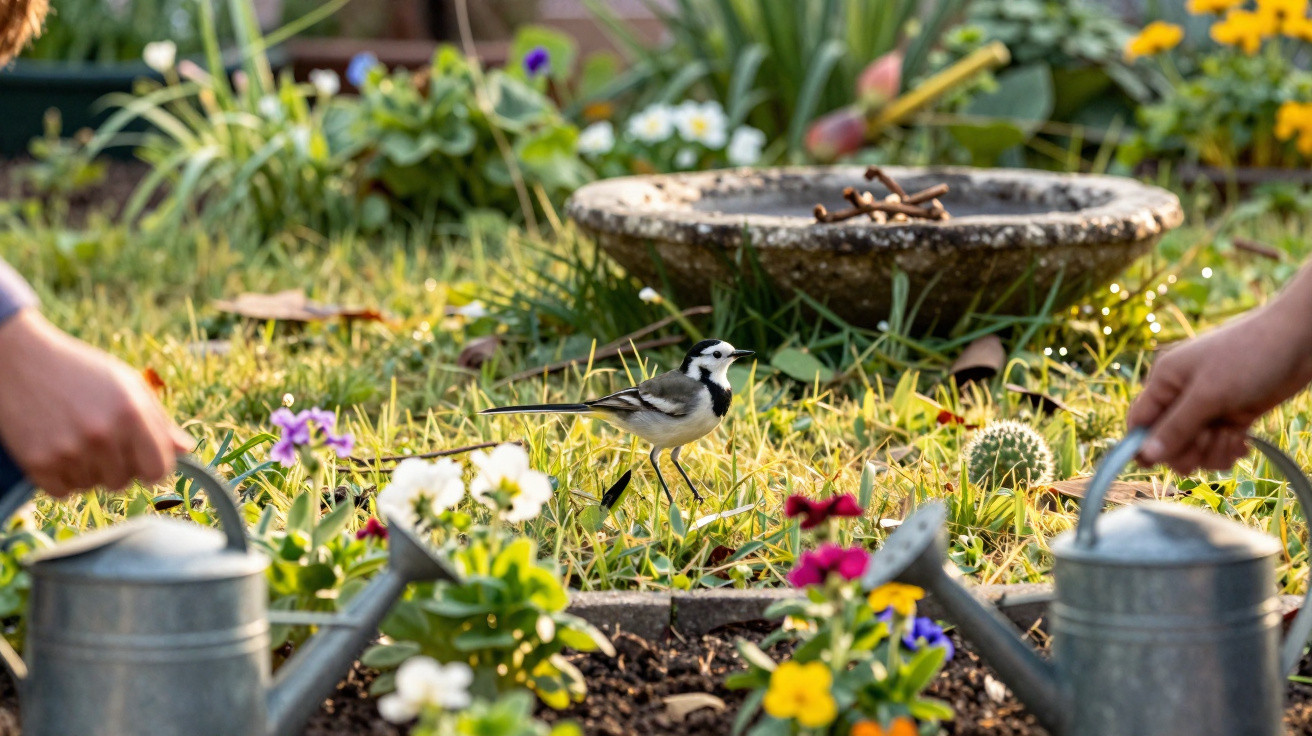
Many garden owners pay close attention to leaves, flowers and the weather forecast - yet miss what may be the most useful indicator right on the doorstep: a small bird that briskly patrols the lawn, pecks at the ground and constantly pumps its long tail up and down. Anyone who reads this behaviour correctly can learn a surprising amount about soil health and what lies ahead for their flower beds.
The quick tail-wagger: the white wagtail on the lawn
The bird in question is the white wagtail (Motacilla alba). It is immediately recognisable by its refined black, white and grey plumage, its slim shape, and its unusually long, dark tail with white edges. One hallmark stands out: rather than hopping like many other songbirds, it moves in quick, neat steps across the ground - with the tail wagging almost nonstop.
Open areas are its preferred territory: gardens, parks, meadows, verges and the edges of ponds. Your chances of spotting it are best if you are up early in spring or looking out in the late afternoon. At this time of year it can seem almost over-energised: a few rapid steps, a captured insect, a brief freeze, tail wagging, then on again.
It gets particularly interesting when it lingers on your lawn and repeatedly works the same patches. In that case, it is not merely picking up a random snack - its routine is a clue that a lot is happening in the soil and the turf.
If the white wagtail stays on your lawn for a noticeably long time, it is signalling: the turf is teeming with life - a major plus for your flowers.
Why the white wagtail wags its tail so vigorously
The tail-wagging is not a nervous habit, but a clever hunting method. Those fast movements create short visual cues and slight vibrations. Many tiny insects respond instinctively: they shift position or come closer to the surface. That is exactly when the white wagtail strikes.
Typical prey includes:
- flies and midges
- small beetles
- larvae just below the surface
- tiny spiders and other arthropods
The more intensely it moves its tail, the more actively it is hunting. If it spends minutes covering the same spot, repeatedly stopping and wagging rapidly, it is sending a clear message: your lawn supports a rich microfauna - in other words, lots of small organisms living in the soil and turf.
Living soil: what that means for your flowers
Where the white wagtail finds plenty of insects, other soil life usually thrives too: earthworms, springtails, woodlice, bacteria and fungi. Together they form a complex system that loosens the ground, breaks down organic matter and makes nutrients available.
For flowers, perennials and summer bedding, this has several direct effects:
- Better aeration: earthworms create channels that let air and water reach deeper layers.
- Faster nutrient cycling: small creatures shred dead plant material, and micro-organisms convert it into nutrients plants can use.
- Stronger root systems: loose soil allows roots to penetrate and branch out more easily.
- Greater drought tolerance: well-structured soil holds water better and releases it more slowly.
So if you treat your lawn as a “living carpet”, rather than a sterile green surface, you gain twice over: the turf looks healthier, and the neighbouring flower beds rest on a stronger foundation. Very often, the benefits show up a few weeks later - perennials push into growth more vigorously, flower heads appear fuller, and plants bounce back faster after hot spells.
Living soil works like an invisible supply network: the white wagtail’s behaviour shows whether that network is intact.
When the lawn turns patchy: warning signs and pest control
Not every spot where the white wagtail hunts intensely is automatically a paradise. Especially in early spring, when parts of the lawn look yellow or brown, its focus can point to a problem. If it keeps returning to those patches, it may be targeting larvae that feed on grass roots.
That can include, for example, crane fly larvae and cockchafer grubs. Both can cause significant damage by gnawing roots and effectively lifting tufts of grass from below.
A quick practical check:
- Lift a small section of turf from a suspicious patch using a spade.
- Inspect the root layer and the top section of soil closely.
- Collect larvae, grubs or other larger pests by hand.
Here the white wagtail helps in two ways: it highlights the affected area and eats some of the pests. If you are patient, watch it for a few days before taking action - often the issue has already reduced noticeably.
How to make your garden attractive to this helpful bird
You do not need major changes to keep the white wagtail as an ally in the long term. A few simple adjustments are usually enough for it to use your garden regularly and with confidence.
Chemical-free care instead of the heavy-handed approach
Pesticides and synthetic fertilisers hit the base of the food chain first: insects and soil organisms. If you intervene too aggressively, you drive away precisely the food the white wagtail relies on. A wildlife-friendly approach is better:
- avoid chemical insecticides
- use lawn fertiliser sparingly, preferably organic
- use leaves and plant trimmings as mulch in borders
A mulch layer around 5 cm thick, made from chipped prunings or dried grass clippings, keeps the soil moist, protects against erosion and attracts earthworms. The entire garden ecosystem benefits - including the white wagtail.
Create structure and places to retreat
The bird prefers to hunt on open ground, but it also needs safe nearby spots to rest or feed its young. Suitable options include:
- piles of stones or low dry-stone walls
- dense hedges or shrubs
- untidy corners with leaves and deadwood
A small pile of autumn leaves under a hedge can be crucial in May: if late frosts slow insect activity on the lawn, food can still be available there. That way, the white wagtail does not have to leave your plot and can continue keeping pest numbers down.
How to watch the bird without disturbing it
If you want a closer look at the white wagtail, keep your distance. Around 10 metres is usually enough for it not to feel pressured. During the breeding season in particular, it is sensitive to sudden movement and loud noise.
Watching from a window or a balcony works best. Many garden owners quickly notice it follows an almost daily rhythm: short, intense hunting bursts early in the morning and again in late afternoon, with longer breaks in between.
| Time of day | Typical behaviour |
|---|---|
| early morning | intense foraging, frequent tail movements |
| midday | shorter hunting periods, more resting |
| late afternoon | renewed activity, targeted searching of specific areas |
Why a “weed-free” lawn can become a problem
The often-desired, near-sterile carpet lawn may look tidy, but it offers little habitat. No clover, hardly any flowers, and little dead plant material - so there are correspondingly fewer insects. In such an area, the white wagtail finds less to eat and may only appear briefly, or not at all.
A slightly “imperfect” lawn, with a few flowering patches, daisies, clover and perhaps one small corner left a little longer, supports insects far better. That diversity feeds back into your flower beds indirectly: more insects means more beneficial species, healthier soil and greater natural control of potential pests.
Loosening your own standards of millimetre-perfect appearance often results in a remarkably stable little ecosystem - with the white wagtail playing a highly visible leading role.
More calm, more life: what garden owners can take away
Watching a single bird can provide a kind of real-time diagnosis of your garden’s condition. Frequent tail-wagging and keen hunting on the lawn point to active, living soil that benefits flowers and perennials over the long term. If the white wagtail concentrates on yellow or sparse areas, it is worth taking a closer look for root-feeding pests.
If you see your garden as a shared habitat, the white wagtail becomes more than a pretty visitor. It is an early-warning system, a pest hunter and a health indicator all in one - and each tail movement tells you how well your flowers are really doing.
Comments
No comments yet. Be the first to comment!
Leave a Comment