
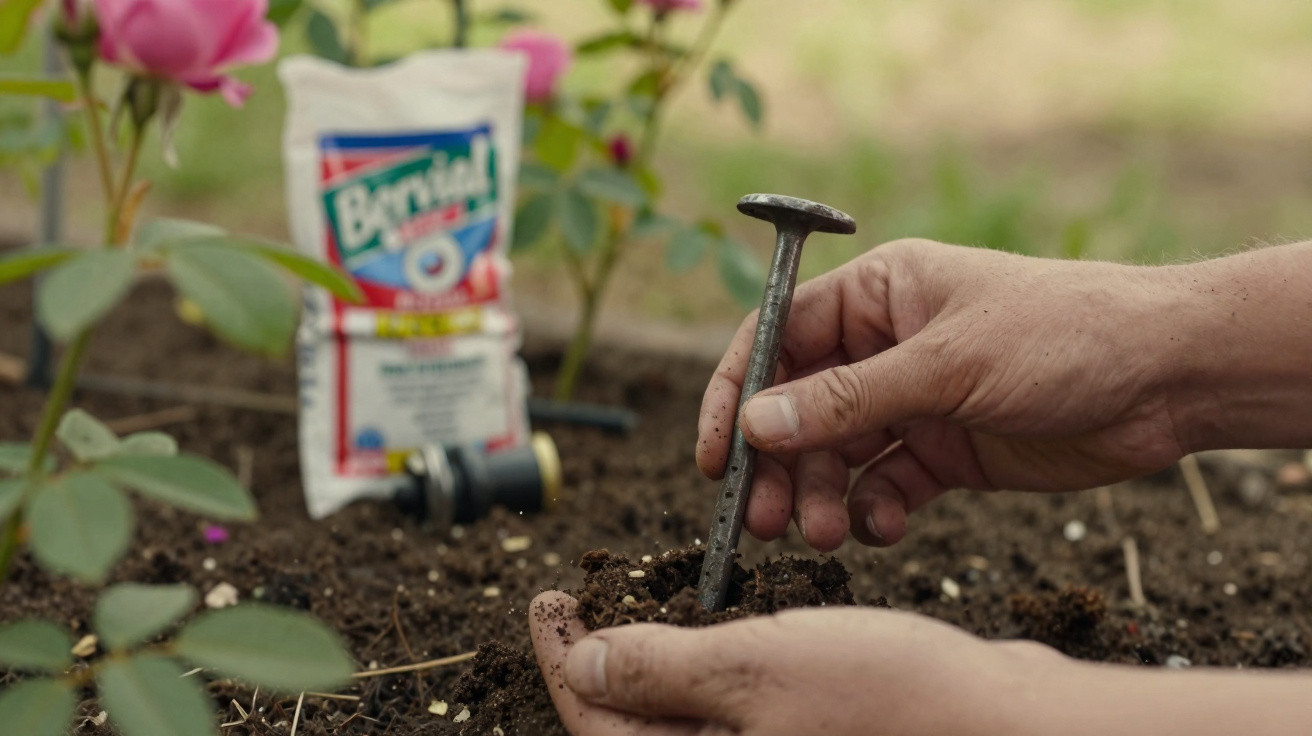
An elderly man lowered himself so gradually you could almost imagine the creak in his joints. He swept back the mulch at the base of his rose bush, looked over his shoulder as though he were letting you in on a private tip, and tucked something small and dark into the earth: a rusty nail. Then he smoothed the soil back into place, gently, as if he were settling a child.
From the garden gate I watched, torn between a laugh and genuine curiosity. It didn’t resemble anything I’d seen in the usual advice: no pH kit, no soil report, no expensive feed. Just a familiar little routine carried out with calm certainty.
Much later, I realised he wasn’t remotely alone.
Why gardeners trusted a rusty nail more than a fertiliser bag
If you were raised around older gardeners, you’ve probably spotted the signs. A battered box of bent nails and stray screws in the shed. A coffee tin filled with odd offcuts of metal, kept "for the roses."
They rarely made a big speech about it. Once a year, they’d stroll up to the plants, push a nail into the soil close to the stem, then carry on-almost like topping up a pet’s bowl.
In their eyes it wasn’t folklore for folklore’s sake. It was a quiet, practical habit that had proved itself over years of seasons.
A retired mechanic from Yorkshire once told me he used to bury a handful of rusty nuts and bolts around his mother’s rose border each spring. No branded rose feed, no specialist compost-yet the neighbours insisted her blooms were the richest, deepest red they’d ever seen.
Versions of the same story turn up all over: across the UK, in the US, and in small Eastern European villages too. Grandparents handing down the trick to children. "Give the roses iron," they’d say, placing a grimy nail into a little hand like a keepsake. No online debate-just word-of-mouth and whatever the petals seemed to prove.
The idea beneath it is straightforward. Roses, like people, need iron. It plays a key role in producing chlorophyll, the green pigment that keeps leaves vigorous and healthy. When the soil can’t supply enough available iron, foliage can wash out to a weary yellow while the veins remain green, and growth can slow.
A rusty nail is simply iron entering the soil slowly. As it corrodes, it sheds tiny amounts of iron oxide that roots may be able to use-particularly in poor sandy soils or ground that’s been over-limed.
It’s not quick, and it’s not a precise method. But for gardeners who didn’t have garden centres on every high street, it was cheap, to hand, and felt close to miraculous when a struggling rose started to look a little more alive.
How the rusty nail trick actually works (and how to use it today)
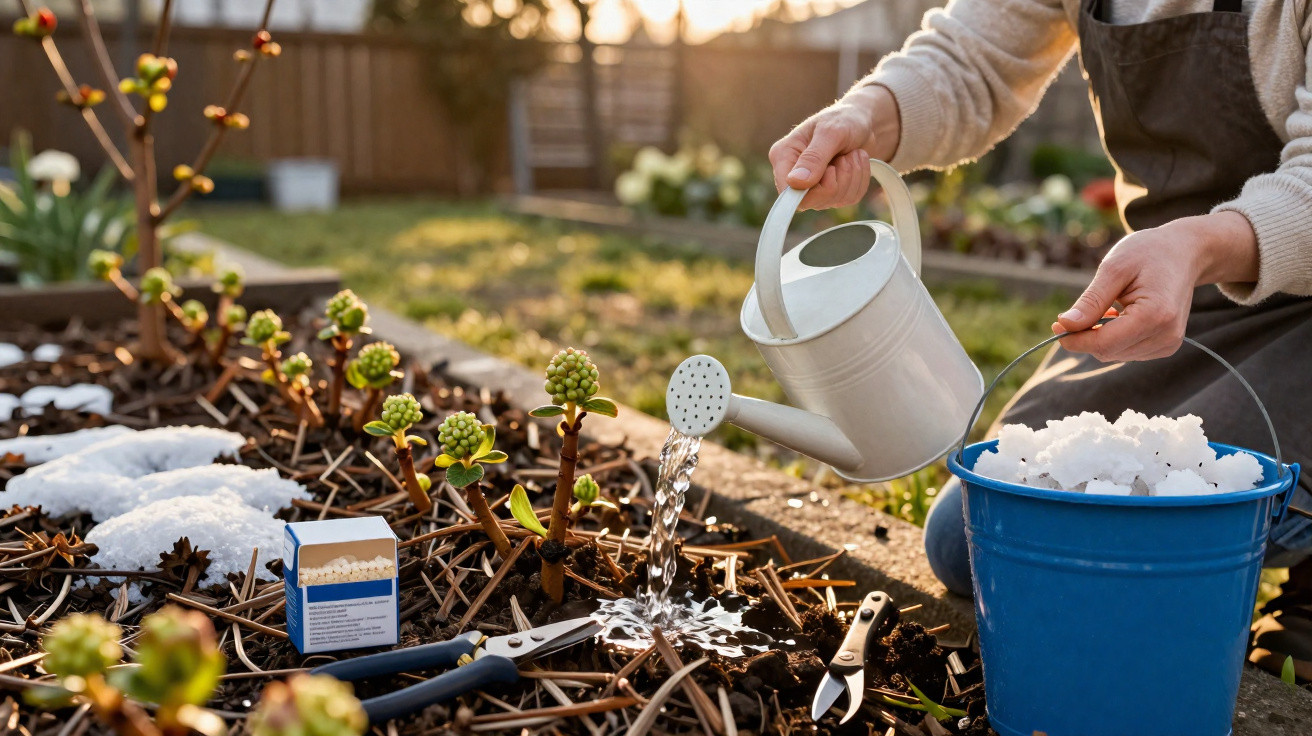
If you want to try it yourself, the method is almost absurdly simple. Take one or two old iron nails-proper iron or plain steel, not shiny, coated, or galvanised-and push them into the soil around 10–15 cm from the base of the rose.
Press them 5–8 cm down so they sit within the root zone rather than rusting away on the surface. Cover the area back over, then water as you normally would.
And that’s the whole routine. No monthly plan, no reminder on your phone-just a small annual gesture at most.
The point that tends to worry people is quantity. Some imagine a fistful of nails turning a border into a toxic scrapyard. In practice, most traditional gardeners used only a couple for an average bush and simply left them to break down over time.
These days the more common error is the other way round: treating the nail as a universal fix. Yellow leaves? Nail. Drooping buds? Nail. Blackspot? Nail.
Iron only helps if the rose is actually short on iron. If the drainage is poor, the plant is being overwatered, or the roots were damaged during transplanting, no scrap of metal is going to work wonders. And that’s fine-gardens don’t offer a hidden shortcut for every problem.
Mention this trick and you’ll usually hear two responses. Science-leaning gardeners will point out that iron from a nail is released too slowly to make much difference. Others will insist their grandmother’s roses "woke up" afterwards.
“Sometimes the garden doesn’t care whether the fix is perfect on paper. It cares that you paid attention long enough to notice it was struggling.”
A sensible way to hold both views at the same time is this:
- Use the rusty nail as a mild supplement, not a cure-all.
- Back it up with proper care: decent soil, mulching, and watering at the base.
- Look for changes over weeks rather than days; iron-related shifts take time.
- If your soil is already fertile, leave the nails in the shed.
- If nothing changes, consider a proper soil test and a targeted feed.
What this old trick still says about roses - and about us
There’s something unexpectedly moving about seeing someone bury a nail beside a plant. It’s low-tech-almost defiantly so-in a world where you can buy ten different "rose boosters" with a single tap.
When you kneel in the soil with one ordinary nail, you’re admitting what gardening really is: slow, unpredictable, and hands-on. You’re also agreeing to try small interventions without any promise they’ll work.
Most of us know that uneasy moment when a plant looks miserable and we feel a stab of guilt, as though we’ve broken an unspoken pact with a living thing.
Older gardeners didn’t always reach for phrases like "micronutrient deficiency". Instead, they worked from patterns. They knew that in some soils-especially chalky or heavily limed ones-roses could yellow unless they "got some iron." The nail became a convenient shorthand, a stand-in for what we might now handle with chelated iron or a soil amendment.
In that sense, the nail isn’t just iron. It’s attention made tangible. You notice the yellowing, you rummage in a pocket or the shed, you choose something, you kneel, you do something.
Let’s be honest: nobody truly does that every day. Even one deliberate act of care shifts the feel of a garden.
Modern advice can push us towards perfection: the ideal variety, the correct feed, the right pH, the right pruning cut. Many older gardeners aimed for "good enough". They buried nails, tipped in old tea leaves, passed cuttings over the fence, and traded hints at the allotment.
That may be why the tale of the rusty nail continues to travel so easily. It isn’t only about nutrient chemistry. It’s also about giving yourself permission to try something modest and home-made in a world of glossy labels.
You might decide a specialist iron tonic is the better option. You might test your soil and conclude you need neither. Still, that small ritual-bending down, pressing something into the earth, hoping-has a habit of staying with you.
| Key point | Detail | Why it matters to the reader |
|---|---|---|
| Origin of the rusty nail | A tip passed down by older gardeners to "give" iron to rose bushes | Understand where the practice comes from and why it has endured |
| Role of iron for roses | Iron supports chlorophyll production and helps prevent leaves turning yellow | Spot when a rose may be short on iron and what it changes visually |
| Modern use and limits | A rusty nail works slowly and should be treated as a supplement, not a miracle fix | Avoid disappointment by pairing tradition with up-to-date rose care |
FAQ:
- Does burying a rusty nail really help roses? It can, but only in specific situations. If your soil is genuinely low in available iron, slowly corroding iron can offer a tiny, long-term boost. It won’t rescue a plant suffering from poor watering, disease, or compacted soil.
- Can I use any type of nail or metal? Stick to plain iron or mild steel nails. Avoid galvanised, zinc-coated, painted, or stainless steel pieces, as coatings and alloys can bring metals you don’t want in your soil.
- How many nails should I bury around a rose bush? For a mature rose, one or two medium nails once a year is plenty. Pushing in handfuls won’t speed things up and just clutters the root zone with metal.
- Are there better ways to give iron to roses? Yes. If your roses show clear iron chlorosis, chelated iron products or targeted soil amendments act faster and with more predictable results than a nail.
- Is the rusty nail trick dangerous for the garden? Used modestly, it’s unlikely to cause harm. The main risk is relying on it instead of addressing real issues like drainage, soil structure, or fungal diseases that nails can’t fix.
Comments
No comments yet. Be the first to comment!
Leave a Comment