
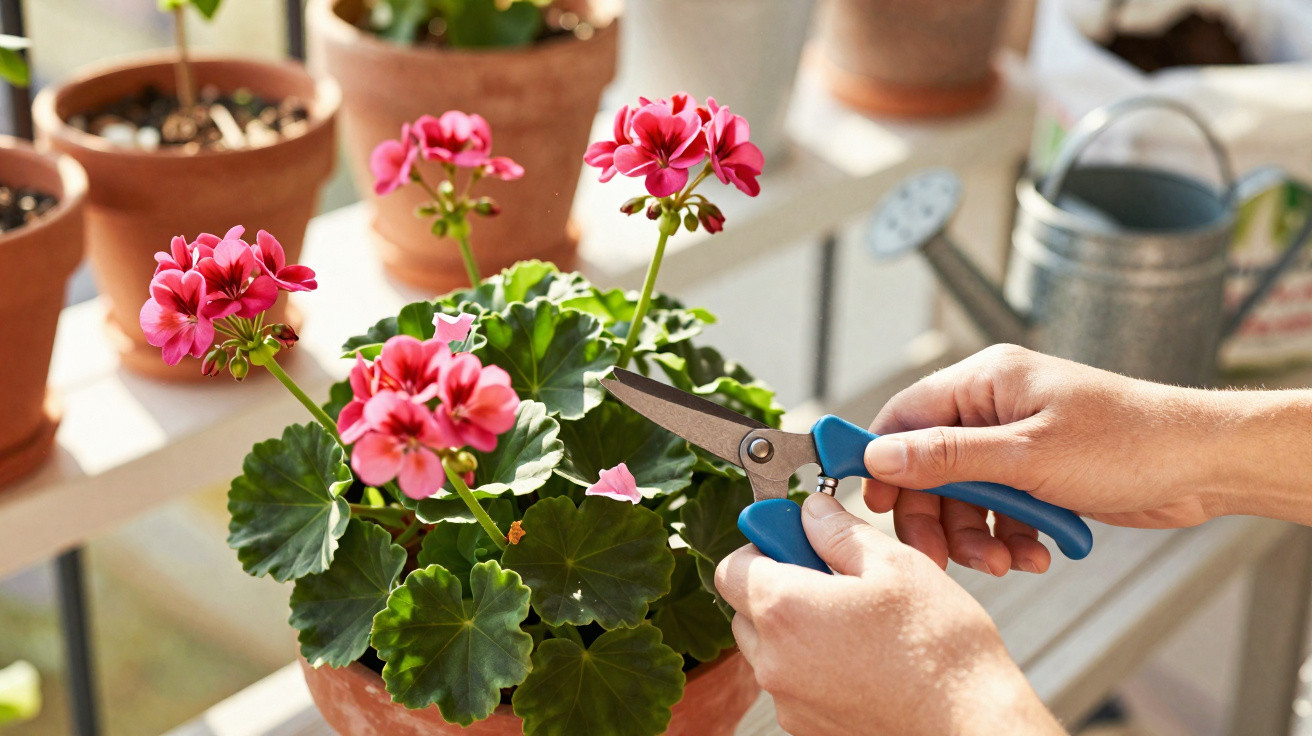
Late-winter sunlight finally reaches the kitchen window and falls right across your forgotten geraniums. On the sill, the stems have stretched into thin, spindly lines; the leaves have dulled to a slightly yellow tint; and a few crisp, spent flower heads cling on like tired decorations from an old celebration. You remember how much better they looked last summer. You also promise yourself you’ll sort them out “soon”.
Outdoors, the air is still sharp, yet the season has unmistakably begun to turn. Birds sound bolder. Daylight hangs on a touch longer. And your geraniums are stirring too-quietly-despite the messy, tangled way they currently present themselves. You brush a brittle stem and a fragment of dried petal drops to the floor.
This is the hushed point in the year when the next wave of flowers is effectively chosen.
Why pruning before spring changes everything for your geraniums
It becomes obvious the moment you notice two balconies on the same street. One has geraniums that have grown long, loose and floppy, managing only a handful of washed-out blooms. Next door-same aspect, same city, same weather-there’s a tidy burst of rounded, compact plants covered in vivid red flowers. You pass by thinking, a little begrudgingly, “What are they doing that I’m not?”
Usually it isn’t a mysterious feed or a secret family remedy. The difference tends to begin earlier, while everything still looks dormant and unremarkable. It begins in late winter, with a pair of scissors.
A gardener I spoke with in a small town in southern Spain sticks to a straightforward habit. He keeps dozens of geraniums on his terrace-so floriferous that tourists stop to photograph them. His method is simple: as winter ends, he moves from pot to pot with the same unhurried rhythm-snip, snip, snip. Finished blooms, leggy shoots, damaged leaves: all removed.
He describes this as “cleaning the promise”. One year he missed the proper cut-back because work took over. Summer arrived, the plants still put on growth, but flowering was sparse and uneven. “They had no energy left to give,” he told me with a shrug. “I’d let them waste it on old growth.”
Geraniums will happily keep going, but they’re not endlessly giving. They direct their resources towards whatever remains on the plant. Leave a jumble of exhausted stems and spent flower heads, and the plant continues to support them-like paying rent on a room you never enter. Pruning in late winter makes the instruction unmistakable: put effort into fresh growth.
From a botanical point of view, these cuts encourage branching. Where one weak extension might have continued, a cut prompts two new shoots instead. More shoots lead to more potential flower buds. Clearing tired foliage also improves light and airflow through the centre of the plant. The payoff isn’t only appearance-it’s resilience. Long, steady flowering is almost never luck.
The quick trimming rule that wakes your geraniums up
The reassuring part is how achievable it is. Towards the end of winter-ideally on a dry day-stand in front of your geraniums with clean, sharp scissors or secateurs. Begin by removing every dead flower head, cutting down to the point where the stalk joins a healthy leaf or a node.
Next, trace each long, thin stem with your eyes. If most of its length is bare, with leaves only near the tip, shorten it by about one third. That’s the quick trimming rule: take off roughly a third of the leggy growth so the plant branches lower down and stays compact. You’re not reducing it to a stump-just bringing it back and renewing its shape.
Many people pause here. They see green stems about to be cut and it feels, briefly, like an act of cruelty. Plants feel so fragile when we decide their fate with one clean cut. But that hesitation is often what produces, by July, pots of tangled, uneven geraniums dotted with weary-looking flowers.
Realistically, hardly anyone keeps up with perfect day-to-day tidying. Life fills the calendar, and plants slip down the list. That’s precisely why this late-winter session matters: it’s a deliberate reset. Once a year, you rebuild the plant’s framework so that the rest of the season is simple upkeep rather than emergency repairs.
“Think of geraniums like someone training for a marathon,” says Elise, a balcony gardener in Lyon. “If you carry all your old bags, you never run far. When I prune before spring, I’m basically dropping the bags for them.”
- Cut off all dried flower stalks at the base so the plant stops wasting energy on what’s finished.
- Reduce the longest, bare stems by about one third to stimulate new side shoots.
- Take away yellowing or soft, mushy leaves so light and air can reach the plant’s centre.
- Disinfect tools before and after, particularly if any plants showed signs of illness.
- Once trimmed, water sparingly and keep the pots in bright light to restart growth gently.
Geraniums, seasons, and the quiet joy of doing things on time
There’s a surprising satisfaction in this small pruning ritual. Moments ago, your geraniums looked tired and neglected. Now they’re shorter and a little barer, yet they appear somehow fresher-like they’ve just taken a deep breath after winter. You can’t see the reward yet, but the clean, purposeful lines of the stems hint at what’s coming.
Within a few weeks, tiny new shoots will begin to push from the cut points, and the whole process will click into place. You’ll pass your balcony or windowsill and notice the plants filling out into fuller, rounder shapes. On some days, you may even find yourself counting the developing flower buds as if they were small treasures. We all recognise that feeling: one modest action that ends up reshaping an entire season.
That is what pruning before spring really provides-not a miracle, but a way to align yourself with the plant’s internal timing. A quiet annual appointment between you, a pair of scissors, and a geranium that simply needs a clear signal to give its best.
| Key point | Detail | Value for the reader |
|---|---|---|
| Prune before spring | Late-winter trimming of old flowers and leggy stems | Boosts branching and sets the stage for continuous blooms |
| The “one-third” rule | Shorten the longest, bare stems by about one third | Creates compact plants that flower more evenly all season |
| Clean, focused session | 10–20 minutes once a year with sharp, disinfected tools | Saves time later and prevents weak, exhausted geraniums |
FAQ:
- When exactly should I prune my geraniums before spring? Ideally at the end of winter, when frosts are almost over but before strong new growth starts. For many regions, that’s late February to mid-March.
- Can I prune geraniums very hard to rejuvenate them? You can cut them back more severely if they’re very old and woody, but do it in stages. Start with the one-third rule, then adjust once new shoots appear.
- Will pruning stop my geraniums from flowering? They may pause briefly, but pruning actually encourages many more flowers in the medium term and a longer, more regular blooming period.
- Should I fertilise right after pruning? Wait a week or two, then start a light, balanced fertiliser. Right after pruning, the plant mostly needs rest, light, and moderate water.
- Is this pruning rule valid for both zonal and trailing geraniums? Yes, though for trailing types you can be slightly gentler, focusing on cleaning and shortening the very longest stems to keep a soft cascade.




Comments
No comments yet. Be the first to comment!
Leave a Comment