
On a cramped city balcony in late spring, it’s easy to think you’ve nailed it. Basil throws out vivid green leaves, tomato stems surge up their canes, and tiny pepper plants seem to put on size almost overnight. You water, you check in, and with your morning coffee you feel that small, steady satisfaction: it’s working. Things are growing - quickly.
Then time moves on. Blossoms don’t properly appear. The stems stay wiry. The basil shoots to seed before you’ve picked more than a couple of handfuls. The tomatoes keep climbing, yet the fruit stays marble-sized and annoyingly pale.
From a distance, it’s all greenery. Up close, it feels like progress has stalled.
When plants look busy but go nowhere
Soil scientists have a no-nonsense phrase for these balcony jungles and beds that look abundant but deliver nothing: “all gas, no steering.” The plant is speeding along - just not towards adulthood. You get leaves rather than maturity, height rather than harvest.
Take a stroll through any garden centre in May and you’ll see the pattern. Seedlings wearing huge caps of foliage, crammed into tiny pots. To most people they look “strong”. To someone who reads soils for a living, they look underfed, stressed and a bit doomed.
An agronomist I spoke to in Lyon described a suburban vegetable patch that went viral in a local Facebook group. The pictures looked extraordinary: corn taller than the gardener, squash leaves like dinner plates, the whole plot with a near-tropical feel. Neighbours turned up in numbers to admire the “magic fertilizer” that seemed to be behind it.
By late summer, the reality was very different. The corn set small, stunted cobs with more gaps than kernels. The squash plants still looked powerful, but the fruits either stayed tiny and rotted, or never appeared. Later soil lab work told the story: nitrogen was sky high, available phosphorus was almost absent, and the soil was compacted beneath the first 10 cm. It presented as plenty; it behaved like a dead end.
So why do plants sometimes grow at pace and still fail to reach full maturity? Soil specialists keep pointing to the same dynamic: the hidden structure below ground can’t keep up with what you see above. Roots remain shallow, confined to a thin “comfort layer” of soft soil or potting mix. The nutrients that support sturdy structure and reproduction - phosphorus, calcium, and micronutrients such as boron and zinc - sit out of reach or become chemically locked up.
The plant then does what it has to do to survive. It pours energy into leaf growth to maximise photosynthesis, trying to outrun the limitation. To us, that burst of foliage reads as vigour. To a soil scientist, it’s a stress signal at full volume.
What soil specialists actually do differently
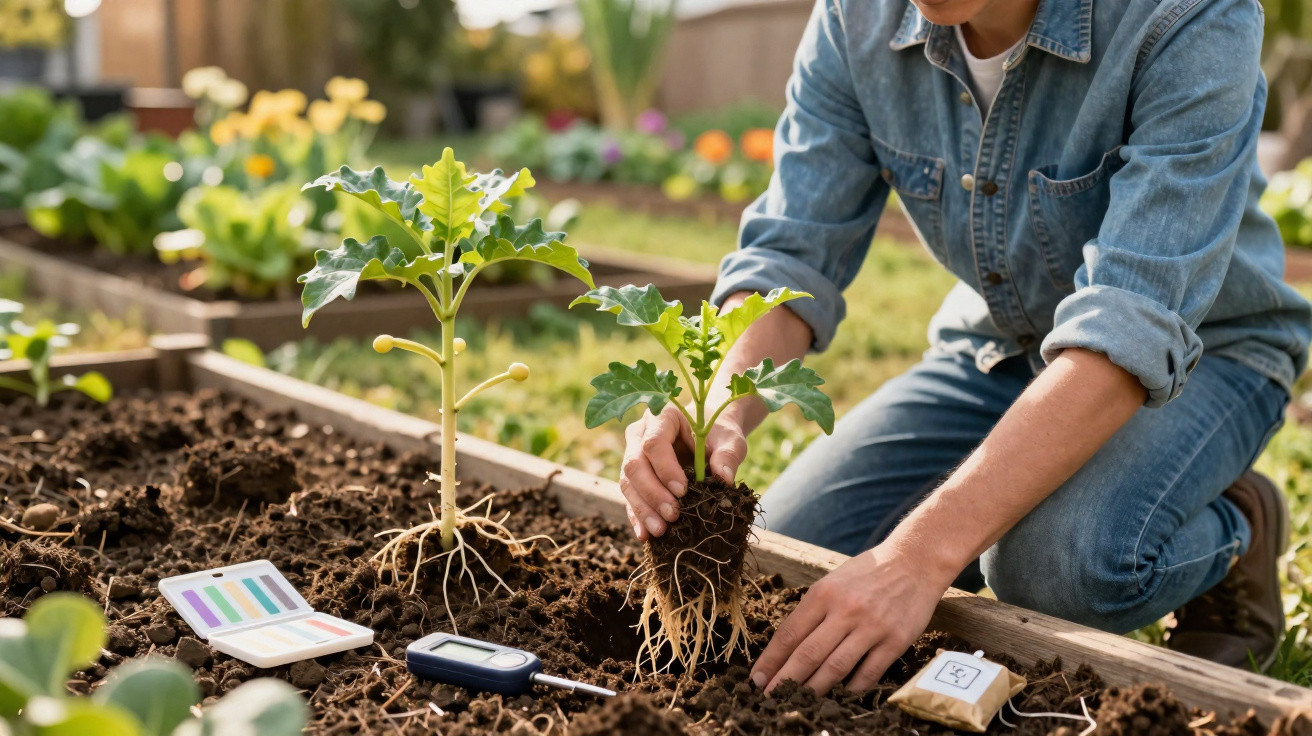
When I asked a seasoned soil consultant what separates genuinely thriving, mature plants from these “eternal teenagers”, he didn’t lead with a miracle product. He reached for a spade. In any garden, his first move is to dig a simple test hole and use his eyes and hands.
He breaks the soil apart in his fingers. He looks at how far down the roots really travel. He smells for that woodland, forest-floor scent that suggests a living system. If the roots are mostly confined to the top few centimetres - or if they meet a firm, smeared band where old cultivation has compressed the ground - he can predict what comes next: a dramatic early surge followed by a stall right at that barrier.
What he does after that is unexpectedly restrained. Rather than pushing more nitrogen-heavy feed to “fix” the foliage, he works on opening the soil profile. He loosens deeper layers lightly with a fork, applies compost that has fully matured, and adds a thin mulch that encourages worms and fungi to do the slow, heavy work.
He also relies on what he calls “slow keys”: rock phosphate, wood ash used cautiously, crushed eggshells, seaweed meal. None of these are showy, and none produces a one-week growth spurt. Instead, they gradually release what plants need to build resilient cells and the structures required for flowering and fruiting. On the surface, almost nothing happens for a while, and then suddenly everything does.
So where do most of us slip up? Soil specialists tend to repeat the same three errors - usually with a kind, knowing tone. We water too often, we overdo fast nitrogen, and we fail to take compaction seriously. When leaves look pale or flowers are slow, we answer with more liquid feed, more watering, more urgency.
And honestly, hardly anyone follows this perfectly every day - but the fertiliser bottle that says “feed weekly” sits at the back of your thoughts like a quiet reproach. It’s easy to overcompensate. Another dose of nitrogen greens everything up immediately, which feels like a win. Meanwhile, the deeper shortcomings remain untouched. Those plants stay busy for months, then bow out having never truly completed a single task.
Soil scientist Marta Rodríguez put it plainly during our interview:
“Fast growth is cheap for a plant. True maturity is expensive.”
She also shared the checklist she reaches for when someone tells her that “everything grows but nothing fruits”:
- Root depth: Are most roots confined to the top 5–10 cm of soil?
- Soil texture: When you squeeze a ball of soil, does it go rock hard as it dries, or turn slimy when wet?
- Nutrient balance: Has nitrogen been added without balancing phosphorus, potassium and calcium?
- Biology: Can you see worms, fungal strands, and fragments of decomposing organic matter?
- Water rhythm: Are plants getting frequent shallow watering instead of deeper, less frequent soaking?
On paper, it can sound technical. In practice, it’s simply paying attention to what the soil has been signalling all season.
The quiet shift that changes everything in your garden
Once you recognise the pattern - rapid greening, no real adulthood - you start seeing it everywhere. A potted fiddle-leaf fig that throws out huge leaves but never thickens its trunk. A balcony tomato thicket that stays short on flowers. An office peace lily that keeps producing foliage yet won’t bloom.
Soil specialists aren’t performing magic. They just begin the story below ground and accept that meaningful change takes time. Their effort goes less into feeding the plant directly and more into feeding the soil life that feeds the plant. They aerate with care rather than endlessly churning. They mulch instead of leaving soil bare to hot sun and battering rain. They water less often but more deeply, so roots are nudged to explore rather than linger near the surface like anxious swimmers.
At this point, some people feel uneasy when they think about how much they’ve spent on liquid feeds and instant “bloom boosters”. Others feel a quiet sense of relief. The idea of growing less - but growing better - can be strangely freeing. You don’t need the tallest, busiest plants in the neighbourhood. You need plants that actually reach the end of their life cycle.
Most of us have lived through that moment when a proud, dense row of lettuce suddenly bolts into bitter towers overnight. Once you’ve tasted the bland leaves that come from a stressed plant rushing towards seed, it becomes hard to romanticise speed. Slow, deep growth starts to feel like respect.
So the next time a new plant explodes into fast green, you may hesitate before celebrating without question. You might press your fingers into the compost and notice whether it stays tight and cold. You might lift the pot and discover roots coiling around themselves, searching for an exit that never arrives.
Under nearly every plant that genuinely matures - from the first soft leaf to a properly heavy fruit - there’s usually the same quiet backstory: patient soil work. Someone loosening, nourishing and protecting the ground long before the first flower opened. It isn’t glamorous and it doesn’t photograph well. But this is where the real connection happens between plant and place; everything else is just decoration.
| Key point | Detail | Value for the reader |
|---|---|---|
| Root depth matters more than height | Shallow roots lead to fast leaf growth but poor flowering and fruiting | Helps you diagnose why plants stall before maturity |
| Nutrient balance beats “more fertilizer” | Excess nitrogen without phosphorus, potassium and calcium locks plants into leafy growth | Prevents wasted money on the wrong products |
| Soil life is the real engine | Worms, fungi and organic matter slowly unlock deeper nutrition | Guides you toward practices that give lasting results |
FAQ:
- Why do my tomatoes grow tall but give almost no fruit? They’re often getting too much nitrogen and not enough phosphorus and potassium, or their roots are trapped in shallow, compacted soil. Focus on deeper watering, loosening the soil around the root zone and using a more balanced fertiliser.
- Can potting soil alone cause plants to stay immature? Yes, especially if it’s fresh, fluffy and high in peat or coco coir. Roots may stay in this comfortable top layer and never explore deeper, leading to fast top growth and weak reproductive development.
- Does pruning help plants mature faster? Good pruning can redirect energy, but it won’t fix poor soil or root issues. On stressed plants, hard pruning can even delay maturity because the plant has to rebuild basic structure first.
- How can I quickly tell if my soil is compacted? Try pushing a garden fork or even a wooden stick into the ground. If it stops sharply at a certain depth or your arm has to strain, you likely have a compacted layer blocking roots.
- Are fast-release fertilizers always bad? Not always; they can help in short bursts for very depleted soils. The problem comes when they’re used repeatedly without correcting deeper structure and micronutrient balance, which keeps plants stuck in “leaf mode.”
Comments
No comments yet. Be the first to comment!
Leave a Comment