
Up close, the scene told another tale: leaves that should have been crisp were limp, the compost was waterlogged, and there was that faint, unsettling scent of something going off. The owner - a delighted new “plant parent” - insisted she was doing it properly: “I water them every morning with my watering can, like you’re supposed to.”
An organic gardener who’d dropped by simply nodded, lifted one pot and gave the base a light tap. There was no proper drainage tray, and the compost felt as heavy as a soaked sponge. He didn’t accuse her of neglect. Instead, he sighed and said, “Eighty percent of potted plants die from this exact thing,” - not from being forgotten, but from being adored with water from above.
Then he did what many of us never do with the plants on our desks or balconies. And without any fuss, everything started to change.
The watering habit that quietly kills potted plants
He watched her routine - the same one millions follow: a fast pour from the top, wetting the surface until a little water eventually trickled into the saucer. It looked attentive. It sounded responsible. The compost turned darker, the foliage shone, and the watering can felt reassuringly effective.
But he pointed out the brutal catch. The top 2 cm were drenched, yet the centre of the root ball remained dust-dry. The roots, searching for moisture, had started circling the edges rather than growing downwards. “You’re watering the surface,” he said softly, “not the plant.” That everyday approach - quick, shallow top-watering - was gradually strangling her supposedly thriving green display.
He’d seen the same pattern in city flats and on suburban patios: people water out of habit instead of responding to the plant. A splash every day. Little sips. Never enough for the compost to be properly soaked through and to drain freely. On paper it sounds sensible; in a container, it leaves the same roots stuck in stale compost that’s always half-wet and half-dry. From years of workshops and house calls, the organic gardener’s estimate was blunt: around 8 out of 10 potted plants that die early are brought down by this well-meant top-watering routine.
It’s usually a perfect storm: decorative pots without real drainage holes, dense shop-bought compost, and a human schedule that doesn’t fit the plant’s needs. Water poured from above hits the surface, packs it down, and then races around the sides of the pot rather than soaking evenly through the middle. The plant appears watered, the saucer fills, yet the heart of the root zone either stays thirsty - or turns into sour, oxygen-poor sludge in patches. That’s where the invisible damage begins, well before any leaves start dropping.
The bottom-watering shift that changes everything
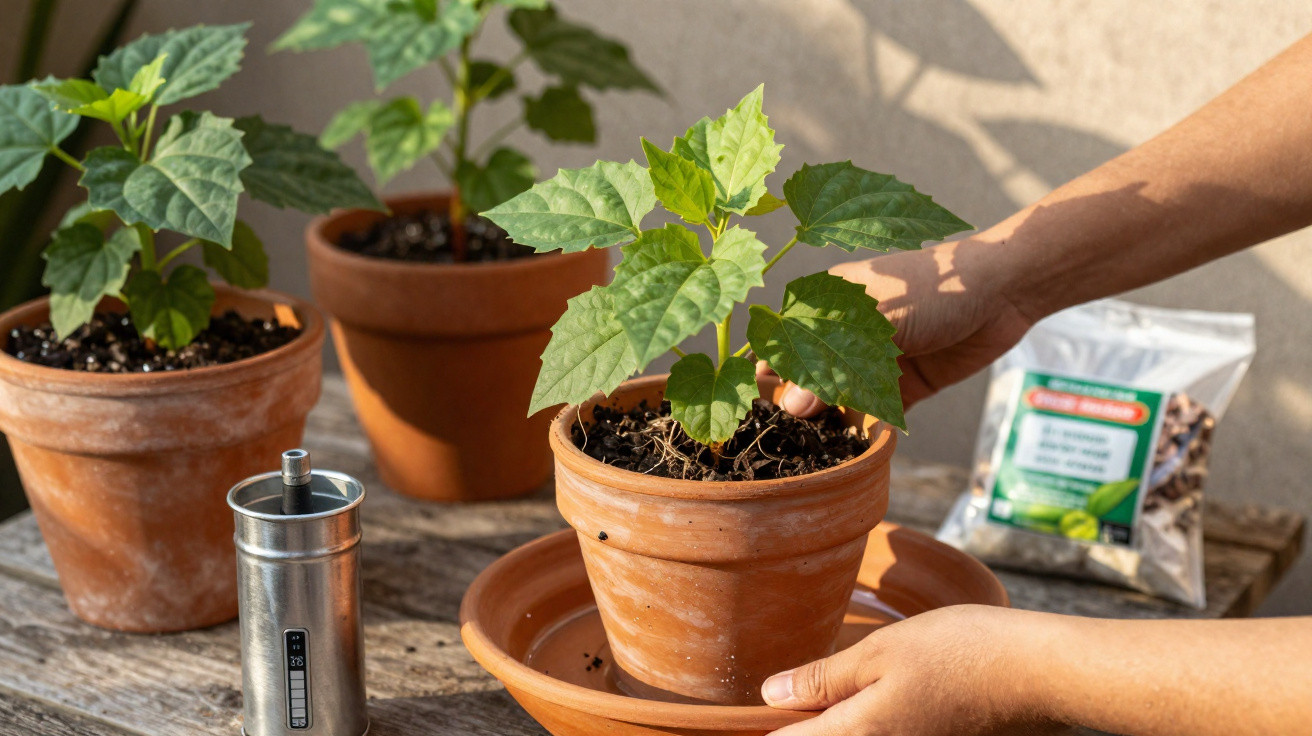
The gardener went into the kitchen, found a plastic basin and poured in a few centimetres of water. Then he did something that felt oddly radical despite being so simple: he placed the entire pot into the basin and stepped away. No speech. Just time.
Ten minutes later he lifted the pot back out. The compost, which had resisted those quick showers from above, now felt evenly and satisfyingly heavy. Through capillary action, water had travelled up from the drainage holes, moistening the mix from the bottom all the way to the surface. “This,” he said, “is how pots are meant to drink.” Bottom-watering: slow, thorough, and focused on the roots the plant actually depends on.
Once you witness it, it’s difficult to forget. Top-watering prioritises speed; bottom-watering prioritises survival. The technique is almost embarrassingly straightforward: sit your potted plant in a tray, sink, or bucket with water coming to roughly one third of the pot’s height, then leave it for 15–30 minutes. After that, lift it out and allow the excess to drain away completely.
That one adjustment tackles three common plant-killers in one go. First, it stops the top layer being beaten into a crust that feels like concrete, which keeps air and roots moving. Second, it prompts roots to grow deeper, following moisture downwards rather than camping near the surface. Third, it gives you a clear, hands-on way to tell whether the plant is truly hydrated: the weight of the pot is a better guide than any moisture-meter app. It’s low-tech, but it works.
He always added an important nuance: bottom-watering doesn’t mean “never water from the top again.” It means the backbone of your routine becomes a deep soak from below, with the occasional top-water to rinse away dust or flush out salts. The real shift isn’t the basin itself - it’s paying attention to the hidden world beneath the compost, where the plant’s real life is happening.
Practical rules to keep your pots alive (instead of on life support)
Later, sitting on the floor among pots and bags of compost, the organic gardener shared the exact method he wanted her to follow. About once a week - or once every ten days - bring your potted plants together near the sink or bath. Fill a tray or basin with room-temperature water. Stand the pots in it and wait until the top of the compost feels only slightly damp to the touch.
Most small indoor pots need roughly 15–20 minutes. Bigger terracotta containers can take 30–40 minutes. Lift each pot out and let it drain properly before returning it to its place. Don’t leave water sitting in saucers for hours. Don’t get stuck in the half-wet, half-dry guessing game. Look for one clear cue: evenly moist compost, then a rest period.
Between soaks, drop the idea of a fixed “watering day”. As you walk past, push a finger 3–4 cm into the compost. If it’s cool and faintly moist, do nothing. If it’s completely dry and the pot feels noticeably light, it’s ready for the next bottom-watering session. Let’s be honest: hardly anyone does this every day, but even once a week is a huge move away from automatic top-watering that never truly reaches the roots.
At a human level, the toughest part isn’t the technique - it’s resisting the urge to add “just a little” with the watering can when you’re bored, restless, or worried about your plants. Over-care is the quiet danger here. A quick splash onto already damp compost collapses air pockets, encourages fungus gnats, and keeps roots sitting in a dull, low-oxygen soup. The organic gardener said he sees far more plants drowned by love than lost to dryness.
He also pointed to a moment most of us recognise. During a busy week, the plants cope - maybe a touch dusty, but fine. After a heartbreak, a looming deadline, or a rainy weekend indoors, they’re suddenly drenched three times in four days. We’ve all had that moment when watering becomes a way to soothe ourselves. The plant turns into an emotional outlet, not just a living thing with roots. That’s when this “common watering method” becomes genuinely risky.
“If you only change one thing,” the organic gardener told her, “let it be this: stop thinking of watering as a daily task, and start thinking of it as a deep conversation that happens less often, but really counts.”
Before he left, he handed her a small checklist, scribbled on a recycled envelope:
- Always choose pots with real drainage holes, not only decorative cachepots.
- Water mostly from the bottom, until the compost feels evenly heavy.
- Let the top 2–3 cm dry out before the next soak, especially for most houseplants.
- Empty saucers 15–20 minutes after watering; no standing water.
- Pay more attention to leaves and pot weight than to the calendar.
It wasn’t a miracle cure - just a handful of habits that quietly change the fate of so many potted plants on shelves and balconies.
Rethinking our relationship with water and potted plants
What shifted on that balcony wasn’t merely a basin trick. Over the following weeks, the owner began lifting pots instead of judging by leaves alone. She learned how light and hollow a genuinely thirsty plant feels in the hand, and how a freshly soaked pot carries a deep, steady weight. It stopped being about “Wednesday is watering day” and became about reading each pot as its own small, ongoing story.
A few plants recovered quickly. Fresh leaves opened on the philodendron, and the rosemary stopped browning from the bottom upwards. Others didn’t survive; the roots had already been damaged too badly. She discovered there’s a point where care arrives too late - part of the reality of growing living things in containers. Not every plant gets a neat rescue.
What stayed with her was the gardener’s blunt estimate: this rushed, shallow top-watering habit likely kills around 80% of potted plants that never reach their potential. Not pests. Not missing fertiliser. Simply water delivered in the wrong way, on the wrong rhythm, for a life confined to a pot rather than anchored in open ground.
So next time a plant mysteriously “gives up” on your desk or balcony, picture what’s happening beneath the surface. Imagine roots either gasping in soggy compost or scraping at dry, untouched pockets in the middle of the pot. Ask yourself when you last let the plant drink properly from the bottom - slowly - until it decided it had had enough. That quiet question, more than any fancy compost blend or rare variety, may be what keeps your next plant alive long enough to become part of your real life.
| Key point | Detail | Why it matters to you |
|---|---|---|
| Top-watering kills roots | Fast, surface-only watering leaves the root ball dry or waterlogged in pockets | Explains why “good” routines can still end with failing plants |
| Bottom-watering hydrates evenly | Soaking pots in a shallow tray lets compost drink from below via capillary action | A simple, practical fix for most potted plants |
| Read pots, not calendars | Check soil depth, pot weight, and leaves instead of watering on set days | Cuts overwatering and saves time, money, and frustration |
FAQ:
- How often should I bottom-water my potted plants? Most indoor plants do well with a deep bottom-watering every 7–10 days, but the real signal is dry topsoil and a noticeably light pot, not the calendar.
- Can I bottom-water all kinds of plants? Yes for most houseplants and herbs; for cacti and succulents, use a shorter soak and let them dry longer between waterings.
- Is top-watering always bad for potted plants? No, it’s fine occasionally, especially to flush salts, as long as you water deeply until excess drains out and don’t just sprinkle the surface.
- What if my pots don’t have drainage holes? Use them only as cachepots: keep the plant in a plastic nursery pot inside, or drill holes if possible, because no method can save roots in a sealed container long-term.
- How do I know if I’ve already overwatered? Signs include yellowing lower leaves, a musty smell, fungus gnats, and compost that stays soggy for days; in that case, let the plant dry longer and consider repotting into a fresh, airy mix.
Comments
No comments yet. Be the first to comment!
Leave a Comment