
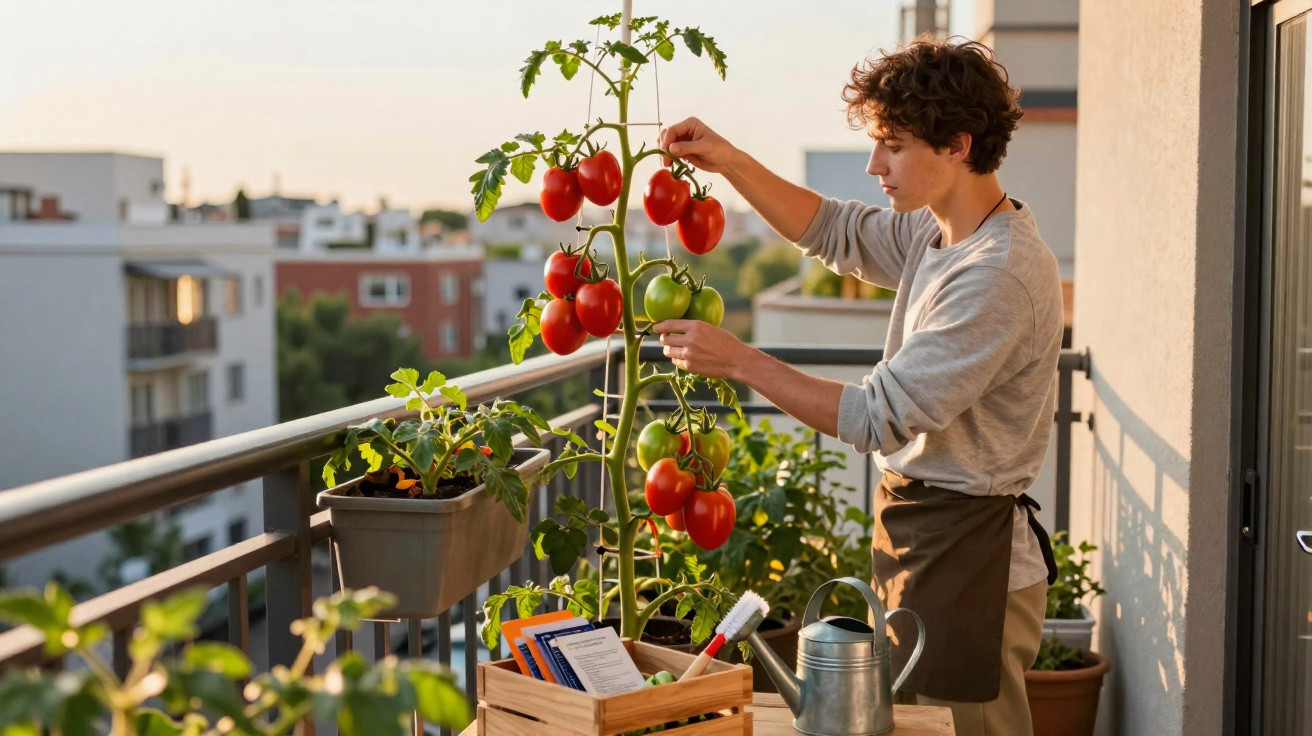
The balcony smelled of wet soil and tomato leaves, even though it was still April. Three floors above the street, wedged between satellite dishes and washing lines, a small patch of garden suddenly seemed to float in mid-air. Not an Instagram-perfect balcony, but a narrow, slightly rattly wooden frame with green shoots reaching out into the city. A neighbour paused, looked up, frowned for a second - and then simply smiled. You could almost hear the question popping into her head: “How on earth did he get that up there?”
Why tomatoes are suddenly growing upwards
Vertical tomato gardens are appearing everywhere right now: on balcony railings, along house walls, in tiny courtyards. You see fabric pockets filled with compost, pallets fitted with small buckets, wires stretched tight so delicate stems can climb. It feels a bit like urban improvisation theatre - except the final act involves salad and tomato sauce. The appeal is obvious: more harvest from less space, a touch of self-sufficiency measured in square metres. And, honestly, picking your own tomato from the third floor makes you feel briefly like the king of the back court.
A friend of mine with a balcony barely 1 metre deep gave it a go last summer. Instead of pushing two sad tubs into the corner like he used to, he propped an old Euro pallet against the wall, fixed three rows of planting pockets to it, and stretched a wire grid above. In the pockets: bushy cocktail tomatoes; in a big container at the bottom, a cordon tomato that was allowed to cling to the mesh. By July, you could read his season in a single colour: red. His WhatsApp was packed with photos - children picking trusses as if from a sweet shop, neighbours who “just wanted a taste”. By the end of the season, he’d harvested almost ten kilos of tomatoes out of nowhere. On a balcony where there’s barely room for a sun lounger.
What’s happening is simply smart use of surface area. Tomatoes are natural climbers; they thrive when they’re supported and guided. In a traditional bed they sprawl sideways, hog half the plot, and leave fruit half in the dirt. With a vertical garden, you redirect that energy upwards. The plant grows more streamlined, air moves through more easily, and fungal diseases struggle to take hold. Light reaches several levels instead of just one. The trick isn’t more space - it’s a new direction. All at once, yield appears on a wall that used to be nothing but dull grey.
How to build your vertical tomato garden step by step
The easiest way in is to think in tiers rather than individual pots. You need a solid base - a balcony railing, wall, fence, or a home-built wooden frame - and then you attach your “floors” to it. These can be planting pockets, cut-down 10-litre containers, sturdy buckets, or wooden boxes with drainage holes. At the bottom goes the “power tier” with large containers and hungry varieties such as beef tomatoes. Above that, lighter plantings - for example cherry tomatoes in compact pots. Right at the top, you keep only the climbing growth, trained upwards on strings or wire. The result is a green column you can work your way up when watering.
Most people don’t come unstuck during the build; they come unstuck in day-to-day life. Everyone knows that moment in August: you step outside after a long day and the plants are drooping like wet towels. Let’s be realistic - nobody waters three times a day with a can just because it’s 34°C. With a vertical tomato garden, one simple idea is worth it: create a shared water base. For instance, use a long trough planter at the bottom and run a basic hose irrigation line that feeds every level. Or set large saucers underneath so water can collect rather than disappearing instantly. That way, the garden can cope even if you’re late one day.
A line from my older neighbour has stayed with me ever since I built my first tomato tower:
“The plant shows you what it needs - you just have to look often enough.”
Three straightforward anchors make the difference, and you could practically write them on the wall:
- Soil volume: at least 10 litres per tomato plant, preferably more - otherwise you’re constantly battling dried-out roots.
- Light: a minimum of 6 hours of sun; partial shade is possible, but the flavour noticeably suffers.
- Stability: every plant needs its own support - cane, string, wire - or the whole tower can topple in wind.
Fine details that turn “nice” into a real harvest tower
Once the frame is up, the real craft begins: choosing varieties. Not every tomato enjoys life in a high-rise. Vertical systems suit compact or climbing types best: bush tomatoes for the middle tiers, cocktail and cherry tomatoes higher up, and one or two vigorous cordon tomatoes at the bottom. Three, at most four plants per square metre of wall area is plenty. In this case, less really is more - pack it too densely and you end up with a thick mass of leaves where flowers get hidden and air stands still. You’re aiming for a green wall, not a jungle wall.
A common set of mistakes is planting too early, too much, and with too little patience. Plenty of people put plants out in April “because it feels so warm”, then find that a single frosty night turns the whole build into a gloomy still life. Others cram the containers with heavy, compacted compost that turns to concrete the first time you get a downpour. A vertical tomato garden depends on loose, humus-rich compost with some added composted organic matter and a well-planned initial feed. Another detail that’s often overlooked: wind is harsher at balcony height than at ground level. Flimsy frames shudder in every summer storm. If your supports wobble with a firm push of your hand, it isn’t ready for a balcony.
An experienced city grower once summed it up dryly:
“If you garden vertically, you build less for today - and more for August.”
To make sure your project gets there, a few unglamorous but golden habits help:
- Pinch out side shoots on tall varieties so energy goes into fruit rather than chaotic leaf growth.
- Plan rain protection - for example a small clear roof - to reduce blight caused by leaves staying wet for days.
- Keep routines small: better 10 minutes every other day to check, water, and inspect leaves than a Saturday “garden marathon”.
Why your tomato tower is about more than just vegetables
Anyone who has eaten a fully ripe, warm, deep-red tomato straight off their own climbing support in the middle of the city quickly understands: this is more than a project designed to avoid the supermarket. A vertical tomato garden changes what your window looks out onto. Instead of concrete, you see growth; instead of “just another balcony”, you have a small place of production. Children learn almost accidentally where flavour comes from. Neighbours talk more readily when there’s suddenly a living, glowing thing hanging on the façade. A few square metres of air turns into a spot where the seasons become visible.
Perhaps that’s the quiet appeal: moving from “I’ve only got a small balcony” to “something is happening here that belongs to me”. It doesn’t have to be flawless. Sometimes the structure ends up slightly out of level; sometimes a string tangles; sometimes blight wipes out a plant. And still, every day you get that quick glance at something you built with your own hands - even if you started with nothing more than a watering can and a wobbly wooden frame. And then, in the middle of one of those long, hot summer days, you catch yourself eating a tomato standing up and thinking: I don’t actually need more space - just a bit more height.
| Key point | Detail | Value for the reader |
|---|---|---|
| Vertical build | Use walls, railings and frames to plant tomatoes in tiers | More yield in the smallest space, ideal for balconies and tiny courtyards |
| Suitable varieties | Compact bush and cocktail tomatoes for upper levels, vigorous cordon tomatoes at the bottom | Better fit for limited soil volume, steadier growth |
| Care routines | Regular watering, pinching out, and planning wind and rain protection | Healthier plants, lower disease risk, reliable harvest |
FAQ:
- Question 1 How much weight can a normal balcony take for a vertical tomato garden? In most cases, far more than you’d expect - but you can’t guess your balcony’s structural limits. Use lightweight containers (plastic rather than heavy ceramic), spread the load across a wider area, and if in doubt have a quick word with your landlord or building management before you hang an entire wall full of planters.
- Question 2 Do I need special tomato compost for vertical growing? You don’t need any exclusive “vertical compost”, but you do need a loose, nutrient-rich mix. Good quality multipurpose compost plus well-rotted compost and a bit of organic tomato feed usually works better than cheap bagged compost that clumps and dries out quickly.
- Question 3 How often do I need to water in a vertical garden? In high summer on a sunny balcony it can be once or twice a day; in cooler spells it’s more like every two to three days. Small containers dry out much faster. Simple irrigation kits or home-made water reservoirs take the pressure off significantly.
- Question 4 Can I set up a vertical tomato garden in partial shade? Yes, but you’ll notice the difference in both flavour and quantity. With 4–5 hours of sun a day, tomatoes grow but ripen more slowly and are often less aromatic. In that case, choose smaller varieties such as cherry tomatoes, which cope better with lower light.
- Question 5 What should I do with my vertical system in winter? Remove the tomato plants; you can reuse some of the compost in the garden or on the compost heap. The frame stays in place, gets cleaned, and should be checked for damage. Many people use winter to tweak the setup slightly - and the second year is almost always better.





Comments
No comments yet. Be the first to comment!
Leave a Comment