
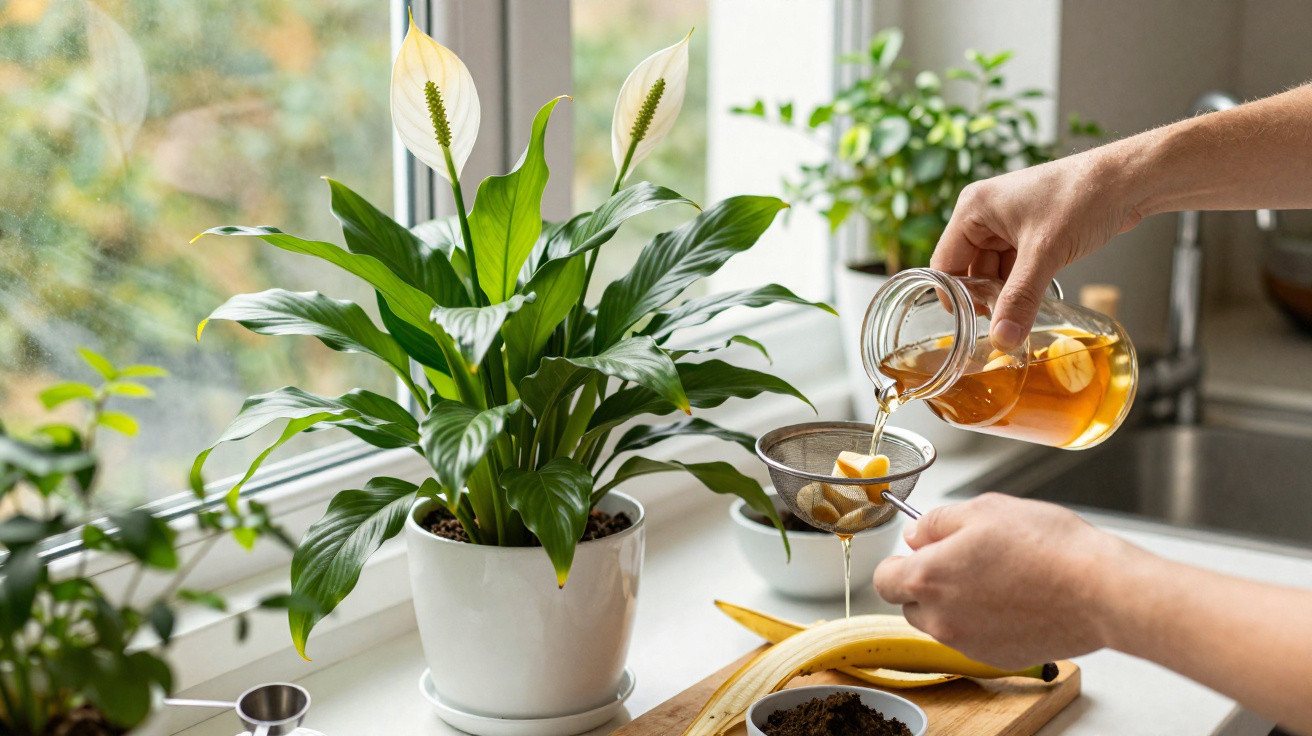
More and more indoor gardeners are swapping bottles of blue crystals for what is already in the fruit bowl. The claim is straightforward: a simple banana peel mixture can coax a tired peace lily into producing fresh white blooms-without harsh chemicals or fussy routines.
Why peace lilies stop flowering indoors
The peace lily (Spathiphyllum) is famous for two reasons: it copes with lower light, and it produces elegant white spathes that most people treat as flowers. Indoors, many owners only get the first benefit. The plant stays alive, but remains stubbornly leafy and green for months on end.
In most homes, peace lilies run into the same trio of quiet issues: light that is too dim, watering that is inconsistent, and nutrition that is lacking. Over time, shop-bought compost loses what it started with, and tap water contributes virtually no potassium or phosphorus. When those key elements are missing, the plant tends to invest in leaves rather than blooms.
"A peace lily will keep its leaves with minimal care, but it needs the right balance of light, moisture and potassium before it starts thinking about flowers."
Garden centres often plug this gap with synthetic bloom boosters. They can be effective, but misuse can scorch roots, they may affect indoor air quality if handled poorly, and they cost more than many casual houseplant owners want to pay.
The banana peel trend: from kitchen scrap to flower fuel
Across social media, peace lily owners have been promoting homemade “banana fertiliser” as a cheap, natural alternative. The approach turns up in quick videos, step-by-step posts and long forum threads where growers compare notes and share before-and-after results.
The principle is uncomplicated: banana peels contain potassium and other minerals, and soaking (lightly fermenting) them in water helps move those nutrients into a form that roots can take up as a liquid feed.
What banana peels actually provide
Banana skins are not a miracle cure. What they offer is a mild, slow nutrient source, with potassium as the standout. Laboratory testing has shown that dried banana peel can contain meaningful amounts of:
- Potassium (K): supports flower formation, disease resistance and water balance.
- Phosphorus (P): helps root growth and overall energy transfer.
- Calcium and magnesium: assist cell walls and leaf colour.
- Small traces of micronutrients such as iron and manganese.
For most houseplants, including peace lilies, nitrogen is usually available in basic compost and through occasional general feeding. Potassium is more likely to fall behind-and that shortage often becomes the limiting factor for flowering.
"For blooming plants, potassium acts like a green light: once levels rise, the plant feels safe to invest energy in flowers rather than just foliage."
How the banana fertiliser is made
The version widely shared by home gardeners uses only two ingredients-banana peels and water-and sits somewhere between a kitchen shortcut and simple fermentation.
Step-by-step method
Plant enthusiasts commonly use a routine much like this:
- Peel one or two ripe bananas and keep the skins.
- Snip the peels into small strips or squares with clean scissors.
- Put the pieces into a clean jar or bottle.
- Add water until the peels are covered, leaving a small air gap at the top.
- Fit the lid loosely and leave at room temperature for two to three days.
- Strain the liquid and bin or compost the softened peels.
- Dilute the darkened liquid with fresh water, typically to around 1:4.
During the short soaking period, microbes begin breaking down the peel. Minerals then leach from the peel into the surrounding water. What you end up with is a weak brown nutrient solution that roots can absorb relatively quickly.
"Roots take up dissolved nutrients far faster than they can mine big chunks of peel buried in the soil, which often rot before the plant can use them."
When and how to use it on a peace lily
Gardeners who swear by this method generally treat banana water as a gentle top-up rather than a complete fertilising plan. How often you use it-and when-matters just as much as the recipe.
Practical application tips
- In spring and summer, use the diluted liquid in place of plain water every two weeks.
- Apply it to the compost, not the leaves or blooms, to reduce the risk of mould and spotting.
- Stop once you see excess liquid draining from the pot’s holes.
- Miss a feed if the compost is already very wet or has a sour smell.
Peace lilies like compost that stays evenly moist, but they struggle in pots that remain waterlogged. Too much liquid-even mineral-rich liquid-can deprive roots of oxygen when drainage is poor. With a consistent routine (light feeding, steady moisture, and bright but indirect light), many plants respond within a few weeks by pushing up fresh white bracts.
Banana brew versus chemical fertiliser
For many people, this choice is about more than the number of blooms. Risk, cost and sustainability all influence what seems sensible on a typical windowsill. Here is how the two approaches are often compared.
| Factor | Banana peel solution | Chemical fertiliser |
|---|---|---|
| Cost | Uses kitchen scraps; nearly free | Needs regular purchases; can be pricey |
| Risk of root burn | Low, because concentration stays mild | Higher if dosing or dilution goes wrong |
| Environmental impact | Reuses waste; minimal packaging | Relies on industrial production and transport |
| Predictability | Variable nutrient content | Labelled N‑P‑K values and trace elements |
Commercial growers still tend to use formulated feeds where accuracy and repeatability are essential. In the average living room, though, many owners prefer the wider safety margin and reduced waste of kitchen-based feeding, even if it means results are slower or harder to measure.
Conditions that boost the effect of the banana trick
No fertiliser-homemade or shop-bought-can make up for poor fundamentals. Reports of dramatic flowering after banana feeds nearly always come with improved day-to-day conditions as well.
Peace lilies do best when a handful of basics are consistently met:
- Light: bright, indirect light near a window; avoid harsh midday sun on the leaves.
- Temperature: steady indoor conditions between 18°C and 26°C, with minimal cold draughts.
- Humidity: slightly humid air, especially in heated or air-conditioned rooms.
- Soil: a loose, peat-based or coco-based mix that drains well.
- Pot size: a snug pot; oversized containers tend to stay too wet.
"The banana solution functions as a nudge, not a miracle: once light, moisture and temperature sit in the right range, the extra potassium often tips the balance toward flowering."
What science says – and what remains anecdotal
Horticultural research does support the importance of potassium for flowering plants, including Spathiphyllum. However, studies that specifically test banana peel fertiliser for indoor use are uncommon. Most evidence for the trend comes from home growers’ observations rather than controlled experiments.
Researchers also point to both benefits and limitations. Banana peels do contain useful nutrients, but the levels vary depending on the banana variety, how ripe it is, and how the peel is prepared. Fermentation time can also shift what ends up in the liquid.
If you prefer clear labels and exact dosing guidance, that variability may feel like a drawback. For many houseplant owners, the low cost and low risk are enough to make the trade-off worthwhile.
Risks, side-effects and how to avoid them
Even a mild homemade feed can cause minor problems. If banana solution is stored for too long it can keep fermenting, producing strong odours and potentially leaving organic residues in the pot. That build-up may encourage fungus gnats-tiny flies that hover around damp compost.
Keeping fermentation brief, diluting properly and occasionally flushing the pot with plain water helps minimise these issues. Some gardeners avoid storage altogether by making small batches-only enough for a watering or two-so nothing sits around.
There is also the risk of misreading symptoms. Yellowing or fading leaves may be due to low light, root rot or pests rather than a potassium shortage. Relying on banana water alone can delay finding the real cause.
Beyond bananas: other kitchen scraps peace lilies can use
The banana peel trend is part of a wider move towards DIY houseplant care. Tips involving coffee grounds, eggshells and vegetable scraps circulate widely online, with mixed results. For peace lilies, only a few of these ideas translate into practical, repeatable habits.
- Crushed eggshells provide calcium very slowly and are best mixed into fresh compost rather than sprinkled on the surface.
- Used coffee grounds can make compost more acidic and compact if applied heavily; small, thoroughly dried amounts are only suitable for larger pots.
- A weak compost tea, made from well-rotted garden compost, can add a broader nutrient profile to complement banana feeds.
Growers who experiment with these approaches often get the best outcomes when they treat kitchen scraps as occasional supplements, not constant additions. Peace lilies evolved under the filtered light of tropical forest floors, where nutrients arrive gradually rather than in heavy, concentrated doses.
For anyone trying to get a peace lily blooming again, banana peel water is a low-stakes test: a jar, a couple of peels, a few days, and a closer eye on the next round of growth. This plant may look quiet, but it communicates clearly-through stronger stems, fresher foliage and, if conditions are right, the return of those white flags that signal it is thriving again.


Comments
No comments yet. Be the first to comment!
Leave a Comment