
The first warm day arrives, you glance out at the garden, and your fingers start itching: tradition and instinct say it is time to turn the soil in the vegetable garden. Yet what was treated as a springtime ritual for decades is now increasingly questioned. If you look more closely, it becomes clear that soil is not lifeless dirt, but a delicate ecosystem - and the classic, thorough dig puts that system under real strain.
Why intensive digging harms the soil more than it helps
In the top 20 centimetres of healthy soil, life is everywhere. A single gram of earth is thought to contain between 100 million and 1 billion bacteria, alongside fungi, nematodes, tiny arthropods and earthworms. Together, they form a tightly connected system that stores water, unlocks nutrients and protects plant roots.
When you fully turn this zone over with a spade, you disrupt that structure on a large scale. Each soil layer has its own “tenants”, each with specific needs for oxygen, moisture and light. Microorganisms that live deep down in darkness and with little oxygen are suddenly brought to the surface into the light - and die. Meanwhile, organisms that rely on light and oxygen end up deeper down, where they have little chance of survival.
"With vigorous digging, there is a massive collapse in soil life - exactly at the moment when the beds should really be preparing for the new season."
There is another consequence many people underestimate: digging tears apart the fine fungal threads of mycorrhizal fungi. These filaments act like an extension of plant roots. They access nutrients and water that roots could not reach on their own. If you flip everything over each spring, you repeatedly remove this natural “service” from your vegetables.
What experienced gardeners understood intuitively
Even in the past, skilled gardeners often handled soil more gently than many guides suggest today. Compacted patches were loosened, but not every bed was completely turned every single year. People talked about letting the soil “rest” or “not disturbing it too much”. At heart, those observations reflect modern soil science - even if nobody back then threw around figures about microbes and fungal networks.
The key message is simple: the less you scramble soil life, the more stable and fertile the ground remains. Plants become tougher, need less fertiliser, and cope better through dry spells.
The Grelinette: loosen, don’t turn
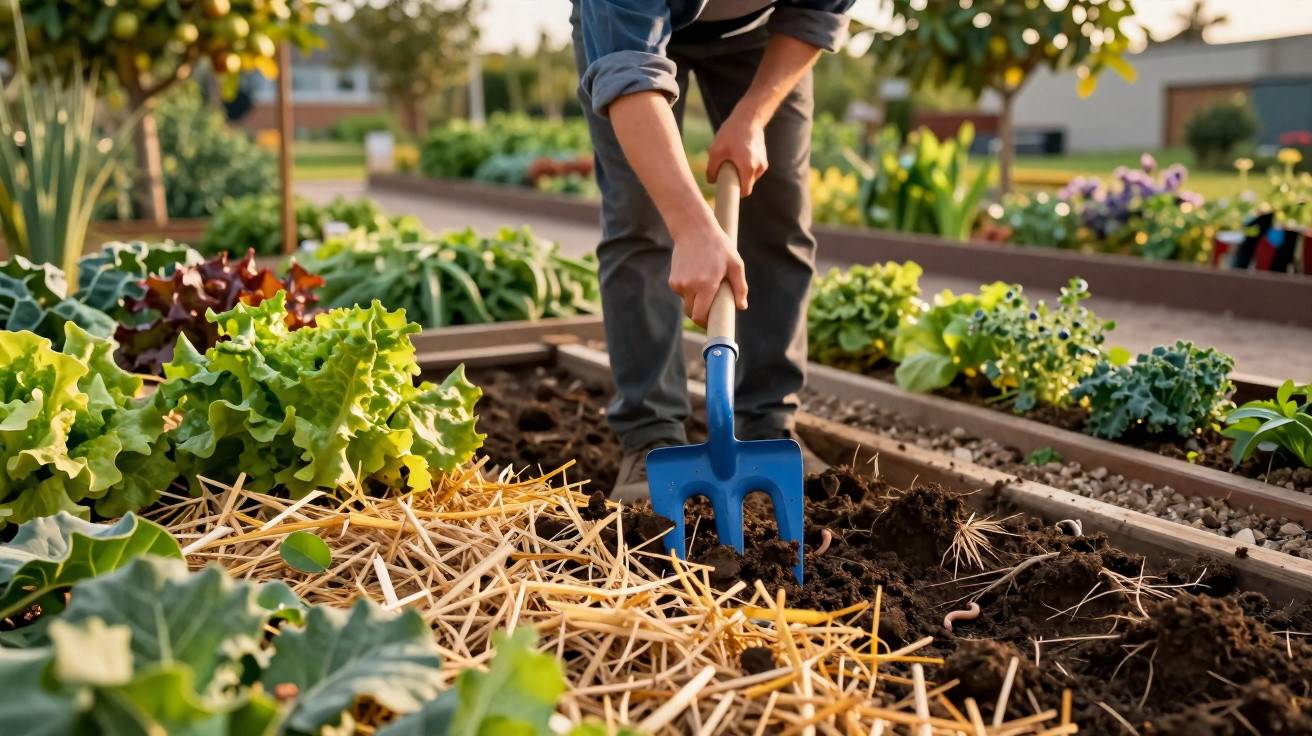
One tool fits this newer - and older - way of thinking perfectly: the Grelinette, often called a double digging fork or bio fork in the UK. It has two or more sturdy tines and a crossbar handle. You push it vertically into the ground, tip the handle slightly backwards, and lift the soil to open it up without flipping it over.
This leads to several benefits:
- Compaction is relieved, so water and air can move through more easily.
- Soil layers largely stay in their original positions.
- Soil organisms are less often torn out of their habitat.
- Roots of perennial plants are less likely to be damaged.
For older gardeners in particular, there is another clear advantage: it is kinder on the back. Instead of heavy shovelling, you work mainly with body weight and a levering motion. That takes noticeable pressure off the lower back and makes longer sessions possible without paying for it the next day.
A Grelinette works best when the ground is slightly damp. If the soil is bone-dry, the job becomes hard work and the tines can be damaged. If it is soaking wet, everything sticks together and compacts again the next time you walk on it. The sweet spot is usually 1–2 days after a decent spring downpour.
Mulch: the quiet revolution in the vegetable garden
While the Grelinette takes care of gentle loosening, a second method supports long-term soil care: mulching. This means covering bare soil with organic material - for example straw, shredded leaves, dried grass clippings or wood chips.
"Mulch imitates the forest floor: the soil is never left naked, but is constantly covered with plant material that protects it and feeds it slowly."
This straightforward layer offers several advantages at once:
- Moisture stays in the soil for longer, so you can extend watering intervals significantly.
- Soil temperature fluctuates less, which keeps soil life more stable.
- Weed seedlings get far less light, making it much harder for them.
- Rain does not hit the surface directly, so a hard crust forms less often.
- The material breaks down gradually and is turned into fertile soil by earthworms and microbes.
For anyone who no longer wants to be bent over the beds every day, mulching is almost a secret weapon: fewer trips with the watering can, less crouching for weeding, and less hoeing after every shower. The garden still looks well tended, even though you are doing less work in practice.
How invisible soil life makes plants stronger
Many gardening guides focus almost entirely on NPK - nitrogen, phosphorus and potassium. Modern soil science, however, puts the spotlight on the partnership between roots, bacteria, fungi and small soil creatures. Plants release sugary solutions from their roots into the ground. In effect, they “feed” microorganisms, which then help make nutrients available in return.
A few examples:
- Nitrogen-fixing bacteria make atmospheric nitrogen usable for plants.
- Fungi multiply the effective reach of roots, which is especially helpful during dry periods.
- Earthworms pull mulch into the soil, shred it, and leave behind nutrient-rich worm castings.
This network is sensitive to heavy disturbance. If you dig deeply every year, you force microorganisms to start over again and again. If, instead, you loosen the soil, mulch, and use well-rotted compost, you gradually build a stable soil habitat. Such soils crust over less, stay crumbly for longer, and support harvests that appear less prone to disease.
Practical switch: what to do instead of a spade marathon
Nobody has to abandon every habit overnight. A gradual change usually works better - and keeps motivation up over time. One possible plan for the coming season looks like this:
| Spring | Action |
|---|---|
| March/April | Loosen beds with a Grelinette, without turning clods over. |
| Immediately afterwards | Spread a 3–5 cm layer of mature compost on the surface. |
| After planting | Cover bare spaces between rows with mulch material. |
| Summer | Top up mulch when it has visibly rotted down. |
| Autumn | Mulch cleared beds straight away again, or sow a green manure cover crop. |
With extremely heavy, compacted or long-neglected soils, a one-off deep intervention may be necessary at the start - for example with a spade or digging fork. That step should be done deliberately, as the starting signal for a permanently gentler approach. If you then use compost and mulch each year, you will notice the soil slowly improving its structure on its own.
Common spring mistakes - and how to avoid them
Many problems in the vegetable garden are not caused by “bad soil”, but by unsuitable cultivation. Three classics:
- Working too early on wet ground: footprints and spade marks squeeze the soil together and close up pores. Wait until the soil feels mouldable when pressed, but not sloppy or smeary.
- Leaving bare soil in the sun: wind and sun dry out the surface, and rain can wash fine particles down into a sealed layer. Even a thin layer of mulch helps, including before planting.
- Digging to the same depth every year: repeatedly turning soil at an identical depth can create a compacted “plough pan” just below the worked zone. Loosening with a Grelinette breaks through this layer in a gentler way.
Why a gentler approach to soil is worth it
Those who make the change usually notice a clear difference after a few years: beds become easier to work, earthworms become far more numerous, the soil smells pleasant and crumbles in the hand. Plants tend to show sturdier growth, and dry spells cause less damage.
There is another benefit, too: digging less deeply does not only save physical effort. It also reduces the need for synthetic fertiliser and peat-based bags from the DIY shop. The garden becomes more self-reliant, with many nutrients coming directly from compost, mulch and what the soil can mobilise itself.
If you are curious, try a small test bed: work one patch as usual with a spade, and a second using a Grelinette, compost and mulch. After one season, it is often very clear which system performs better - not in theory, but right outside your own back door.
Comments
No comments yet. Be the first to comment!
Leave a Comment