
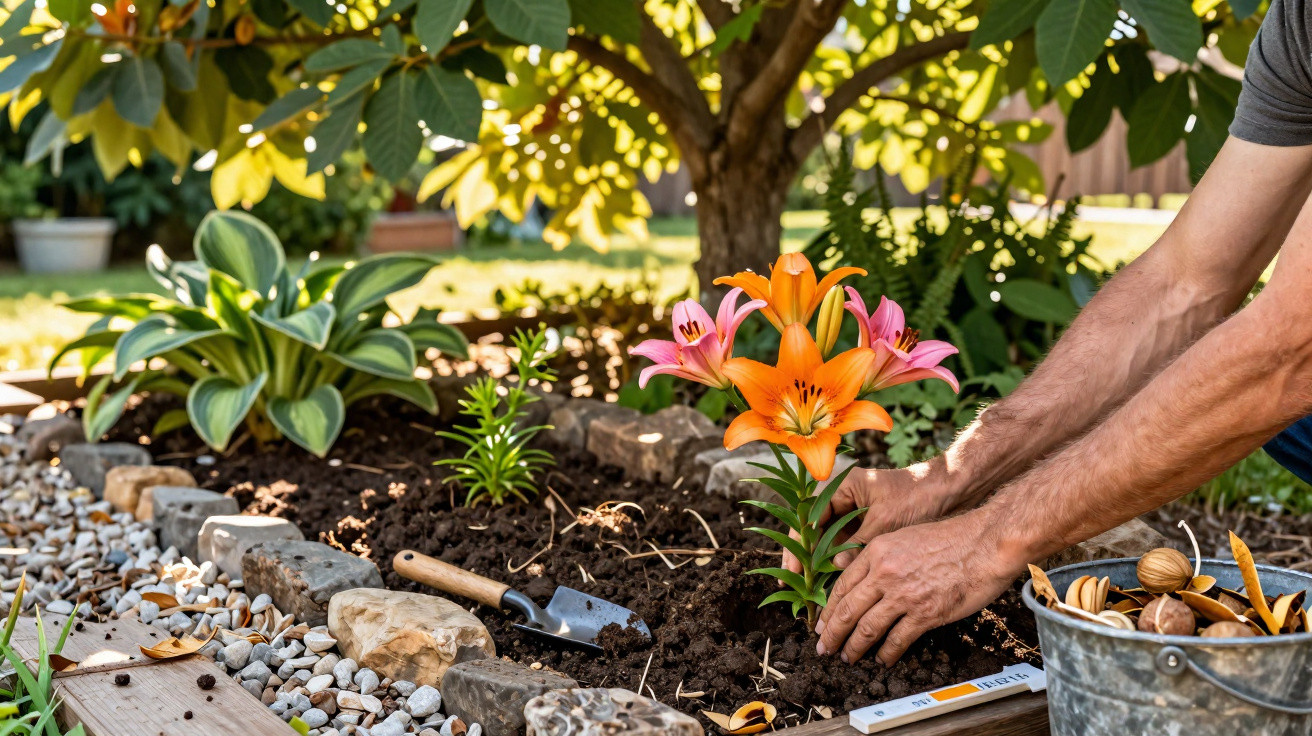
Many keen gardeners notice the same puzzle: beneath and beside walnut trees, very little grows the way it should. The black walnut in particular has a reputation as a real “plant bully”. If you’re fond of Asian lilies, it’s natural to wonder whether these elegant summer flowers stand any chance nearby - or whether the tree will slowly poison them.
What juglone really is - and why the walnut tree becomes a difficult neighbour
Walnut trees - especially black walnut, butternut and English walnut - often dictate their own terms in a garden. They produce juglone, a naturally occurring plant chemical that can weaken many other species or kill them outright.
Juglone is present in almost every part of the tree: the roots, bark, leaves and the green outer husks of the nuts. Rain carries the substance into the soil, while fallen leaves and husks release more as they break down.
“Around a mature walnut tree, an invisible ‘poison zone’ often forms, which depending on the site can extend 15 to 25 metres into the garden.”
Within this zone, sensitive plants can show clear stress symptoms: they may wilt within one to two days, leaves can yellow, growth may stall and, in severe cases, plants die. Heavy, poorly drained clay soils make matters worse because they hold on to juglone for longer.
Which plants suffer most - and which cope well
Vegetables in the nightshade family are among the most sensitive: tomatoes, peppers and potatoes can decline markedly under walnut trees. Rhododendrons, azaleas and many heather-family plants also tolerate juglone poorly.
Other plants manage far better. Many bulb flowers, tough perennials and various woodland plants remain surprisingly healthy year after year within the root zone of older walnut trees. Researchers infer from this that some species have developed their own defences or workarounds against juglone.
Are Asian lilies juglone-tolerant?
For lily enthusiasts, the key question is simple: do Asian lilies collapse under the walnut tree’s chemical pressure, or can they hold their own?
“Several horticultural advisory services classify Asian lilies as ‘moderately to well juglone-tolerant’. That places them firmly among the more resilient ornamental plants in walnut shade.”
In real-world garden observations, Asian lilies often prove unexpectedly steady. With the right conditions, they can even flower quite well under the tree’s drip line - the area where rainwater runs off the canopy and hits the ground.
The explanation seems to lie in their physiology: the cells of Asian lilies appear to experience less disruption to their energy metabolism when juglone enters the root zone. As a result, they are far less likely to wilt suddenly, and they generally do not simply die back without warning.
Limits of tolerance
That said, Asian lilies sometimes pay a price. Compared directly with plants grown in beds free of juglone, they can occasionally look:
- slightly shorter
- with fewer shoots per bulb
- with smaller blooms, or flowers that are a bit less plentiful
So they usually survive, but they do not always reach peak performance. This is especially true in heavy, poorly draining soils or where thick layers of walnut leaves are left to rot slowly in the bed.
How different lilies handle juglone
If you already have a walnut tree to contend with, it helps to compare lily groups before you plan a planting scheme.
| Lily type | Assessment of juglone tolerance | Recommended planting area near a walnut tree |
|---|---|---|
| Asian hybrids | Moderate to good | Feasible within roughly 15–25 metres |
| Oriental lilies | Medium | Better towards the outer edge with good drainage |
| Trumpet lilies | Medium | Preferably at the edge of the influence zone |
| Species (wild types) | Variable, often good | Usually fine with some distance from the trunk |
If you want to be especially cautious, start with a few trial plants before investing in a whole bed of costly bulbs.
How to plant Asian lilies successfully beside walnut trees
With a little planning, you can reduce the risks considerably. The biggest lever you can pull is the soil.
Drainage as a shield
Juglone causes the most trouble when it lingers in soil water. In well-drained, more sandy or humus-rich soils, the compound is washed through or diluted more quickly.
- Before planting, dig a test hole (about 30 cm deep), fill it with water and check how quickly it drains.
- If there is still water in the hole after 24 hours, the spot needs significant soil improvement.
- Compost and well-rotted manure open up the soil, stimulate soil life and may help juglone break down faster.
- Raised beds or slightly mounded planting ridges lift lily roots away from the most concentrated part of the “poison zone”.
Asian lily bulbs are ideally planted at a depth of about 15–20 centimetres. This keeps them protected while still allowing easy access to moisture and nutrients.
Keeping the bed tidy around the walnut tree
Anything that drops from the tree increases the local juglone load around the lilies. If you want to reduce exposure, be consistent:
- Collect walnut leaves, nut husks and small twigs regularly and do not let them decompose in the lily bed.
- Apply 5–7 cm mulch layers using bark mulch or shredded, juglone-free material.
- Renew the mulch annually so it stays open-textured rather than forming a dense, waterlogged mat.
- During dry spells, water deeply but not every day - less frequent, thorough watering helps dilute juglone.
“A well-maintained mulch and compost system can act like a biological filter in the lilies’ root area.”
Which plants make good neighbours for Asian lilies under walnuts
A bed made up solely of lilies can look spectacular, but it may respond more sharply to stress. Mixed planting tends to be more resilient. Around a walnut tree, robust species with juglone tolerance are the best choice.
Proven companions for Asian lilies include, for example:
- hostas for shade and part-shade
- astilbes with their airy flower plumes
- ferns to visually soften the root area
- many spring bulbs such as daffodils or crocuses
These combinations keep the planting structured through the whole season and cushion the display if a few plants fail. If a lily is lost, the bed does not end up with an obvious gap.
Long-term care: when Asian lilies need support
Even tolerant plants like Asian lilies can slip into chronic stress if juglone, nutrient shortage and drought occur together. If you watch your plants over several years, early warning signs are easier to spot:
- shoots become slightly shorter each year
- the number of flowers drops noticeably
- leaves show yellow patches or remain pale overall
In these cases, it’s worth checking soil pH and nutrient levels. A lack of potassium or nitrogen can resemble mild juglone stress and reduce resilience. A balanced, not over-strong general fertiliser in spring can help steady the plants.
Coping better with seasonal juglone peaks
Juglone levels in soil fluctuate through the year. Two periods are especially critical: the walnut’s strong growth phase in early summer, and the leaf-fall period in autumn. During these weeks, particularly large amounts of material enter the soil.
If you are planting new Asian lilies, it’s better to schedule the job for early spring or for a quieter spell in late autumn, once most leaves have already been cleared away. That way, the bulbs can establish in a relatively calmer environment.
What gardeners can learn from this - a thought experiment
Imagine two neighbouring gardens, both with an old black walnut on the boundary fence. On one side, the owner plants Asian lilies close to the trunk, leaves the fallen foliage in place, waters only rarely and has heavy clay soil. On the other side, the neighbour uses raised beds, removes fallen leaves diligently, improves the soil with compost and relies on sturdy companion plants.
In the first garden, each lily struggles to survive and may disappear after two or three years. In the second garden, stable clumps gradually form - not quite as lush as in a perfect ornamental border, but reliably flowering year after year, turning the walnut tree into an interesting feature rather than a persistent problem.
From this comes a practical answer to the original question: Asian lilies are not indestructible, but they are among the few refined bulb plants that cope with juglone surprisingly well - provided gardeners support them with smart soil care, sensible placement and attentive observation.






Comments
No comments yet. Be the first to comment!
Leave a Comment