
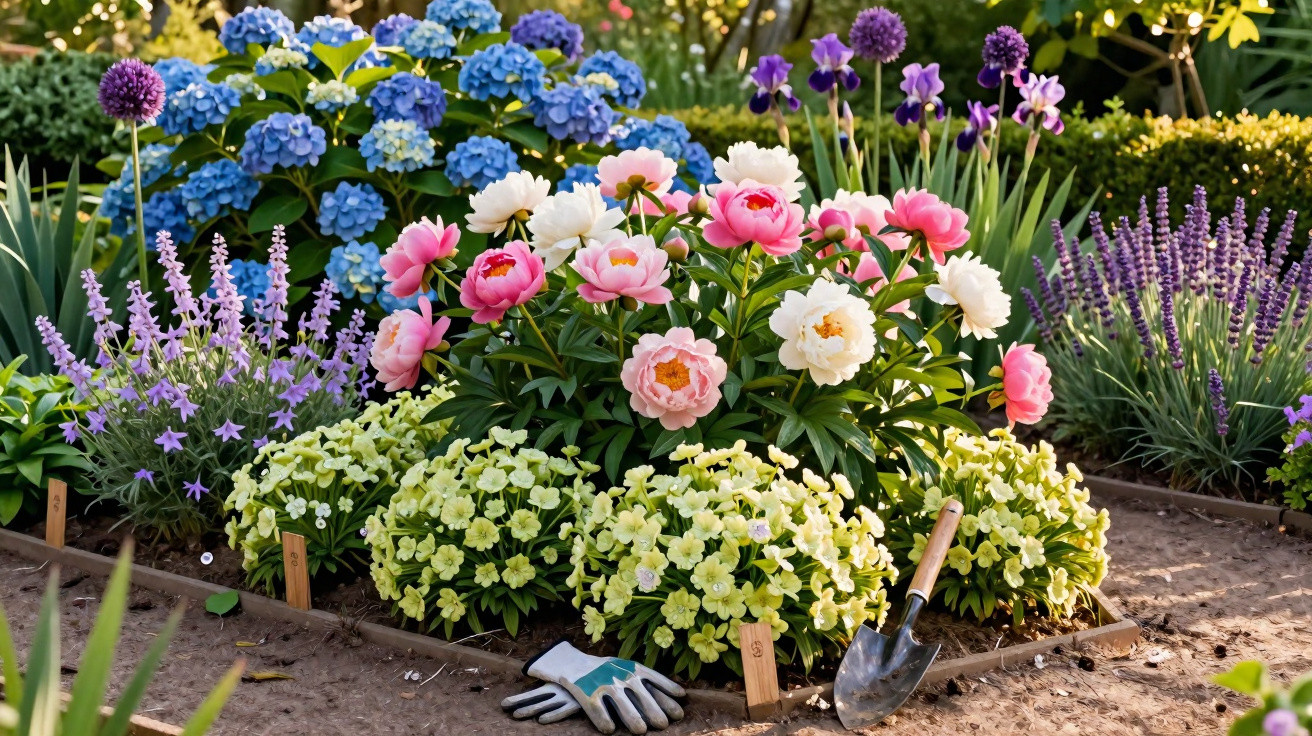
Many amateur gardeners plant peonies on their own in a border and then wonder why the big wow factor never quite arrives. The perennials are striking in their own right, but they only look truly spectacular with the right companion plants - and with plenty of breathing space around each clump. Follow a few basic rules and you can create a border that looks like a painted scene from spring right through to mid-summer.
What peonies really need before you add neighbours
Peonies are among the most long-lived perennials you can grow. They often stay in the same spot for decades without being lifted or moved, which is exactly why it pays to think carefully about both the position and the plants you set alongside them.
"Peonies love sun, deep, nutrient-rich soil and, above all, distance from pushy neighbours."
At a glance, these are the key growing requirements:
- Light: full sun to light partial shade; ideally at least 5–6 hours of direct sun per day.
- Soil: deep, humus-rich and free-draining; not persistently waterlogged in winter.
- Root competition: avoid placing strong shallow-rooted plants or woody shrubs right next to them.
- Spacing: each plant needs a clear area so the foliage can dry quickly after rain.
When a border is planted too tightly, moisture lingers. Fungal problems such as grey mould (Botrytis) can spread and ruin whole flushes of bloom. In other words, an airy planting scheme isn’t just a design choice - it’s practical plant protection.
Lady’s mantle and bellflowers: a gentle stage for big blooms
Once the fundamentals are sorted, you can start designing. Some perennials make peonies look even more lavish without competing for attention.
Lady’s mantle as a soft carpet
Lady’s mantle (Alchemilla mollis) is a classic companion. It forms dense but low mounds of pleated leaves, topped in early summer with a misty haze of yellow-green flowers.
This pairing offers several benefits:
- The delicate flower froth highlights soft pink and creamy peony shades.
- It stays low and doesn’t crowd the peony clumps.
- Cut stems work brilliantly as a filler in peony bouquets.
Bellflowers for playful contrast
Compact bellflower varieties (Campanula) sit well with peonies. Their nodding or upright bells add lightness to the planting, and they usually flower slightly later - extending the period when the border looks its best.
Spacing still matters: if bellflowers are planted right into the peony crown, they reduce both light and airflow. Leaving a small gap of 20–30 centimetres helps keep both plants healthy.
Hydrangeas and bulbs: colour behind and throughout the season
Hydrangeas as a calm backdrop
Behind taller herbaceous peonies, hydrangeas can work beautifully. Their rounded flowerheads echo the peony shape, but they come into their own a little later, creating a natural handover effect as summer progresses.
To make the combination work, keep these points in mind:
- Don’t plant hydrangeas too close behind peonies, otherwise they’ll cast too much shade.
- Choose varieties that tolerate sun and cope with normal garden soil.
- With larger shrubs, position them slightly to the side to maintain good air circulation through the border.
Iris, alliums and daylilies: timing the display
With a bit of planning, you can create a border that flowers almost continuously:
| Plant | Typical flowering time | Role in a peony border |
|---|---|---|
| Bearded iris | Early to mid spring | Opens the season before peonies properly get going |
| Peonies | Late April to June (depending on variety) | The main event: big, showy individual blooms |
| Allium | Late spring to early summer | Spherical accents among peonies; also acts as a protective companion |
| Daylilies | Mid-summer | Take over as peonies finish and the foliage starts to fade |
This sequencing keeps the planting interesting for months, rather than looking good for only a short window.
Lavender as a fragrant protective barrier
Lavender is far more than a holiday-scent plant for a Mediterranean-style garden. Its preferences align neatly with peonies: lots of sun, free-draining soil and no standing water.
"Lavender around peonies works like a natural protective belt: lovely to look at and unpleasant for many pests."
Its strong fragrance deters a range of unwanted visitors, for example:
- mosquitoes
- flies
- fleas
- moths
- deer, which tend to avoid moving through strongly scented areas
Combine lavender with alliums and you get a double benefit. Ornamental alliums bring striking purple or white globe flowers, while their onion-like scent is disliked by many insects. Together, they form an almost invisible defensive ring around a peony border.
Which planting partners are better kept at a distance
Not every plant that looks as though it would match is suitable as a close neighbour. Vigorous species in particular can quite literally rob peonies of air.
These are commonly problematic:
- tall ornamental grasses with strong root systems planted right against the clump,
- perennials that prefer consistently wet soil,
- very wide-growing shrubs set in the immediate vicinity.
Plants like these increase dampness around the peonies and push them into shade. If you enjoy bog plants or moisture-loving perennials, it’s better to place them in a separate part of the garden or with a clear divide, such as a path or a wall.
Practical tips for a peony border that stays stable long-term
Plan generous spacing from the start
Peonies can look surprisingly small when first planted, which leads many people to pack the gaps with other perennials. It’s wiser to design for the mature size: a well-established clump can reach around 80 centimetres across.
A tried-and-tested layout:
- Place the peony clump in the middle of the bed.
- Plant lower companions such as lady’s mantle or bellflowers at 40–60 centimetres distance.
- Set lavender, ornamental alliums and (if desired) small shrubs further out again.
Soil care without stressing the plants
Because peonies are best left undisturbed, the soil around them should be disrupted as little as possible. Deep digging close to the crown weakens the plant. A gentler approach works better:
- In spring, add a little well-rotted compost around the plant, but don’t dig it in.
- Remove weeds carefully by hand; avoid hoeing right up to the crown.
- Spread a thin mulch of fine material (for example, lawn clippings after they’ve dried off slightly) over bare soil, without smothering the root area.
Additional ideas for plant combinations and extra benefits
If you want to think beyond appearance and support pollinators too, you can add bee-friendly perennials between peonies and lavender: catmint, sage or coneflower will draw in honeybees and bumblebees in large numbers. The border then becomes not only spectacular for people, but also an important feeding spot in the garden.
It’s also worth planning for how to handle the fading foliage. As summer goes on, peonies gradually retreat. Daylilies, cranesbill geraniums or low perennial phlox planted in front can neatly disguise browning leaves. The border stays tidy and well kept, without constant cutting back.
If you’re planning a new garden or refreshing an older border, you’ll save yourself a lot of effort by building these principles in from the start: plenty of sun, airy planting distances, warm-and-dry companions such as lavender, and decorative protective plants such as alliums. With that in place, a few peony clumps can become a near-overflowing focal point year after year - without any complicated care routines.

Comments
No comments yet. Be the first to comment!
Leave a Comment