
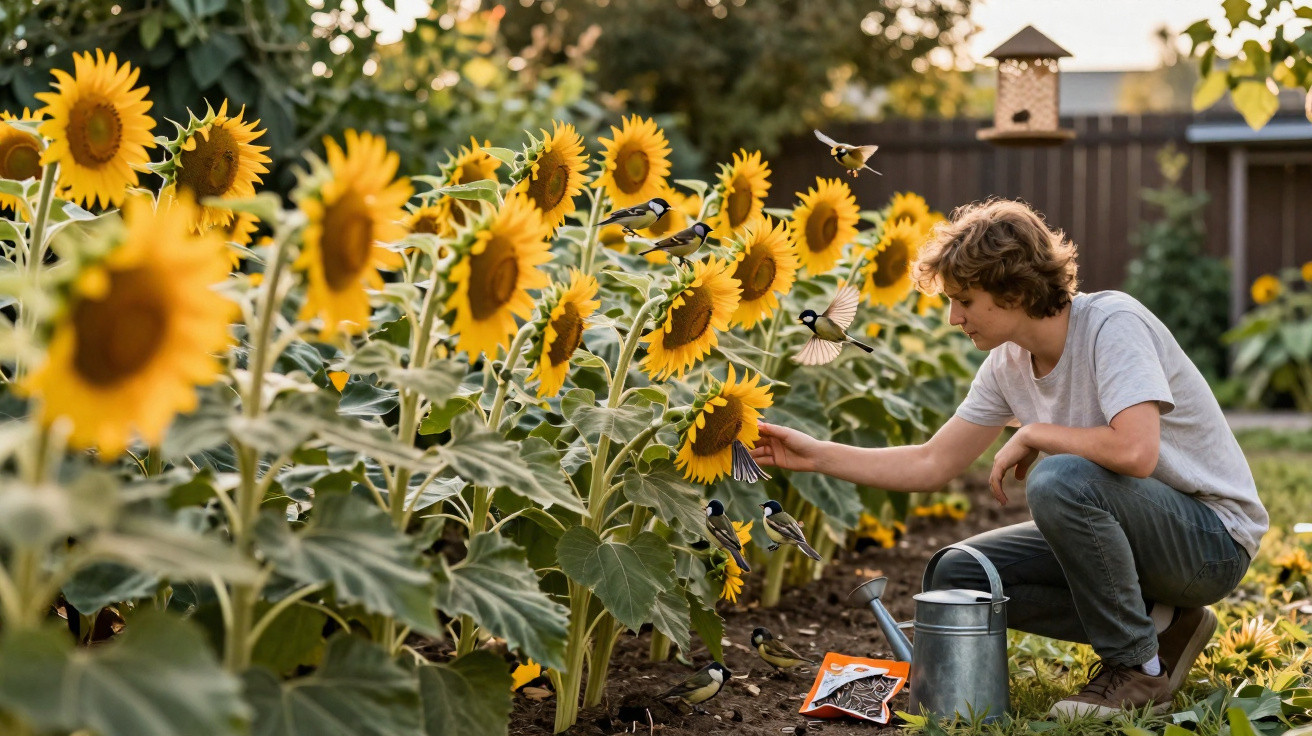
Many amateur gardeners spend money every year on new bird feeders, special seed mixes and stylish designs from the garden centre. Even so, feathered visitors often fail to appear-or only drop in briefly. The real secret is usually not the accessories but what you grow: one particular flower provides plentiful food, a safe landing spot and shelter, without constant topping up.
Why real plants often beat feeding stations
A traditional bird table looks practical at first glance. Food is kept in one place, it is easy to monitor, and everything is in clear view. In reality, that concentration can cause problems. When lots of birds feed in a tight space, the risk of passing on disease rises. If you feed this way, you need to clean regularly and remove old leftovers-otherwise it quickly becomes a hygiene issue.
Wild birds take their cues from natural structures. Dense shrubs, seed heads and faded perennials feel far more familiar than plastic and metal. They provide cover from birds of prey, gentle transitions between food and hiding places, and-crucially-the soundscape birds recognise: rustling leaves, moving stems, swaying seed heads.
Living plants provide food, shelter and perches in one-and they feel far more “real” to birds than any feeding station.
In a wildlife-friendly garden, birds spread out across many small feeding points. That reduces stress, lowers squabbling over territory and makes the whole space more appealing. By choosing plants, you are creating not just a buffet, but a complete micro-ecosystem.
The quiet star: sunflowers as natural bird feeders
Among classic garden plants, one stands out: the sunflower. In summer it looks like pure decoration, but after flowering it reveals itself as a high-performance bird feeder. The large flower head dries, the seeds remain neatly held in the sturdy structure, and they stay well protected even after heavy rain.
For many birds, the dried head is an ideal landing platform. It is stable, non-slip and easy to scan. Blackcaps and tits clamber along the edges, while goldfinches work their way deep into the centre. Whatever drops to the ground is picked up by finches, sparrows or even mice and hedgehogs-so the whole food chain benefits.
Mini energy packs
Sunflower seeds are compact calorie boosters. They are rich in fat and protein, providing exactly what birds urgently need in winter. A single flower head can hold hundreds to thousands of seeds. For your feathered guests, that means a big return with relatively little searching.
Varieties with black seeds are especially valuable. They contain more oil than striped types and are preferred by many species. Great tits, blue tits, nuthatches and bullfinches can strip them quickly because they want maximum energy for minimal effort-vital on bitterly cold nights.
Who visits the sunflower bar?
If you consistently leave sunflowers standing in the garden, you will soon notice a jump in the number of species. Common visitors include:
- Tit species such as great tit, blue tit and coal tit
- Goldfinches, skilfully pecking deep from the hollows
- Greenfinches and chaffinches, collecting seeds that fall to the ground
- House sparrows and tree sparrows, arriving in groups
- Woodpigeons or turtle doves, waiting beneath the tall stems
Around a small cluster of sunflowers, you often get a real “multi-storey canteen”. At the top, the acrobats cling to the flower head; in the middle, birds briefly perch on the stems; below, ground-feeders rummage through leaves and soil for fallen seeds.
Just five to ten sunflowers are enough to turn a quiet bed into a lively meeting point for many different bird species.
Sowing sunflowers properly: how to get the most for birds
Sunflowers are considered easy-going, provided you give them a sunny position. A moderately fertile, well-loosened soil is already sufficient. Sowing starts after the last night frosts, usually from April or early May.
Step by step to a bird-friendly haven
- Sowing time: after the last frosts in spring
- Spacing: about 20–30 cm between plants; 30–50 cm between rows for tall varieties
- Sowing depth: roughly 2–3 cm
- Watering: keep lightly moist for the first two to three weeks; after that, rainfall is usually enough
- Feeding: not necessary in most gardens, as long as the spot is sunny and the soil is not completely exhausted
If you sow in two rounds-around two to three weeks apart-you will stagger flowering and ripening. The result is a longer flowering period in summer and, more importantly, seed heads that mature over weeks in autumn and winter.
The most important trick: simply leave them standing
The most common mistake is cutting sunflowers down after flowering because they “no longer look pretty”. For birds, that is when things get interesting. As soon as the yellow petals drop and the head turns brown, the plant becomes a fully fledged food source.
Leave the stems in place through winter-ideally right into spring-and you give wildlife months of food and resting perches. Even if some seeds remain unused, many other creatures benefit later on: insect larvae move into the hollow stems in spring, solitary bees use them as shelter, and spiders hunt within them.
A dried sunflower stem may look like garden waste to us-for birds and insects it is a home, larder and viewing platform all at once.
Ecological and financial gains at the same time
If you buy less bird food and sow sunflowers instead, you often save real money. A small packet of seed costs only a few pounds yet can easily yield several kilograms of seeds. If a few drop in the bed, nature may even handle part of next year’s sowing by itself.
At the same time, the workload falls: no weekly cleaning of feeders, no mould checks, no frustration with wet seed in a dispenser. Instead, a quick look at the bed is enough to see birds helping themselves.
Quick comparison: sunflowers versus a bird feeder
| Aspect | Sunflowers | Bird feeder |
|---|---|---|
| Food | Natural seeds, high fat content | Bought mixes, quality varies |
| Hygiene | Spread-out feeding points, lower disease risk | Many birds in one spot, cleaning required |
| Costs | Inexpensive seed, often self-seeding | Ongoing spend on food, possibly new feeders |
| Ecology | Supports insects, birds and soil life | Largely limited to birds, little added benefit |
What sunflowers mean for the whole garden
By leaving sunflowers standing, you support more than just birds-you help the garden’s wider wildlife. Their strong roots loosen the soil, the blooms draw huge numbers of bees and butterflies in summer, and the dry stems provide nesting and overwintering sites.
For children and adults alike, they create a direct connection to nature: from planting in spring, through growth, to the first tit landing on a dried flower head, you can observe a full yearly cycle. Many people report that this one simple plant gives them a completely new relationship with “their” garden.
If you are unsure, start small: one or two rows along a fence, a few plants in a sunny corner of the vegetable patch, or single specimens in a perennial border. By the first winter you will see whether birds take to it-and it is usually quicker than you expect.
It becomes particularly effective when combined with other seed heads. If thistles, asters or ornamental grasses are also left standing through winter, you create a colourful mosaic of feeding islands. Birds hop from plant to plant, find different seed shapes and structures, and stay in the garden for longer. With this approach, you often only need to top up with feeders occasionally-the majority of the work is then done by nature itself.
Comments
No comments yet. Be the first to comment!
Leave a Comment