
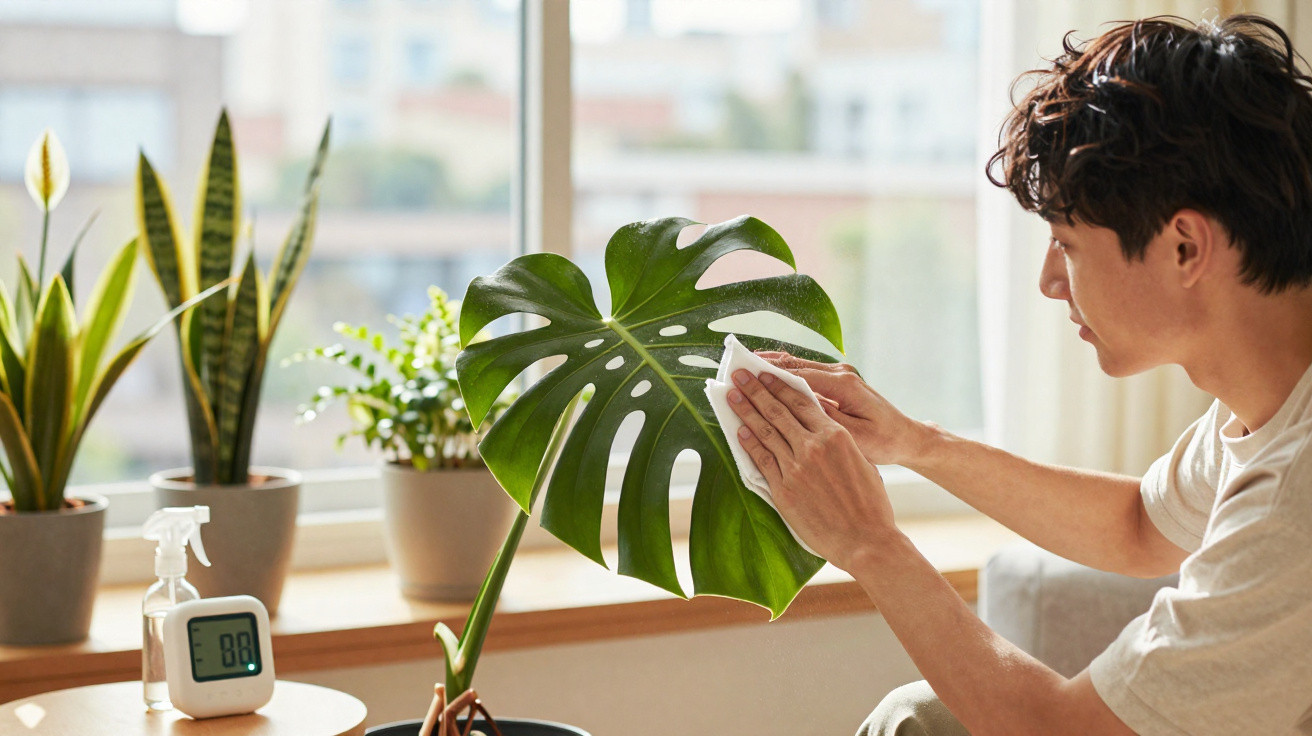
The Monstera deliciosa - usually shortened to Monstera and sometimes nicknamed the “window leaf” (Swiss cheese plant) - has become a staple in countless living rooms, offices and house shares. Its reputation is clear: urban, stylish and supposedly good for the air. There’s some truth behind that idea, although not nearly as much as many Instagram posts imply.
What a Monstera does to the air in your home
Like any green houseplant, a Monstera works through photosynthesis: it absorbs carbon dioxide and releases oxygen. Its large, split leaves also provide plenty of surface area for gas exchange.
"The Monstera noticeably improves the indoor climate - but it does not replace a filter-based air purifier."
There is another effect that many people only notice once they own several sizeable plants: through its leaves, a Monstera releases water into the air. This process, known as transpiration, increases humidity - a real advantage in dry, centrally heated flats or in a home office where a laptop is running all day.
What about pollutants in the air?
Since the well-known NASA study from the 1980s, houseplants have been viewed as natural air cleaners. Researchers looked at how plants in closed environments can break down certain airborne pollutants. Monstera was not the main focus of that study, but related species demonstrate what is possible in principle.
The key takeaway from more recent research is this: a Monstera can absorb volatile organic compounds (VOCs) such as formaldehyde to a limited extent, for example from furniture, paint or cleaning products. The effect can be measured, but it is far smaller than marketing claims often suggest.
| Pollutant | Effectiveness of Monstera | Note |
|---|---|---|
| Carbon dioxide | Moderate uptake | Active during the day via photosynthesis |
| Formaldehyde | Limited reduction | Several large plants needed for a noticeable effect |
| Dust particles | Good binding | Large leaves trap airborne dust |
| Benzene & similar | Low impact | Significantly weaker than well-known “filter plants” |
In a typical living room, a single Monstera will not “radically clean” the air. It is better understood as one element within a broader mix of ventilation, filtration and regular cleaning.
Monstera compared with true “air-purifier stars”
If you specifically want plants to act as natural filters, you quickly end up with species such as snake plant, devil’s ivy or spider plant. In studies, these repeatedly rank among the most effective options for breaking down certain pollutants.
"In the race for the strongest air-cleaning performance, Monstera isn’t in first place - it shines elsewhere."
While snake plant or devil’s ivy often process pollutants more efficiently, Monstera brings different advantages:
- it produces plenty of oxygen during the day,
- it measurably increases humidity,
- it captures a striking amount of dust thanks to its large leaves,
- it looks decorative and demonstrably improves wellbeing.
According to specialists, a noticeable effect on specific pollutants would require roughly two large plants per ten square metres. With a Monstera, that means several pots in the room rather than a single specimen - and the plants must be healthy and growing vigorously.
How to get the most out of your Monstera
For a plant to improve indoor air at all, it needs to be in good condition. A struggling Monstera with yellowing leaves contributes very little to the indoor climate. Good care therefore makes a direct difference.
Position, light and watering
Monstera originates from tropical forests in Central and South America. It prefers bright conditions without harsh direct sun, and it does best in warm temperatures away from draughts.
- Light: a bright spot with indirect sunlight; avoid hours of strong midday sun in a south-facing window
- Watering: only water once the top 2 centimetres of compost feels dry
- Humidity: around 60–80 percent is ideal; misting or placing bowls of water on radiators can help
- Fertiliser: in spring and summer, about once a month with a balanced liquid fertiliser
- Repotting: every two years into fresh substrate so roots and leaves can continue to grow
One point that is often overlooked: dust on the leaves blocks light and therefore reduces photosynthesis. Wiping the leaves regularly with a damp cloth immediately improves its oxygen production and humidity contribution.
Combine it with other plants
Rather than relying on a single large Monstera, a “plant team” can be more effective. Different species complement one another’s strengths. One possible living-room mix could look like this:
- 1–2 large Monsteras for oxygen, humidity and dust binding,
- 1 snake plant, which releases oxygen at night as well and is ideal for bedrooms,
- 1–2 devil’s ivy plants or spider plants, which have shown good results for certain pollutants in studies.
This combination is closer to the diversity of a natural environment and spreads the “jobs” across several plants - from managing humidity to reducing pollutants.
Realistic expectations for plants as air purifiers
If you live in a city flat on a busy road, or in a new build with lots of off-gassing from furniture and paint, houseplants alone will not be enough. Mechanical systems with a HEPA filter, regular burst ventilation and dusting reduce exposure far more effectively than any single plant.
"Plants are one building block for a better indoor climate - not a miracle cure for bad air."
Monstera’s biggest strengths lie elsewhere: people tend to feel more relaxed, focused and creative around greenery. Studies show lower stress levels and improved mood in planted spaces. With its large, tropical silhouette, a Monstera can feel almost like living furniture - and it noticeably changes how a room feels.
Risks, limitations and sensible everyday use
Despite the benefits, it’s worth considering potential risks. Monstera leaves and sap are mildly toxic. Small children and pets should not chew them. In most households, placing it out of direct reach is sufficient.
If your home is prone to mould, keep an eye on the additional humidity. Too many large plants in a poorly ventilated room can push moisture levels too high. A hygrometer makes it easy to monitor.
In day-to-day life, Monstera fits best as:
- a bold focal point in a living room or workspace,
- a natural humidifier in winter,
- a complement to other plants that filter more strongly,
- a nudge to pay more attention to indoor climate and ventilation in general.
What “air cleaning” by plants really means in practice
The term “air cleaning” sounds like laboratory conditions - small chambers, defined pollutant amounts and controlled airflow. In those setups, plants can sometimes deliver impressive figures. Real homes are different: bigger rooms, constant new sources of pollutants, and doors and windows opening and closing.
That’s why Monstera’s impact is more gradual and in the background. It:
- produces oxygen consistently,
- helps stabilise humidity,
- traps some of the dust,
- absorbs small amounts of certain chemicals.
Combined with mindful ventilation, minimal use of fragrance sprays, smoke-free rooms and a filter-based air purifier, this creates a much healthier overall package. If you buy a Monstera with that expectation - attractive looks, a moderate contribution to air quality, and a strong effect on mood - you’re likely to be very happy with this trend plant.


Comments
No comments yet. Be the first to comment!
Leave a Comment