
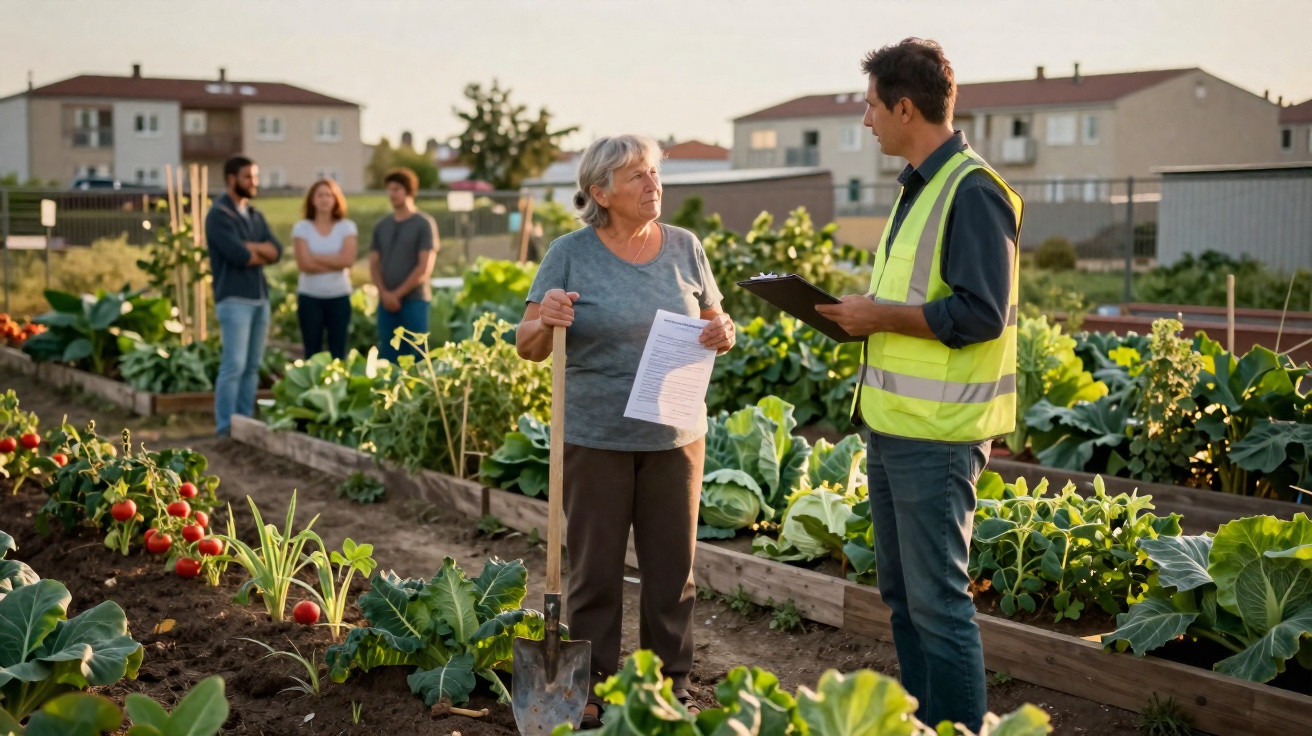
On a narrow, neglected ribbon of grass between two blocks of flats - the sort of overlooked council land most people walk past without seeing - a man in threadbare gardening gloves is crouched beside where cabbages used to grow. He is Karl*, 73, and he has been working this soil for longer than some of his neighbours have been alive.
This cold morning, he is not planting or picking. Under the watch of a council officer in a fluorescent vest, he is lifting out timber edging and taking down bean poles.
The council has instructed him to clear away his cherished vegetable beds because of what it calls an “unauthorised occupation of public space”.
For twenty years, this scrap of ground stocked his own kitchen and, at times, fed half the building.
Today, it feels like a front line.
A vegetable garden turned into a problem overnight
From the pavement, Karl’s garden never looked like a public outrage. There were a handful of raised beds, a rusty watering can, and a tangle of tomato canes that only gardeners can decode. Several residents say the little plot made the estate feel more “alive” than the neat-but-empty lawn the council kept there before. Children walking past in late summer would point at the pumpkins, as if they had stumbled on a hidden farm in the middle of the city.
Then a single letter reset everything.
A recorded-delivery envelope from the council - full of by-law references and plot numbers - described the beds as a “non-compliant installation on municipal land” and gave him 30 days to tear out 20 years of routine.
What hurts Karl most is how abrupt it is. He insists he never tried to disguise anything: the beds could be seen from the path, and from every window that looks down into the courtyard. Grounds staff who came to cut the grass used to stop for a chat and leave with sprigs of parsley. No one raised an objection.
That changed when a new tenant moved into the building opposite and began complaining about “mess” and “nuisances”. A photograph arrived on the desk of a council department head, a file was opened, and soon after came the decisive letter.
As one neighbour puts it, quietly: “We thought they’d send someone to talk, to find a middle ground… Not this.”
The dispute hits a nerve because it sits where two ideas of city life collide. On one side is public space that is neat, regulated and standardised - managed through forms, registers and legal notes. On the other is the improvised, human-scale corner people shape themselves, using their hands and a few leftover planks.
Urban planners may speak about “temporary uses” and “citizen initiatives”. Retirees like Karl call it “growing some beans where there was just mud.” The law rarely bridges that distance.
So a simple case file turns into a question: who really gets to claim the forgotten edges of a city - the administration, or the people who live beside them every day?
Neighbours divided between law, jealousy and solidarity
In the stairwell, the tale spreads faster than any rumour about the rent. One resident fumes: “It’s public land, he knew it.” Another shrugs, arguing the council is right - let one person plant courgettes and the next will dump an old caravan there. A third admits she used to rely on Karl’s tomatoes at the end of the month when her wages arrived late.
These small alliances and irritations play out by the postboxes, near the lift, and in the building’s WhatsApp chats. One tenant circulates a photo of Karl beside his almost-cleared plot, asking who will sign a petition. Someone else replies with a screenshot of the council by-laws, highlighting the phrase “unauthorised encroachment”.
The beds may have disappeared from the grass, but the argument now occupies everyone’s mind.
Karl’s situation is not unusual. Across many towns and cities, similar rows flare up over compost corners, backyard chicken runs, or unofficial flower beds on council verges. In another area, a retired teacher was made to cut back raspberry canes planted along a cycle path after a cyclist complained about reduced visibility. Elsewhere, a group of young parents were told to remove homemade benches from a playground because they were not “certified equipment”.
These stories rarely reach national headlines, but in local Facebook groups they erupt. Under images of uprooted courgette plants, comments stack up: “We can’t do anything anymore,” “Rules gone mad,” and, now and then, more careful voices asking, “What if it was next to your window, with noise at 6 a.m.?”
These everyday dramas reveal how delicate informal agreements can be in shared spaces.
The council defends its position with reasoning that reads watertight on paper. If officials allow unregulated gardens on municipal land, where is the limit? Who is liable if a child is injured on a rusty stake, or if contaminated soil causes health problems? Rules are written not for Karl - the kindly man handing out parsley - but for the imagined worst-case scenario that ends in a claim.
Council lawyers say they are not “against gardens”, only against informal, undocumented ones. They point to existing community garden schemes run by associations, with insurance and charters. Karl, like many pensioners, never joined because he simply did not know they existed.
And, honestly, almost nobody reads the council website’s “urban gardening procedures” before they plant a tomato.
How this kind of conflict could be handled differently
Under the anger, one straightforward question keeps surfacing among residents: why did the council begin with a threat rather than a conversation? A knock at the door, a visit on a bright morning, someone from the council actually stepping into the garden. They might have checked the soil, marked a modest boundary, and suggested small safety changes.
Some councils already work like this. They send mediators or “public space stewards” to speak with residents when informal uses appear. Instead of a top-down instruction, they offer a light-touch agreement: low fencing, limits on the height of structures, and clear access routes for the fire service. The garden becomes semi-official without losing what made it feel human.
It would not solve every issue, but it can lower the temperature for everyone involved.
For residents, a common misstep is assuming that “no one’s complained, so it must be allowed”. Years of calm can end overnight with a new neighbour, a new officer, or stricter enforcement of an old rule. Another pitfall is letting a garden creep beyond its original footprint. What begins as three tidy beds can gradually spill into a jumble of pallets, buckets and discarded furniture - and that is often when objections start.
If you are considering using an unused strip near your building, taking a few photos and sending a brief email to the council’s parks or green-spaces team can make a decisive difference. Not a plea - simply: “This is what I’d like to do; is there a framework?” It may feel bureaucratic, but sometimes that small digital paper trail is what saves your beans three years later.
Most people know that sinking feeling: realising something you built with love never officially existed anywhere.
Karl doesn’t speak in policy terms. He just looks at his bare patch of earth and says quietly: “For 20 years this has been my reason to get out of bed. I gave half of what I grew away. Now they tell me I was disturbing public order.” Then he adds, almost apologizing, “It was just a few potatoes.”
For neighbours
Speak early - not only once the letter arrives. A quick corridor chat (“Is the garden bothering you? Is anything worrying you?”) often prevents the angry email to the council sent in a moment of frustration.For council officials
Before issuing a legal notice, send a person. Ten minutes on site can matter: see the space, hear the resident, and consider the symbolic cost in real lives - not just in regulations.For would-be gardeners
Start small and keep it reversible. Use light structures, avoid concrete, and skip permanent sheds. If someone later says “this has to go,” it is less painful to dismantle a few beds than an entire invented world.
When a few square metres of soil expose what a city really values
What remains on Karl’s strip of municipal land is a rough rectangle of turned earth, almost the same as it was before he ever touched it. The council intends to seed it with grass “for uniformity.” From their windows, neighbours see something else: a clear before-and-after. One version of the story calls it “restored public space.” The other calls it “erased life.”
These minor clashes over vegetable beds and timber borders will not swing an election. But they quietly shape how people feel about home. When a council rejects a DIY fix, some residents hear: “Your initiative isn’t welcome here.” When a neighbour calls the authorities instead of ringing the doorbell, another invisible line is drawn between “us” and “them.”
Some of Karl’s supporters are now discussing an official community garden nearby - this time with permissions, fencing and rules. Others argue the magic will vanish once it is institutionalised, because the whole point was that it grew in the cracks of the system.
Between those poles, most people simply pause with a cup of coffee at the window, wondering what they would have done. Sent the email? Signed the petition? Knocked to help carry the last crate of onions upstairs?
Those questions linger long after the beds have been cleared. They cling to the shoes of anyone who walks past that flat, lifeless strip of grass and half-remembers that, not so long ago, there were tomatoes there - and an old man who knew every neighbour’s favourite herb.
| Key point | Detail | Value for the reader |
|---|---|---|
| Informal gardens are fragile | A single complaint or stricter enforcement can trigger a removal order even after years of tolerance | Helps readers judge the real risk before investing time and emotion in a similar project |
| Dialogue can change outcomes | Early conversations with neighbours and a quick email to the council often defuse conflicts | Gives practical steps to avoid sudden confrontations and legal threats |
| Small plots reveal big issues | Vegetable beds on municipal land crystallise debates about ownership, regulation and solidarity | Invites readers to reflect on their own role in shared urban spaces |
FAQ:
Can a council really make someone remove a vegetable garden on public land?
Yes. Municipal land belongs to the council, and most rules treat any private use without permission as encroachment - even if it is only a few raised beds.Does long-term tolerance create a “right” to keep the garden?
In many places, no. Years without enforcement do not automatically create legal rights, although it may help as a point in mediation.How can residents start a shared garden near their building more safely?
The safest approach is to contact the council, join or set up an association, and request either an official plot or a temporary-use agreement for a defined area.What if a neighbour’s garden on public space genuinely bothers me?
Nearly always, begin with a calm, direct conversation. If that fails - or you feel unsafe - you can contact the council, but it often escalates matters.Are councils becoming stricter about these informal uses?
Many are tightening rules around liability and safety, while also expanding official community garden programmes. The grey zone between the two is where cases like Karl’s arise.


Comments
No comments yet. Be the first to comment!
Leave a Comment