
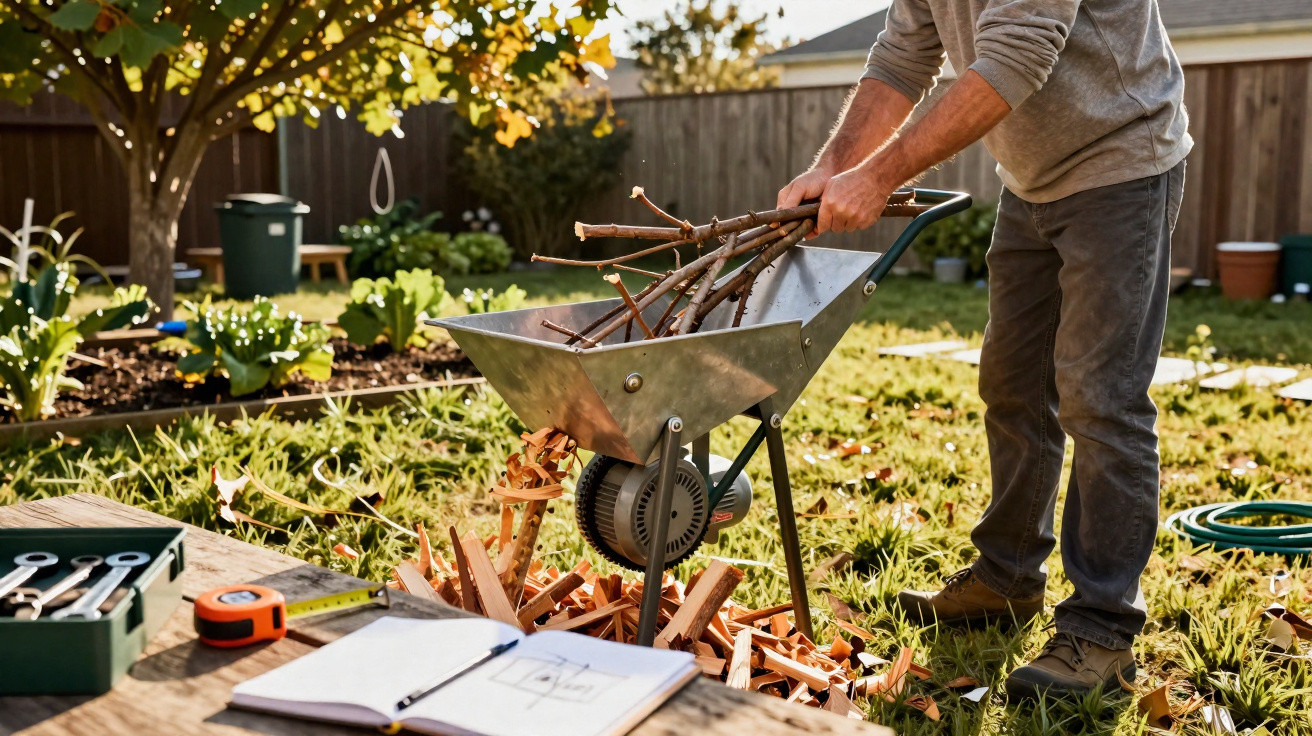
After a blustery weekend they stack up, sulk in the corner of the garden, and practically challenge you to pretend they aren’t there. I’ve burned them, dragged them, hired kit, and sworn at the lot. Shop-bought shredders shrieked, jammed, and then sat there in a mood. Eventually I realised the answer wasn’t another receipt-it was building a machine that suits a real garden rather than a glossy catalogue. Straightforward. Useful. Built to last.
On the first morning I put my homemade shredder to work, a thin frost still coated the apple prunings. The sun hadn’t lifted above the fence and the neighbourhood felt held in that quiet, early pause. I rolled the cart out of the shed, flicked the breaker, and the motor responded with a low, confident hum. No drama-just steady power waiting to be used. I offered the first branch to the chute, felt it pull, and watched the mess of twigs become neat, slightly warm mulch. A robin perched on the handle as if it had booked the best seat. The air carried a sweet smell with a faint metallic edge. One branch became ten, then thirty, and the minutes stopped feeling sharp. It dealt with what used to beat me. Then it went one better.
The idea: slow, simple, and stubborn
I wasn’t chasing speed-I wanted a machine with patience. High-RPM chippers tend to make a racket and throw splinters, then bog down on wet material and stringy vines, which is exactly what most suburban gardens generate. So I went for slow torque over drama: a geared electric motor, a weighty rotor with replaceable blades, and a feed that rewards a steady pace. No complicated electronics, no mystery components, and nothing sealed up for good. If it’s held together with a bolt, it can be taken apart with a bolt.
The build began with a 2 hp induction motor I salvaged from a compressor. It already had a track record for coping with dust and rough weather. I matched it with belt reduction so the cutter turns in that sweet spot-enough bite to work, not so eager that it snatches. There’s something reassuring about a machine that doesn’t feel rushed. You hear the cut rather than the scream. When you can hear the cut, you can anticipate what happens next, which helps keep both fingers and nerves where they belong.
The chassis is a mild-steel rectangle on four sturdy wheels-closer to a barrow than a bench tool. The rotor runs in greasable pillow-block bearings. The blades are simply thick rectangular pieces, ground to a sensible bevel and set to pass close to a fixed anvil. It isn’t fancy; it’s meant to be sharpened on a rainy afternoon and bolted straight back on. Designed to be repaired is a deliberate choice, not a nostalgia exercise.
What it actually does in the garden
The real proof came after a storm clipped my quince and cracked a bay laurel limb-green, sappy, and awkward lengths. I wheeled the shredder over to the heap, slid a folding crate under the chute, and started feeding it. Thin material disappeared instantly. Branches up to thumb thickness hesitated for a moment, then surrendered without any theatrics. What came out looked like warm granola rather than dust-easy to rake, and with a scent almost like tea. In twenty minutes I’d filled a wheelbarrow.
Next I tried hedge trimmings-the sort that used to knot up every hired shredder I’d used. Instead of forming a ball, this machine worked them against the anvil and gradually teased them apart, like easing out a knot without yanking. The long feed chute is key: it keeps hands well away while gravity and the rotor do the heavy lifting. You can hear when a tangle is on the way and simply let the machine deal with it. We’ve all had that instant when a tool suddenly feels like it’s in charge-this one hands control back.
This isn’t performance for bragging rights; it’s about rhythm. On mixed prunings I see roughly a 6:1 reduction. Across an unhurried Saturday, about 150 kg of garden waste became mulch. The sound is closer to a washing machine than a go-kart. I spread the chips under the raspberries and around the apple tree, where they keep moisture in and encourage worms. The pile at the back stopped looking like a problem and started looking like ground cover. That’s more than neat-it’s help for next season.
The build: parts, shortcuts, safety that isn’t optional
I built it around a rule I can live with: use parts you could source twice. Motor, belts, bearings, blades, switchgear, frame-nothing with a proprietary shape and no custom castings. The feed chute is folded sheet metal with a bolted-on rubber curtain. The rotor is a disc drilled and threaded so the blades can be flipped and spaced as needed. I avoided anything so exact that it couldn’t tolerate a washer’s worth of adjustment. What matters is that fasteners are accessible and guards come off without a fight.
And let’s be realistic: very few of us do daily torque checks, regular greasing, and careful dusting inside panels. So I arranged it to be friendly to lazy maintenance. Grease nipples sit where gravity makes life easier. There’s a top window so you can check blade clearance at a glance. The magnetic switch can be hit with a gloved hand. The wheels cope with gravel, and the handle folds so it can live under a shelf. I wasn’t trying to create the perfect tool; I wanted one I’d genuinely roll out after work.
There’s always a small voice that mentions risk when you feed a machine like this-and I pay attention to it.
“Safety is a habit you design into the tool, not a sticker you put on it.”
Here’s the small set of habits I built into the shredder:
- The chute is long, and the opening wears a curtain. You can’t accidentally reach the rotor.
- The switch is lockable, and the power lead unplugs instantly. Nothing starts with a knock.
- The blades are reversible and go blunt gradually, rather than chipping into shrapnel.
- If it binds, it slows and coasts instead of whipping. Belt drive is your ally.
What it changed for me, and what it might change for you
The heaps still appear after windy nights, and they always will. The difference is that now I look at them and see soil-in-waiting. The shredder turned “waste” into a loop, which sounds poetic until you tip the first barrow of warm chips around a thirsty shrub and notice the ground stays damp a week longer. Building it improved my habits too: I prune with cleaner cuts because I know the shredder prefers tidy branches. I stack material by thickness because it feeds more smoothly. I also share the machine with a neighbour who repays the favour with sourdough. There’s a quiet satisfaction in that sort of technology-the kind that doesn’t need an app or a firmware update to be useful next season.
| Key point | Detail | Why it matters to you |
|---|---|---|
| Slow, high-torque cutter | Geared motor and belt drive keep RPM low and bite steady | Quieter running and fewer jams with wet or stringy waste |
| Serviceable parts | Reversible blades, greasable bearings, bolted guards | Lower lifetime cost and practical “fix it today” upkeep |
| Long, safe feed chute | Distance, rubber curtain, lockable switch | More confidence feeding mixed prunings, fewer “uh-oh” moments |
FAQ:
- What size branches can it handle? Finger to thumb thickness is its sweet spot, and it’ll handle up to wrist-size in short lengths if you feed patiently. It prefers straight prunings over knotted, crotched pieces.
- How loud is a slow-torque shredder? It hums rather than shrieks. Think laundry day, not lawn-tractor weekend. You’ll still wear ear protection, yet you can talk over it without shouting.
- Will it clog on wet hedge trimmings? It’s kinder to soggy greens than fast chippers. The anvil and rotor tease fibres apart, and the long chute lets you “pulse” the feed if a clump bunches up.
- What does maintenance look like? Flip blades when the chips look fuzzy, grease bearings by season, and brush off dust after a session. Five calm minutes beats an afternoon of cursing later.
- How much did it cost to build? Scrounging helped. Around $180 in my case, mostly bearings, belts, and steel. Even buying new across the board, you land well under many pro-grade machines.






Comments
No comments yet. Be the first to comment!
Leave a Comment