
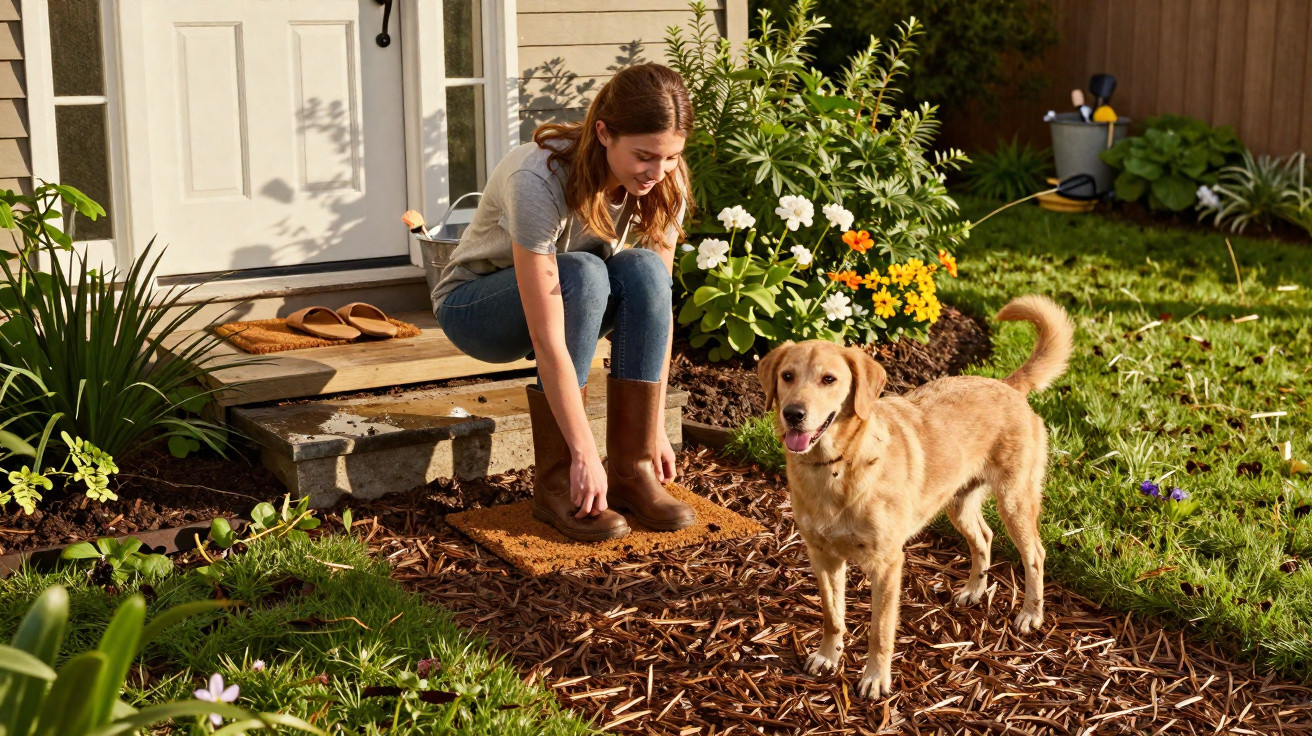
The dog rockets in from the garden, grinning, tongue out… and peppering the white hallway tiles with tiny brown splashes.
Your boots sit gloomily by the door, plastered in sticky soil. The doormat has stopped trying. Outside, the run from patio to shed no longer resembles a path; it looks more like a newly turned field.
You drag an old towel across the floor and tell yourself you’ll “get the garden sorted” someday. Rain taps steadily at the window. The borders are thriving, the lawn’s slightly overgrown, and in between it all are those muddy tracks that funnel straight to your doorstep like a reproach.
Now picture that same line covered with a soft, springy layer of mulch-soaking up the mess before it ever gets onto your shoes. When the ground underfoot behaves differently, everything else follows.
Why a mulched path keeps your hallway clean
After a downpour, you can practically sense where the dirt starts. Exposed soil grips. Grass becomes sludge. Gravel pings everywhere. A mulched path behaves unlike any of those: it has a gentle give, it drinks up water, and it lets go of your soles far more readily.
There’s nothing mystical about it. Mulch works as a barrier between your footwear and the wet earth below. Rather than your boots driving straight into mud, they press into a loose, uneven layer that doesn’t smear in the same way. That means less muck on your shoes, less desperate scraping on the mat, and a lot fewer muddy streaks ghosting across the kitchen floor.
Imagine a typical suburban garden on a rainy Saturday. The main route goes from the back door to the compost heap, then on to a trampoline used daily by two children and a dog convinced it’s part of the family. Before any mulching, every shower turned that strip into a boot-grabbing bog. The parents had more or less accepted that mopping once a day wasn’t enough.
Then, one weekend, they spread a 5–7 cm layer of chipped bark along that well-worn “desire line”. No posh edging, no professional help-just cardboard on the soil, bark on top. The next rain arrived, as it always does. The path looked darker and richer, yet it held firm. The kids still sprinted. The dog still tore along it. Only now, indoors stayed… almost boringly clean.
The science is straightforward. Mud clings because it’s fine particles mixed with water, creating a paste. Step onto bare soil and you compress that paste, then carry it forward as you walk. Mulch changes the point of contact: its pieces are larger and jagged, so they don’t pack down tightly against your tread.
Instead of turning into a smooth, sticky film, mulch acts like a cushion and a sponge at once. It takes up some moisture, interrupts the mud underneath, and helps water drain away rather than cling. Those small gaps between chips also help knock dirt from your boot pattern as you move. It won’t be spotless-but it’s a different world from trudging through a puddled strip of earth.
How to mulch garden pathways the smart way
The best mud-cutting paths go exactly where you already walk. Spend a week paying attention after rain. Which routes have worn lines through the grass? Where does the dog cut the corner every time? That’s where the mulch should go. Don’t design from a sketchbook; design from footprints.
Once you’ve identified those routes, clear off loose bits and put down a base of plain cardboard or thick newspaper, with generous overlaps. Then add 5–10 cm of organic mulch-wood chips, shredded bark, or roughly composted leaves. Rake it to an even-ish surface, then tread it down by walking over it. Notice how different it feels immediately.
A frequent error is being too stingy. A 1–2 cm dusting vanishes after the first proper storm. Go thicker. A deeper layer holds together, takes up more water, and won’t need topping up so quickly. You’ll appreciate that decision on the next soaking Tuesday morning.
Another slip-up is picking the wrong mulch. Fresh, stringy grass cuttings can rot into a slippery, smelly layer. Fine sawdust tends to clump and stick to everything. Choose coarser pieces instead: chipped branches from a tree surgeon, chunky bark from a garden centre, or a mix of leaves with small twigs. It doesn’t need to look pristine to do the job.
And give yourself a break. Let’s be honest: nobody truly spends their weekend raking every bit of mulch perfectly straight. Aim for “comfortable and practical underfoot”, not “Chelsea Flower Show perfection”.
“Once we mulched the path to the back gate, our mop went from daily use to ‘where did we leave that thing?’” a neighbour in Leeds told me, laughing. “The kids still bring in chaos, but not the garden itself.”
That’s the understated benefit of a well-sited mulch path. It doesn’t only protect your floors; it changes how the garden feels when it’s wet. You stop tiptoeing. You stop cursing the weather. You start using the space again-even when your forecast app is nothing but grey.
- Pick chunky, woody mulch for your main routes
- Work with existing “desire lines” rather than forcing new ones
- Put cardboard down first to reduce weeds and block mud
- Keep the layer at 5–10 cm for proper mud control
- Top up the surface once or twice a year
Beyond clean floors: what mulched paths change in daily life
When your key routes are mulched, your day-to-day habits shift in small ways. Wet weather no longer means dashing from door to shed, hoping your shoes survive. You nip out for herbs in your slippers. You take the compost out after dark without hunting down “garden shoes”. You just move through your own space more easily.
There’s a mood change as well. On a cold, drenched morning, a defined, tidy path running between beds brings a quiet sense of control. The garden stops feeling like it’s conspiring against you. It looks cared for, even if the borders are still exuberant and the lawn could do with a cut.
Practically speaking, mulched paths also protect soil structure. Without a buffer, repeated footsteps compact the ground, pushing out air and limiting how water moves through it. Plants suffer, puddles hang around, and those muddy ruts get deeper. Mulch spreads and softens your weight, keeping the soil underneath looser over time, healthier, and less likely to turn swampy at the first heavy shower.
Most of us have experienced that tiny home improvement that makes you wonder why you waited so long. A mulched garden path can be exactly that: not flashy, not perfect for social media-just reliably helpful, week after wet week.
| Key point | Detail | Why it matters to you |
|---|---|---|
| Mulch as a mud buffer | Forms a loose, absorbent layer between shoes and wet soil | Cuts down on mud trodden into the house and reduces cleaning time |
| Right depth and material | 5–10 cm of chunky wood chips or bark over cardboard | Helps the path stay firm, relatively dry, and longer-lasting |
| Follow natural routes | Mulch the lines people and pets already take | Creates paths that feel natural, comfortable, and actually get used |
FAQs:
- Which mulch is best for muddy garden paths? Chunky wood chips or shredded bark are usually the most effective. They drain well, resist turning to slime, and provide decent grip.
- How deep should a mulched pathway be? Aim for 5–10 cm. Any thinner and mud will work its way through; much thicker can feel a bit unstable until it beds in.
- Can a mulched path become slippery in heavy rain? Fresh, chunky mulch generally offers better traction than wet grass or bare soil. Steer clear of fine sawdust or compacted grass cuttings, which can go slick.
- Do I need edging to stop mulch spreading? Edging is helpful but not required. Logs, bricks, or a clean edge cut with a spade will keep most of it in place.
- How often should I top up mulch on pathways? Many gardens need a refresh once a year, or twice in very wet areas or where there’s lots of foot traffic.
Comments
No comments yet. Be the first to comment!
Leave a Comment