
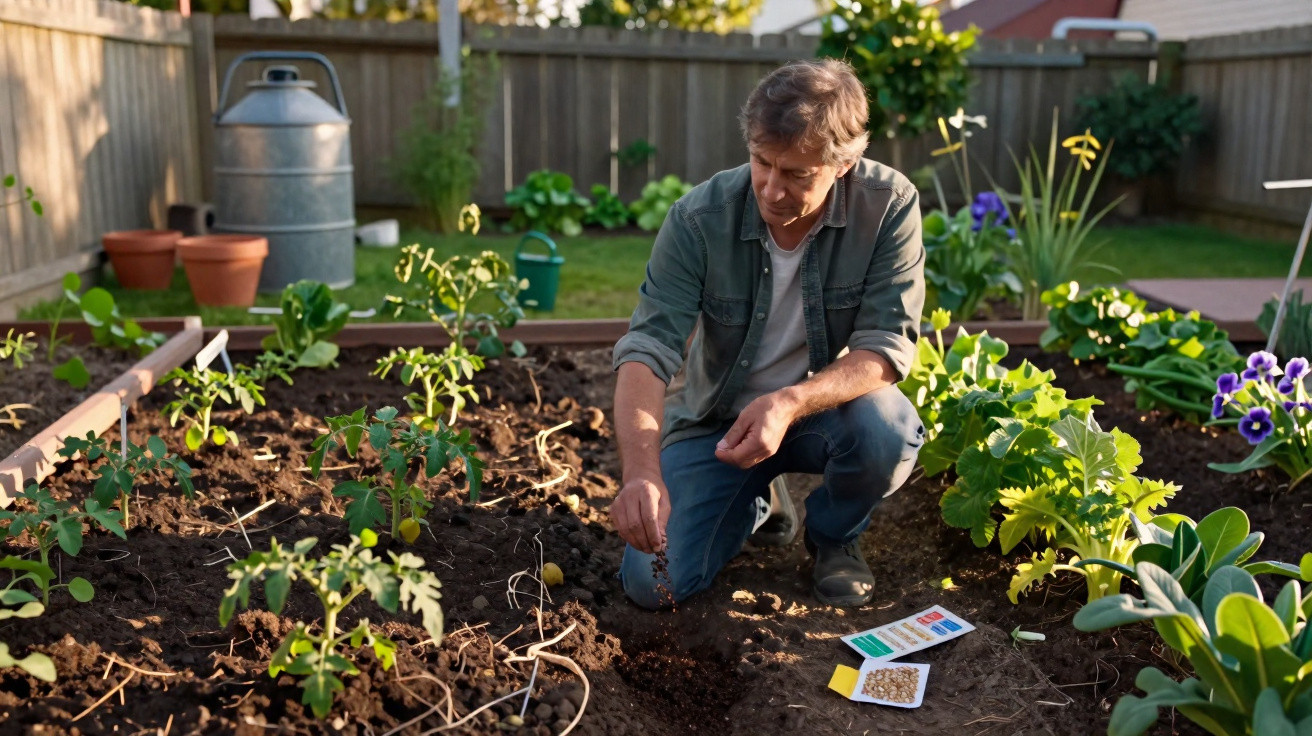
The earliest warning is almost never spectacular. Not a cloud of insects and not some biblical curse.
It’s far more muted: leaves that are a touch smaller than last season, tomatoes that look the part but taste strangely bland, or beans that burst into life once and then… stop.
You find yourself standing in the same patch where you always grow your favourites, and a small doubt edges in. The soil appears fine. You’ve added compost, cleared the weeds and watered with care. Yet the bed feels weary, as though the ground itself is exhaling.
You wipe the soil from your palms and look along the tidy rows-set out in exactly the same positions as last year, and the year before. And you realise something is slowly being worn down underfoot.
The garden that slowly stopped listening
Take a stroll through any suburban neighbourhood in late summer and you’ll spot the pattern repeating in raised beds and little plots.
Tomatoes at the back, again. Peppers in the middle, again. Lettuce along the edge, again.
Before long, the arrangement becomes habit-almost muscle memory. One bed is always for the hungry crops, one for quick salads, and one for whatever ends up in the “miscellaneous” corner. Early on, that consistency is rewarded: heavy harvests, lush growth, and that quietly smug moment when you share a photo of a full basket online. Then, year after year, the vigour drops away-one notch at a time.
A reader in Ohio described the season her garden simply… stalled. For six consecutive years she’d put tomatoes in the same back-right corner of her 1.2 × 2.4 m bed. The first three years were outstanding-the kind of yield that gets the neighbours chatting. In year four, blight took hold. In year five, the leaves yellowed early and the fruit split. By year six, she’d spent a small fortune on organic fertiliser and still ended up with only a handful of watery tomatoes.
The odd thing was what she noticed elsewhere. In the front-left corner-where she grew “cheap” radishes-the soil was dark, crumbly and alive with worms. But in the back-right, where the tomatoes always went, the soil looked pale, tight and strangely lifeless when she pushed in a trowel.
What she was running into has a name: soil fatigue. It isn’t a sudden collapse so much as a gradual burnout.
When one crop type stays in the same place season after season, it repeatedly draws down a narrow set of nutrients-especially the ones that particular plant family relies on. At the same time, pests and diseases that favour that crop start to sync with your garden’s routine and settle in long-term. Underground life shifts too: organisms associated with that plant family become overrepresented, while overall diversity falls. The bed doesn’t “die,” it just stops cooperating.
Above ground it looks like smaller plants and disappointing harvests. Below ground, an entire ecosystem is quietly sliding out of balance.
Breaking the repeat pattern: crop rotation to prevent soil fatigue
There’s a straightforward way to interrupt this slow decline: intentionally change where you plant things. Not an elaborate, colour-coded, six-year agronomy scheme-just a simple crop rotation you can actually stick to.
Begin with a rough sketch of your garden on any scrap of paper. Then, think of your space as three broad zones:
- heavy feeders (tomatoes, squash, sweetcorn, brassicas)
- lighter feeders (carrots, onions, beetroot, herbs)
- soil-builders (beans, peas, clover, cover crops)
Next season, shift each group into a different zone-like turning a wheel by one notch.
That single decision changes which nutrients are taken from which patch, which roots explore which corner, and where overwintering pests emerge in spring only to discover… their preferred host has moved on.
Most gardeners already know the principle. They’ve seen crop rotation diagrams online or heard an older relative mutter, “Never put tomatoes where tomatoes were.” Then planting time arrives, life gets hectic, and the simplest option is to put everything back where the canes and markers already are.
We’ve all had that moment: promising yourself you’ll rotate “properly” next year, then squeezing the peppers back into the same sunny spot because you’re rushed. The truth is, perfection isn’t what helps-memorable, doable patterns are. Even a basic swap-tomato bed becomes bean bed, bean bed becomes brassica bed-starts to unwind the knot of soil fatigue.
“Once I stopped planting my favorites in ‘their’ permanent spots, the soil seemed to wake up,” said Marie, a balcony gardener who rotates crops in simple containers. “The same 10-inch pot gave me weak basil three years in a row. The year I put peas in first, the basil went wild. It felt like cheating.”
- Rotate by family, not just by plant name
Tomatoes, peppers, aubergines and potatoes are all nightshades. Shifting tomatoes elsewhere but leaving peppers in the same soil barely interrupts the cycle. - Use at least a three-year cycle
Ideally, each plant family should have two full seasons away from its previous spot to disrupt disease and help nutrients rebalance. - Drop in soil-builders on purpose
Beans, peas and dedicated cover crops add fertility quietly-especially if you cut plants at soil level and leave the roots in place. - Watch the “tired” corners first
Any area that repeatedly struggles should be first in line for a full rest year with compost, mulch and low-demand crops. - Accept imperfect rotation as progress
Even exchanging just two crop families each year is far better than repeating the same layout for ten years.
Letting the soil breathe again
Soil fatigue caused by repeated planting patterns doesn’t arrive with alarms. It tends to appear as that nagging disappointment when a bed you relied on no longer delivers, even though your watering and feeding feel “correct”.
There’s something quietly powerful about treating the garden like a partner rather than a machine. Rotating crops, giving a corner a season under mulch, or sowing a strip of clover where you’d normally force in another tomato plant-these are small choices that tell the soil, “You can recover.” The response can be subtle at first and then sudden: a richer smell, soil that’s easier to work, and plants that grow strongly with less effort.
And yes, it also means giving up the comfort of fixed positions. Tomatoes don’t have to live in the back-right corner forever.
| Key point | Detail | Value for the reader |
|---|---|---|
| Soil fatigue builds silently | Growing the same crop in the same place repeatedly depletes a narrow range of nutrients and encourages crop-specific pests and diseases | Explains poor yields even when watering and feeding seem “right” |
| Simple rotation beats no rotation | Group crops by family and move them each year to disrupt disease cycles and spread soil demand more evenly | Provides an easy, realistic habit that protects harvests over the long term |
| Soil needs rest and diversity | Legumes, cover crops and occasional “rest years” help restore life in worn-out beds | Offers a practical route to revive struggling areas of the garden |
FAQ:
- Question 1 How can I tell if my soil is suffering from fatigue rather than just poor fertilising?
Look for a repeated pattern over several seasons in the same spot: plants from the same family do badly there but perform better elsewhere with similar care. You may also see recurring diseases or pests linked to that crop, plus soil that feels compacted or lifeless even after compost is added.- Question 2 How long should I wait before planting the same crop in the same place again?
A three-year break is a good target for most vegetables, particularly tomatoes, potatoes, brassicas and cucurbits. In small gardens, a two-year rotation still helps, as long as you avoid planting the same family in the same bed in back-to-back years.- Question 3 What can I plant in a “tired” bed to help it recover?
Choose legumes such as dwarf beans or peas, and add a generous layer of compost and mulch. You can also sow cover crops-such as clover, vetch or rye-then cut them down and leave the material on the surface to feed the soil life below.- Question 4 Does soil fatigue happen in containers and raised beds too?
Yes. Growing the same crop repeatedly in the same container can strip particular nutrients and unbalance the micro-life in that pot. Freshen container compost every year or two and rotate what you grow, rather than assigning a container to one permanent crop.- Question 5 Can fertiliser alone fix soil fatigue from repeated crops?
Fertiliser may improve growth temporarily, but it won’t interrupt disease cycles or restore diverse soil biology. Treat fertiliser as a short-term aid; rotation, organic matter and varied root systems are what properly reset a tired bed.

Comments
No comments yet. Be the first to comment!
Leave a Comment