
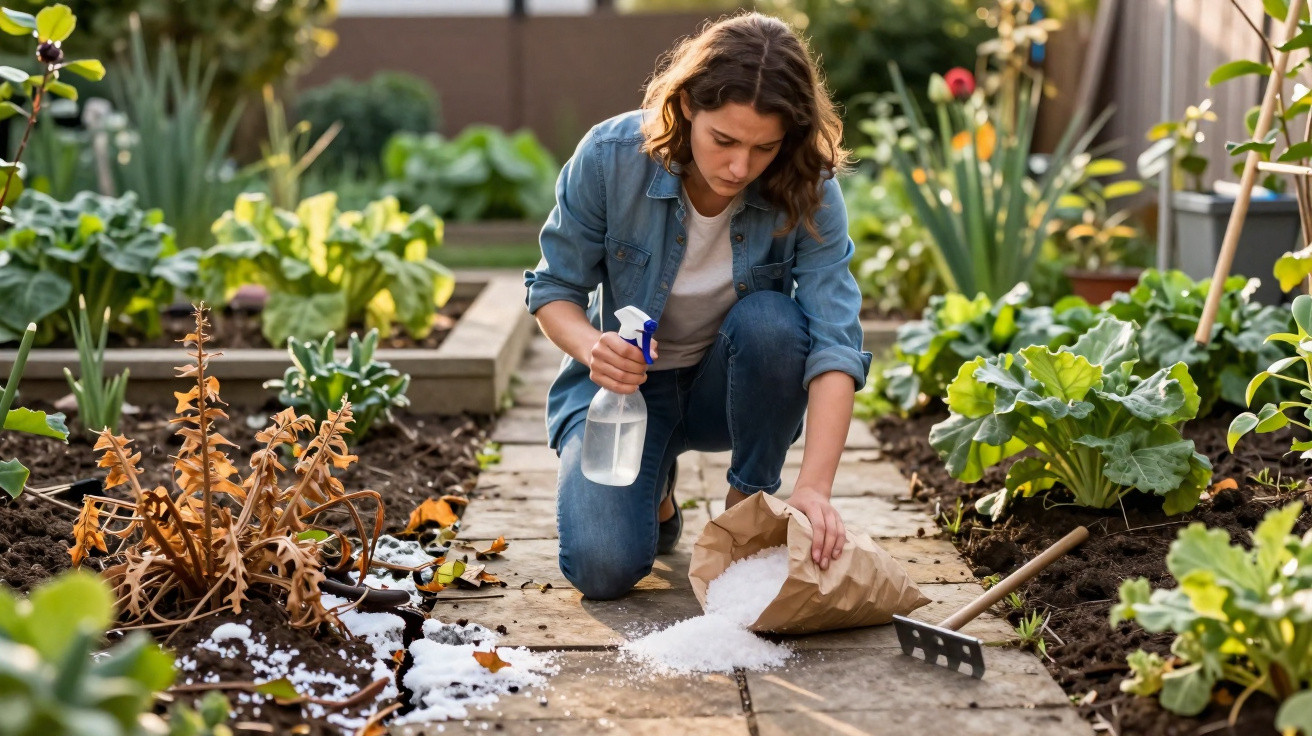
A white kitchen staple is quietly making its way onto garden paths.
What sounds like a clever shortcut can damage your beds for years.
More and more amateur gardeners are reaching for an ingredient from the cupboard to “thoroughly” clear weeds from paving joints, gravel paths and bed edges: salt. Coarse table salt, sprinkled straight from the pack or dissolved in water, is often touted in forums and neighbourhood chats as a secret weapon when nothing else seems to work. But if you turn your plot into a miniature “salt desert”, you are not only knocking back unwanted plants - you are interfering with the soil ecosystem at a fundamental level.
Why salt kills weeds so ruthlessly
Salt’s weedkilling effect has nothing to do with garden folklore; it is straightforward biology and chemistry. Plant cells are largely made up of water, which plants draw in through their roots. Add a lot of salt and that balance is thrown off.
"Salt draws water out of plant cells, disrupts nutrient uptake and puts them into a permanent state of stress - in the end, they literally dry out."
Osmotic shock in the bed
Salt raises the concentration of salts in the soil water. The result is that water moves out of the plant cells, because the surrounding soil solution becomes “saltier” than the fluid inside the cells. Plants can no longer hold on to moisture; leaves droop and shoots die back. This is especially harsh on young, delicate weeds growing in cracks and on gravel surfaces.
Minerals get pushed aside
At the same time, soil particles exchange mineral nutrients. When large amounts of sodium enter the ground, it displaces important elements such as potassium, calcium and magnesium. Those ions then become scarce in the soil solution. Roots may still find water, but there is very little usable nutrition available. The plant effectively starves - and even tough species begin to falter.
Long-term stress on plant cells
Salt also triggers what is known as oxidative stress: more aggressive oxygen compounds form inside cells than the plant’s own “defence system” can cope with. Leaf tissue discolours, growth slows, or patches die off. The nasty part is the delay - the damage can show up later, when the salt application has long been forgotten.
From joint cleaner to soil destroyer
Someone who only wanted to treat a few “annoying blades of grass” can end up with a strip of ground that will not grow much of anything. The reason is simple: salt is not selective. It spreads, and its effects can linger.
When the soil suffocates
Salt changes soil structure. Clay and humus particles clump differently and the crumb structure breaks down. The ground becomes hard and compacted; rainwater penetrates poorly and air barely reaches the deeper layers. Microorganisms, fungi and earthworms lose the conditions they need to live.
"A heavily salted soil can remain sluggish, dense and almost plant-hostile for years - even if there is no visible grain of salt left on the surface."
Without the billions of soil organisms that break down organic matter and make nutrients available, the natural nutrient cycle stops functioning properly. The soil becomes, in effect, “tired”.
Salt does not stay where you put it
Rain and watering dissolve salt and carry it down into deeper layers. From there it can migrate sideways into neighbouring borders or towards groundwater. So what feels like a “precise” treatment on a path can lead to:
- root damage to nearby shrubs or trees
- yellowed, dried leaves on plants that are normally robust
- reduced growth in vegetable beds on slopes below salted areas
- a gradual burden on groundwater through elevated salt concentrations
Deep-rooted trees, in particular, can react badly. They take up the salt with the water flow, and it accumulates in their tissues. In extreme cases, whole crowns can die back over a few years - with no-one connecting it to those earlier “salt experiments” on the drive.
What “homemade salt herbicide” usually looks like
Popular online recipes suggest mixes such as “1 kg of coarse salt to 5 litres of water”, sometimes combined with vinegar and washing-up liquid. The mixture is then poured generously over joints or beds.
| Method | Typical effect | Consequences for the soil |
|---|---|---|
| Scatter dry coarse salt | Rapid die-back at the surface | Slow salinisation at depth, risk to neighbouring plants |
| Water with a salt solution | Strong, wide-area impact | High input into soil water, risks for groundwater |
| Salt plus vinegar & washing-up liquid | Very aggressive; leaves scorch quickly | Double burden: salt damage and added acidity |
From a legal point of view, these DIY mixes are risky territory. In many areas, using chemical products or “home-brew” herbicides on hard surfaces such as driveways, patios or pavements is prohibited without approval, because they can wash straight into drains or seep towards groundwater.
Alternatives to salt that genuinely work
If you want to control weeds without wrecking your soil, there are several proven approaches - some cost effort, others require patience.
Mechanical methods: effort instead of chemistry
- Regular weeding: With a joint scraper, gloves and a hoe or rake, young weeds can be removed early. The smaller the weed, the easier the job.
- Joint brushes or brush machines: For longer drives or paved areas, wire or nylon brushes (manual or motorised) can be effective.
- Hoeing in the veg patch: Slicing shallowly just beneath the surface interrupts roots and allows many weeds to dry out.
Preventing growth rather than chasing it
Cover bare soil and you deny weeds light - and therefore their basis for growth.
- Mulching: A layer of bark mulch, straw, grass clippings or leaves keeps beds more weed-free for longer and also helps prevent drying out.
- Increase planting density: Closely spaced perennials or ground cover plants close gaps where weeds would otherwise germinate.
- Stale seedbed (faux-semis): Prepare the soil, water it, let the first weeds sprout, then lightly skim them off - only then sow or plant.
Heat instead of salt: thermal weed control
Special gas torches or electric hot-air tools briefly heat the plants without setting them alight. The cell tissue ruptures, and the plant dies back over the following days. Repeating the treatment several times in a season noticeably reduces weed pressure, without permanently damaging the soil.
Why “strong” often means “too strong” with herbicides
The desire for a radical fix is understandable: if you have to weed the same joints year after year, you start longing for a once-and-for-all solution. Salt seems to be exactly that - but it does not just hit the target; it hits everything around it.
"A weedkiller that makes soil practically uninhabitable doesn’t solve a problem - it pushes it into the future."
In the short term you save labour; in the long term you pay with soil fertility, biodiversity and, potentially, the loss of plants you value. A “too strong” salt herbicide is like a wrecking ball for soil structure: weeds stop growing, but there is very little room left for healthy new growth as well.
What if the damage has already been done?
If you have already used salt, you can try to limit the harm. Recovery is slow, but not hopeless. Useful steps include:
- remove and dispose of the heavily salted top layer of soil
- water thoroughly over an extended period to flush salt down into deeper, less-used layers
- work in organic material (compost, leaves, straw mulch) to improve soil structure
- sow more salt-tolerant pioneer plants or green manures to gradually bring life back into the ground
Depending on how much salt was applied and the type of soil you have, this can take several years. Anyone who has been through it once usually reaches for the hoe next time, not the salt tub.
Understand the risks before the bucket gets mixed
Salt does not only cause problems in flowerbeds. After salty winters, many councils deal with damage to roadside trees, verges and soils along transport routes. The processes are the same as in a garden - just on a larger scale. Keeping that in mind changes how you view the quick grab for the kitchen packet.
A realistic scenario looks like this: in year one, dandelions and grass vanish from the paving joints. In year two, roses by the path start showing odd leaf discolouration. After a few seasons, the fruit trees by the fence carry sparse foliage and yields fall. Hardly anyone links it back to a few buckets of salt solution from years earlier - but chemically, the connection can be very real.
Rather than hunting for one supposedly brilliant ingredient, it is better to combine several small tactics: weed early, plant smartly, use mulch, apply heat in targeted spots. Weeds will not disappear by magic, but they stay manageable - without turning your soil into collateral damage from an overpowered “home remedy”.
Comments
No comments yet. Be the first to comment!
Leave a Comment