
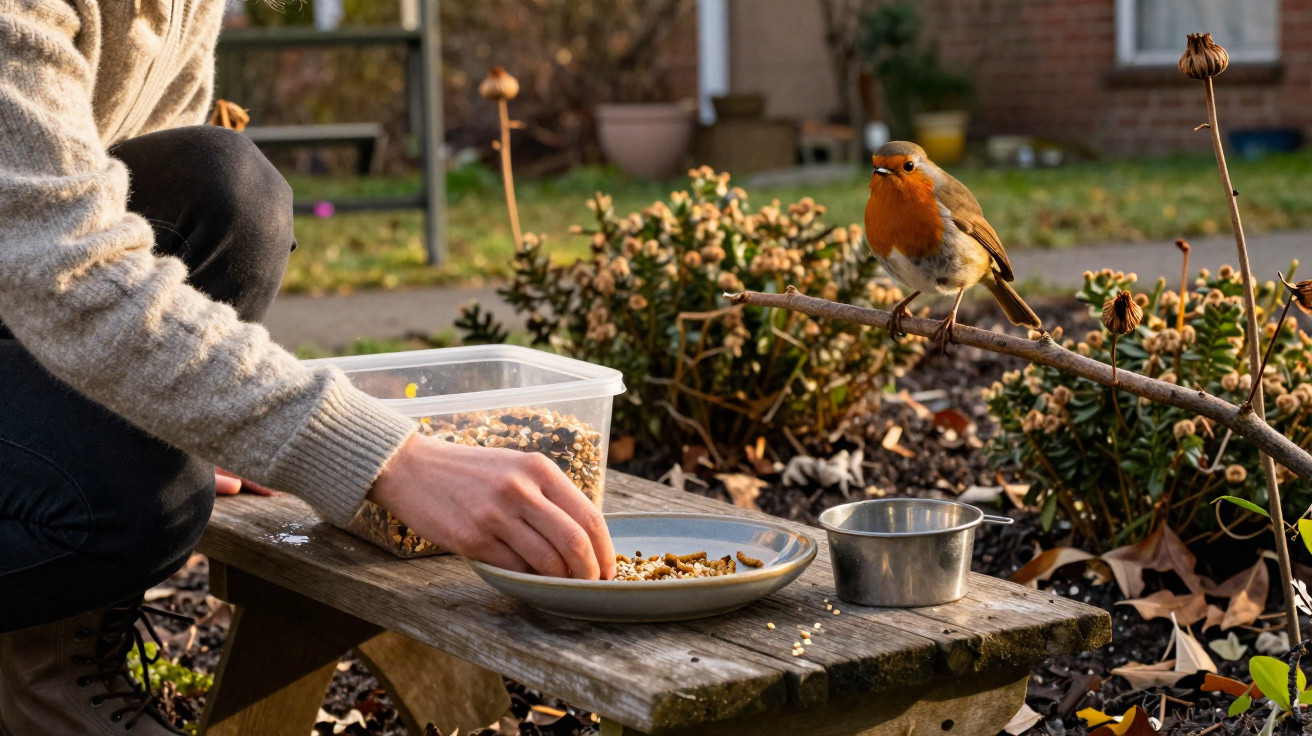
Bright orange chest, bead-black eyes, head cocked as it waits for the next treat. Across thousands of gardens, the same little winter tableau repeats itself: phones come out, people soften, and the bird becomes the star of a cold morning. We refill feeders, scatter mealworms on the patio and enjoy that quiet sense of having done something good.
Garden brands sell it as a comforting seasonal ritual - a snug winter hobby: “feed your garden robins and they’ll keep coming back”. Social feeds are packed with clips of birds bouncing onto outstretched hands, almost like miniature pets. It looks innocent. Even kind.
Yet ornithologists and urban ecologists are starting to flag an uncomfortable possibility. The habit many of us love could be nudging wild robins towards dependency - and the danger tends to show itself when the cold is at its most unforgiving.
The cosy garden trend that’s not so harmless
On an icy January morning in suburban Kent, ecologist Hannah Rhodes stands motionless beside a low stone wall. Below her, a classic robin-redbreast picks at dried mealworms that someone has tipped into a tidy mound. As Hannah eases back a step, the bird trails after her, paying no attention to the hedgerow behind.
“That’s not natural behaviour,” she says quietly, as the robin hops nearer. It pauses, almost impatiently, as if expecting a refill. Instead of probing the leaf litter for hidden insects, it lingers where the easy food appears. It has learnt that people equal effortless calories: no searching, no rivalry, no risk - just reliance packaged as something adorable.
What Hannah is describing has become commonplace: concentrated winter feeding right outside the house, often on exposed patios, tables or windowsills. Garden centres now market “robin survival kits” - fatty mixes, live mealworms and decorative feeding trays designed for outdoor furniture. Instagram reels show robins landing on fingers to collect food. It’s sweet, shareable and spreads quickly.
An RSPB community survey found members reporting a rise in “hand-tamed” robins over the last decade. People swap stories about birds that now appear by the kitchen door each morning. In Facebook gardening groups, you’ll regularly see posts like, “My robin won’t eat from the feeder anymore, only from the ground when I’m there”. It’s more than a one-off tale; it’s a recurring pattern.
The concern among urban ecologists is that some robins are subtly reshaping their winter survival plan. A bird that invests its energy in guarding one high-value food patch beside a house may stop covering its territory as widely. It may pass over natural feeding areas and become poorer at the skill that matters most in a hard winter: finding food independently when we are not there.
There is another, blunter problem too: heavily used feeding spots can turn into disease hubs. UK research on garden birds has linked dense winter feeding with outbreaks of trichomonosis and salmonella. A dish of damp mealworms left out again and again in the same place is, effectively, a public canteen - complete with all the hygiene issues that implies.
Bird experts are not arguing that we should stop feeding altogether. What they want is a change in approach: away from pet-style handouts that create dependency, and towards support that leaves robins wild, cautious and robust.
How to feed robins in winter without making them dependent
Begin with a single mindset shift: think “garden”, not “dish”. Instead of making your routine revolve around one bowl of premium treats by the back door, distribute food and weave it into the space. A pinch of seed and a few suet crumbs under a shrub. A scatter along a log. Several small, mixed pockets rather than one irresistible pile.
That approach encourages robins to keep moving, checking and testing different places. You still help them through the lean season, but you also protect their normal behaviour. A bird that must search a little is less likely to lose the habit.
Food choice matters as well. During cold snaps, high-energy items can be important, but mealworms and soft mixes can start to function like fast food. Switching between options - sunflower hearts, suet pellets, finely chopped nuts, and tiny amounts of grated mild cheese - supports a broader diet. Crucially, some of what you offer should be a little less conspicuous: tucked into leaves or among twigs, rather than always placed on a gleaming plate in the open.
Many people drift into the same pattern because it matches human routines: a big handful first thing, maybe another at dusk, and nothing at all in between. Then, when holidays arrive, feeding stops overnight. For a robin that has reduced its ranging and started to organise the day around your offerings, that becomes a sudden drop.
On a Manchester estate, wildlife volunteer Jon watched “his” winter robin stop visiting nearby gardens once the bird became accustomed to constant treats on his doorstep. When Jon went away for five days, the robin vanished too. Perhaps it found another food source. Perhaps it did not. He still isn’t sure.
A healthier rhythm is modest, consistent and slightly variable. Rather than tipping out one large quantity, add small top-ups when you can, in different corners. And if you know you’ll be away, reduce gradually over a few days to a week instead of going from full feeding to nothing overnight. That gives the bird time to widen its foraging again.
Let’s be honest: hardly anyone manages this every single day. Life gets hectic, children fall ill, weekends disappear. So set your good intentions around what you can genuinely keep up, not an unrealistic idea of constant presence. The goal is not flawless feeding - it is avoiding a situation where one small bird is relying emotionally and physically on your back step.
Ornithologist Claire Booth puts it bluntly:
“If that robin can’t make it through a week without you, something’s gone wrong. Feeding should be a safety net, not a leash.”
Her suggestion is to treat your garden as a long-term buffet that largely maintains itself. Native shrubs such as hawthorn and holly provide berries. Untidy areas with leaves and dead wood shelter insects. Ivy left to flower and fruit adds more. These are the things that keep robins truly wild, even as they accept your winter gifts.
For quick reference, many bird organisations now share a straightforward winter checklist for gardens that suit robins without encouraging dependency:
- Provide small amounts of different foods, rather than relying on one “magic” treat.
- Spread feeding areas out, including sheltered ground spots under cover.
- Wash feeders and trays often to lower disease risk.
- Keep some parts of the garden messy to support natural food.
- Reduce hand-feeding so birds do not structure their day around you.
Rethinking what “helping” garden robins really means
Once you notice the pattern, those cute winter clips online can start to feel different. The robin tapping at the window each morning. The bird sitting tensely on the doorstep as a family loads the car for a week away. The caption underneath: “He’ll be lost without us!”
We want a relationship with nature that feels personal. A robin that seems to recognise you can feel like a tiny neighbour - a reassuring constant when life is messy. That emotional lift is genuine; on a difficult day, a bird landing on your hand can feel like grace. But in midwinter there is a thin boundary between connection and control, and that boundary matters.
On a small street in Bristol, two neighbours have effectively shared responsibility for “their” robin without ever formally agreeing it. One leaves suet crumbs beneath a shrub; the other adds a little seed mix near a log pile. Both have also planted shrubs and kept a corner wild. The bird moves between the gardens, vanishing into the hedge for long periods. It does not wait by either door.
That is the quiet model experts keep pointing to: a patchwork of small supports spread across multiple gardens, rather than a single bright focal point that creates dependency. It may be less Instagram-friendly, but it is far more resilient when a cold front hits and human routines fall apart.
When you step outside on a raw February morning and spot a robin on the fence, you are looking at an animal shaped by evolution to survive through judgement and initiative. Its charm is part of why we care - but it is not the whole story. The best gift we can give is a garden where the bird would still cope if we stopped trying.
Perhaps that is the winter trend worth sharing: not “come and see how tame my robin is”, but “look how alive my garden is without me at the centre”. It is a different kind of pride - one that leaves enough space for the bird to remain what it was always meant to be.
| Key point | Detail | Why it matters to you |
|---|---|---|
| Cute does not mean harmless | Intense feeding close to the house can make robins dependent | Understand how a seemingly gentle act can leave birds more vulnerable |
| Choose the garden over the bowl | It is better to diversify sources (plants, wild areas, small portions) | Makes it easier to adopt habits that respect natural behaviour |
| Think network, not an exclusive relationship | A web of small actions between neighbours makes birds more resilient | Encourages you to discuss it locally and get the wider street involved |
FAQ:
- Are we supposed to stop feeding robins in winter?
Not at all. Experts recommend feeding more thoughtfully: smaller amounts, varied foods, and gardens that also provide natural shelter and insects.- Is hand-feeding robins really that bad?
Occasional hand-feeding isn’t a disaster, yet routine handouts can make a bird time its day entirely around you, which is risky when you’re away or conditions change.- What foods are safest for garden robins?
Good options include suet pellets, sunflower hearts, small seeds, finely chopped nuts, and modest amounts of live or dried mealworms, all offered in clean spots.- How far in advance should I reduce feeding before going away?
A few days to a week of gradually smaller, more dispersed portions helps birds re-expand their foraging range instead of facing a sudden cut-off.- Can a small garden really make a difference?
Yes. Even a tiny patio with a shrub, some leaf litter, and a modest feeder can become one crucial stop in a robin’s wider winter territory.

Comments
No comments yet. Be the first to comment!
Leave a Comment