
For the third day running, I found myself staring at my pathetic little tomato cane. To my left, the neighbour’s plants sagged with XXL trusses; to my right sat my own miserable, mini harvest. The compost looked grey, the pot was bone-dry around the edges, and my neighbour gave me that sympathetic look-kind, but tactfully unspoken. I even leaned in and sniffed the soil as if it might confess what I’d done wrong. Nothing. Just dust, and a faint hint of autumn.
That evening, I scrolled through gardening forums-an online universe of half-anonymous usernames and wonky mobile photos. Thread after thread, the same claim kept surfacing: a single, straightforward fertiliser recipe that supposedly makes everything grow. Balcony pots, beds, houseplants. It sounded far too good to be true.
After filling half a notebook, and with equal parts scepticism and curiosity, I crept out into the back yard with an old glass bottle. What happened next to my plants feels, in hindsight, like a tiny stop-motion film-except it wasn’t animation. It was real.
The quiet revolution in the watering can
You know the feeling: you water, you glance at the leaves on your way past, and-if you’re honest-nothing really changes. Everything stays stubbornly “fine”. Not dead, not thriving. Just a sort of green-beige existence. Eventually you accept it, the way you accept bland canteen food.
The fertiliser mix people whisper about shifts exactly that kind of resignation. Not with fireworks overnight-more like someone gradually turning a dial until, suddenly, the music in the room is right again. Leaves look properly lush rather than merely green. New shoots appear faster than you expect. And you catch yourself pausing for longer in front of your plants.
Let’s be frank: hardly anyone has the time to juggle five different specialist feeds for five different plants. Almost nobody keeps a fertilising diary or calculates N–P–K ratios. Most of us grab whatever’s on offer at the garden centre and hope for the best. This one recipe works largely because it turns chaos into a repeatable routine-something you can manage even on tired evenings.
I tried it first on a plant I could afford to lose: a forgotten supermarket basil pot. The leaves were limp, the stems already half woody, and in my head I’d written it off. One last experiment before it went into the food-waste bin. I mixed the liquid, poured a small amount at the roots, and put it back on its spot by the kitchen window.
For three days, it felt like nothing happened. Then came one morning where I did a double take: between the old, exhausted leaves, fresh glossy shoots were suddenly pushing upwards. The colour was a bold, almost cheeky green. After ten days I could pick basil again-not the overflowing abundance of an advert, but enough to scatter over pasta and think, alright, this isn’t just nonsense.
Later, I gave the same mix to my tomatoes, the tired monstera in the living room, even the sulky lavender on the balcony. Different plants, same formula. It’s not a miracle potion that makes everything explode in 48 hours. It’s more like steady tailwind-slowly turning “just hanging on” into “hang on, when did this happen?”
If you look at it scientifically, it’s not mystical at all. Plants mainly need three key nutrients: nitrogen for leafy growth, phosphorus for roots and flowers, and potassium for resilience. Most amateur gardeners either underfeed, or throw things at the soil in an unhelpful jumble. This recipe pulls the basics together: organic material that releases nutrients gradually, plus a small amount of more readily available “food”.
The best part is that the mix supports the growing medium rather than fighting it. Microorganisms get something to eat, the structure becomes looser, and moisture is held more effectively. Instead of a one-off jab of energy, your fertiliser becomes a tiny ecosystem in a jar. That’s why it doesn’t just lift one plant-it benefits the whole little balcony jungle.
The real trick isn’t a single ingredient, but the combination and the consistency. It’s simple enough that you’ll actually use it, yet complex enough to be more than sugary water for plants.
The recipe: simple, cheap, works for almost everything
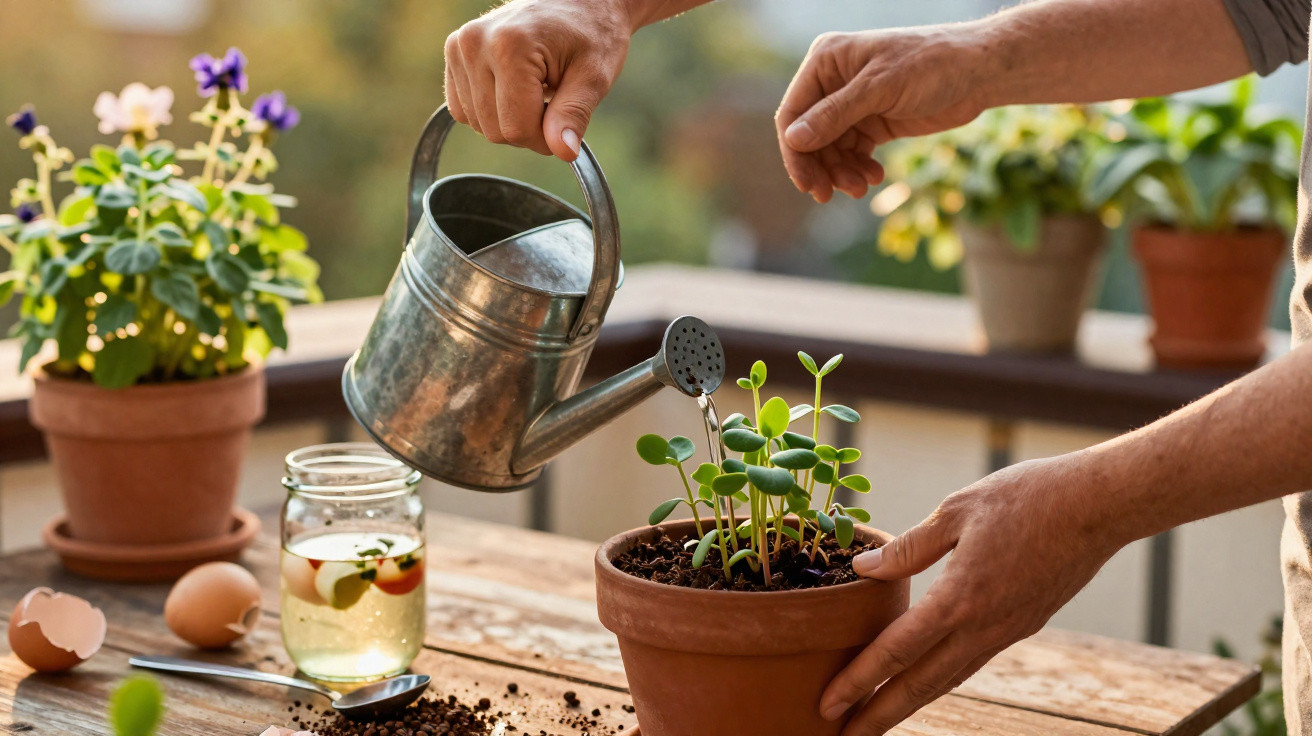
The base recipe that keeps cropping up in forum posts is roughly this: coffee grounds, eggshells, banana peel-and, if you want, a touch of honey or molasses. All of it is kitchen by-product you’d have anyway. No lab kit, no specialist bottles. Just a large jar or an old bottle with a lid.
Over one to two days, set aside dry coffee grounds, crush one or two eggshells into small pieces, and slice one banana peel into strips. Put everything into the jar, top up with lukewarm water, add one teaspoon of honey, and close it up. Leave it to steep at room temperature for at least 24 hours-48 is better.
What matters: shake it well before each use, and dilute the liquid at about 1:10 with water. In other words, one cup of this “brew” into a large watering can. For most plants, once a week is plenty. No daily ceremony, no dissertation-just one set day, one can, and a brief moment of “right, I’m looking after you now”.
It’s very tempting to go all-in: more coffee grounds, more shells, more concentrate, because surely it will work faster. That’s often exactly where things go wrong. Too-strong feed stresses plants-especially those in pots. The compost can become too acidic, mould has a field day, and roots retreat instead of spreading.
Another common mistake is tipping fresh, still-warm coffee grounds in clumps on top of the soil. It looks like “I’m doing something”, but it can quickly form a hard crust. It’s better to let grounds dry and use them crumbly, or simply rely on the liquid feed. And if you’ve just repotted something, give it time to settle before you start fertilising.
Let’s be honest: almost nobody measures a perfectly level teaspoon every single time, or keeps a precise record of the last feed. If leaves start looking yellowish or a plant seems droopy, doing less can be the better long-term move. Fertiliser is support, not a cure-all for every bit of neglected care.
A gardener I met at a small city-garden festival said something I haven’t forgotten:
“Most plants don’t die because they get too little - but because, in our impatience, we give too much.”
That patient middle ground is where this recipe has its strength. Yes, you’re using kitchen scraps-but you’re treating them as useful, not as rubbish. And you start developing an instinct for when your plants are genuinely “asking” for more.
What tends to work well in practice:
- Start small: trial it on one or two plants first, not your entire collection
- Check the smell: if the brew reeks of rot, bin it and start again
- Don’t water in direct sun; do it in the morning or evening
- Watch the leaves: deeper colour and fresh shoots are good signs
- Refresh the potting compost at least once a year - fertiliser doesn’t replace a soil change
Why this “one recipe” is more than a trick
A few weeks after my first batch, I noticed something odd: I no longer stood at the door with the watering can for a quick splash and dash. I started crouching down, looking more closely at the leaves, and running my fingers over the surface of the compost as if it were a fabric I liked. That simple fertiliser recipe had nudged me into regular, low-pressure contact with my plants.
Chemically, a mix of coffee grounds, peels, shells and water isn’t a revolution. The real difference is how easy it makes it to keep going. No complicated schedule, no expensive bottles, no guilt every time you water. Plant care stops feeling like a chore and becomes a small ritual you return to.
Maybe that’s the hidden core of this “one recipe that makes everything grow”: it doesn’t only encourage leaves, roots and flowers. It also grows our attention. Our patience. And that quiet sense of wonder when a basil pot you’d basically given up on becomes something alive again-something that smells like summer.
| Key point | Detail | Benefit for the reader |
|---|---|---|
| Simple all-purpose recipe | Coffee grounds, eggshells, banana peel, water, a little honey/molasses | Make an effective fertiliser from household leftovers with no extra cost |
| Gentle application | Steep for 24–48 hours, dilute 1:10, water once a week | Lower risk of overfeeding and easy to fit into everyday life |
| Observe instead of overdoing it | Read plant responses, reduce if stressed, support healthy soil life | Healthier plants long-term and better feel for your own “micro-garden” |
FAQ:
- Can I use this fertiliser for all plants? For almost all of them-except very sensitive specialists such as carnivorous plants or extremely lime-sensitive species. For orchids and succulents, test it very weak first.
- How long does the brew keep? At most a week in a sealed container, stored somewhere cool and dark. If it smells strongly rotten or goes mouldy, make a fresh batch.
- Do I have to add honey or molasses? No. It works without it. The small sugar addition mainly feeds microorganisms and can help kick-start the process.
- Can I spray the fertiliser on the leaves? Only when very diluted, and preferably in the evening. Some plants are sensitive, so test on a single leaf first.
- How quickly will I see results? Depending on the plant and its starting condition, between one and three weeks. Fresh shoots, richer colour and sturdier stems are the clearest signals.


Comments
No comments yet. Be the first to comment!
Leave a Comment