

A light dusting of sugar across the grass, sparkling softly beneath the streetlamp. Then morning arrived, the ice vanished, and half the young border plants sagged like wilted greens. The geraniums blackened at the tips. The basil looked as though it had been scalded. Next door, the gardener simply shrugged and said, “That’s what you get without a greenhouse.”
But one part of the garden didn’t match the damage. An untidy little section-nothing showy-partly tucked behind an old bench. In that patch, the plants were still standing tall, leaves taut, not a single sign of frost scorch. No plastic tunnel. No horticultural fleece. No tarpaulin draped over the bed like a sheeted ghost.
The answer was in the ground. Quite literally.
The quiet power of warm ground
Seasoned country gardeners don’t begin by battling the cold air. They start with the soil. On those crisp, cloudless nights when the temperature drops quicker than your spirits, the earth acts as a silent storage heater-releasing the warmth it collected through the day in a slow, steady sigh.
When soil is exposed and compacted, that heat bleeds away quickly. When it’s layered, mulched and full of life, it hangs on longer-around the roots, the lower stems, the plant base where survival really matters.
That’s the real shift in thinking: let the soil become your unseen blanket, rather than wrestling with covers that rattle loose in the wind.
In a small Cotswolds village, an elderly gardener called Margaret insists she hasn’t used plastic sheeting for twenty years. She still harvests tender lettuces well into early winter without a greenhouse. Her “secret” wouldn’t impress a garden centre marketing team: thick, dark mulch and a few well-placed stones.
Each autumn she lays down a 5–8 cm layer of shredded leaves, half-finished compost and old straw around the base of her plants. Then she nests a handful of large stones or bricks along the sunniest edge of the bed. In daylight, those stones drink in heat; after dark, they give it back gradually around the plants’ lower stems.
Last year, a late April frost swept through the village. Her neighbours lost their tomato seedlings. Margaret lost two. Out of sixty.
The reasoning is bluntly straightforward. Frost damage isn’t only about cold air; it begins when plant tissue falls below a critical temperature and the water inside freezes. A bed with little thermal mass chills rapidly. A bed insulated with mulch and bordered with stone cools more slowly-sometimes just enough to stay on the safe side.
Mulch works like insulation, slowing heat loss from the soil. Stones, bricks-even old tiles-behave like small radiators. Combined, they can extend that narrow margin of safety by one or two degrees. On paper, that sounds insignificant.
In practice, it’s the difference between drooping blackened leaves and a bed that looks as though frost never touched it.
The country gardener’s frost shield: soil, mulch and stones
The most classic country-gardener approach is almost absurdly simple: create a little “heat bank” for each tender plant. No plastic cloches. No clever gadgets. Just a pocket of protected, warmer ground. Begin by tidying the immediate base of the plant-remove weeds and loose debris. Then add a light, airy layer of organic material around it, making a ring about 20–30 cm wide.
That ring can be built from chopped leaves, straw, dried grass clippings, or half-mature compost. The aim isn’t to bury the plant; it’s to keep the roots snug. Leave a small gap around the stem so moisture doesn’t sit against it and cause rot.
After that, set a few flat stones or bricks on the outer edge of the ring-especially on the south or west side, where the sun is strongest during the day. They absorb warmth while it’s bright, then release it slowly once the light goes.
It can sound like another job on the list: spread mulch, lug stones, crouch beside every plant. But gardens are rarely that tidy in real life. Some mornings you dash outside with a mug of tea, notice the forecast is calling 0°C, and toss whatever you can find around the most delicate plants. That’s fine. The method still works, even if it’s not perfect or pretty.
The common mistakes are easy enough to avoid. Packing mulch tightly against the stem? That encourages rot. Making the layer too thin-more like a decorative dusting? It won’t hold much heat. Using fresh grass clippings in thick, wet mats? They can warm up, go slimy and cause problems.
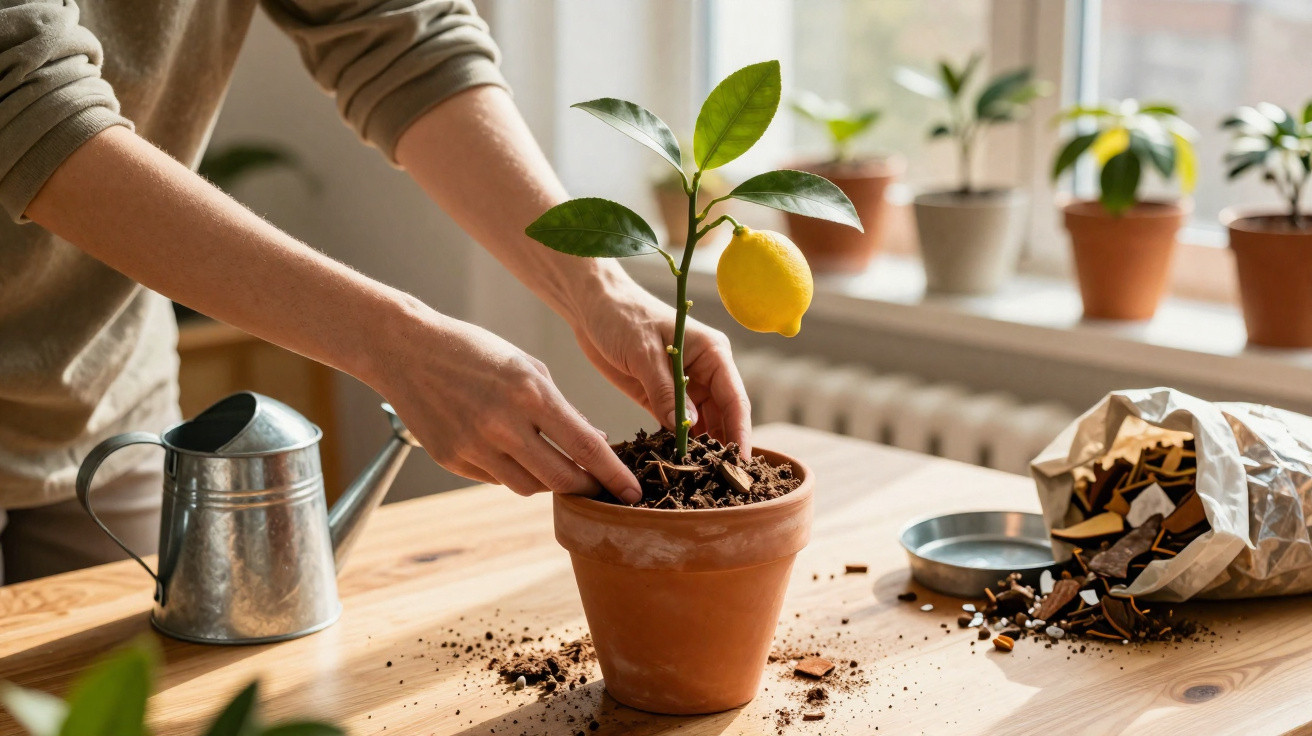
Let’s be honest: nobody keeps this up flawlessly every day. The practical trick is to concentrate on the plants you’d truly hate to lose-the lemon tree in a pot, the newly planted roses, the late-season lettuce that keeps meals lively. Protect those first; anything else is a bonus.
Country gardeners often speak about frost as though it’s a neighbour: familiar, mildly irritating, but not mysterious. They treat the soil as an ally rather than an opponent.
“I don’t fight the frost,” an old farmer once told me. “I just make sure my plants have a warmer bed than the air does.”
That “warmer bed” can be created in plenty of ways, and it doesn’t need to cost a penny. Think of it as shaping a small microclimate-one plant at a time, one bed at a time. To keep it very practical:
- Choose dark mulch (it takes in more heat during the day than pale material).
- Place 2–3 stones along the edge of each small bed or pot.
- Focus on slopes and low dips, where frost settles first.
- Refresh the mulch after heavy rain that flattens it or washes it aside.
- Keep an eye on one “test plant” to learn how your garden responds.
Ultimately, the frost trick isn’t a product. It’s simply arranging things so the earth does the work while you’re asleep.
Rethinking frost as part of the garden, not an enemy
A curious calm arrives when you stop treating frost as a freak event and start expecting it like a regular visitor. Those pale mornings still sting when you step outside. Your breath hangs in little puffs. The watering can turns into a block of ice.
But if you’ve mulched, if the stones are set, if you’ve tucked in even a handful of favourites, a quiet confidence sits underneath the worry. You look across the beds and think, “We’ve done what we could.” Sometimes that’s enough.
On a practical note, this approach offers more than straightforward frost protection. Mulched soil holds its structure better. Worms remain nearer the surface, pulling organic matter down. The ground doesn’t swing so wildly between waterlogged and bone dry. Roots are able to travel deeper, which can also make plants less vulnerable during summer heatwaves.
People often picture a “frost-proof” garden as one packed with structures-polytunnels, greenhouses, electric cables. The country gardener’s version is quieter: warmth stored in soil particles, in stones, in layers of leaves. It’s a greenhouse without glass, built at ground level.
And once you start spotting which parts of your plot naturally keep their warmth, you’ll never look at your garden in quite the same way again.
| Key point | Detail | What it gives the reader |
|---|---|---|
| Use the soil as a natural radiator | The ground stores heat by day and releases it at night around the roots | Learn how to create a protective microclimate without expensive kit |
| Combine mulch and stones | An organic layer insulates; stones act as small heat stores | Put a simple, low-cost, long-lasting method into practice against frost |
| Protect only the key plants | Focus on sensitive or valuable varieties rather than the whole garden | Save time, reduce mental load, and limit the losses that actually matter |
FAQ:
- Does this trick work in very harsh climates? It helps, but it has limits. Mulch and stones can soften a few degrees of cold, not severe Arctic-style snaps. In very harsh regions, combine this with windbreaks, cloches or temporary covers on the coldest nights.
- What kind of mulch is best for frost protection? Shredded leaves, straw, wood chips and half-mature compost can all work. Dark, loose materials are best because they trap air and absorb warmth during the day.
- Can I use this method in pots and containers? Yes, and it can be surprisingly effective. Mulch the surface of the pot, group several pots together, and add a few stones on top or around the base to increase thermal mass.
- Will mulch attract pests or cause rot? It can if it’s heaped directly against stems or kept constantly wet. Leave a small gap around the stem and aim for a loose layer rather than a heavy, compacted mat.
- When should I put the mulch down for frost protection? Apply it before the main frost season, usually from mid to late autumn, then lightly top it up after heavy rain or if it starts to thin.



Comments
No comments yet. Be the first to comment!
Leave a Comment