
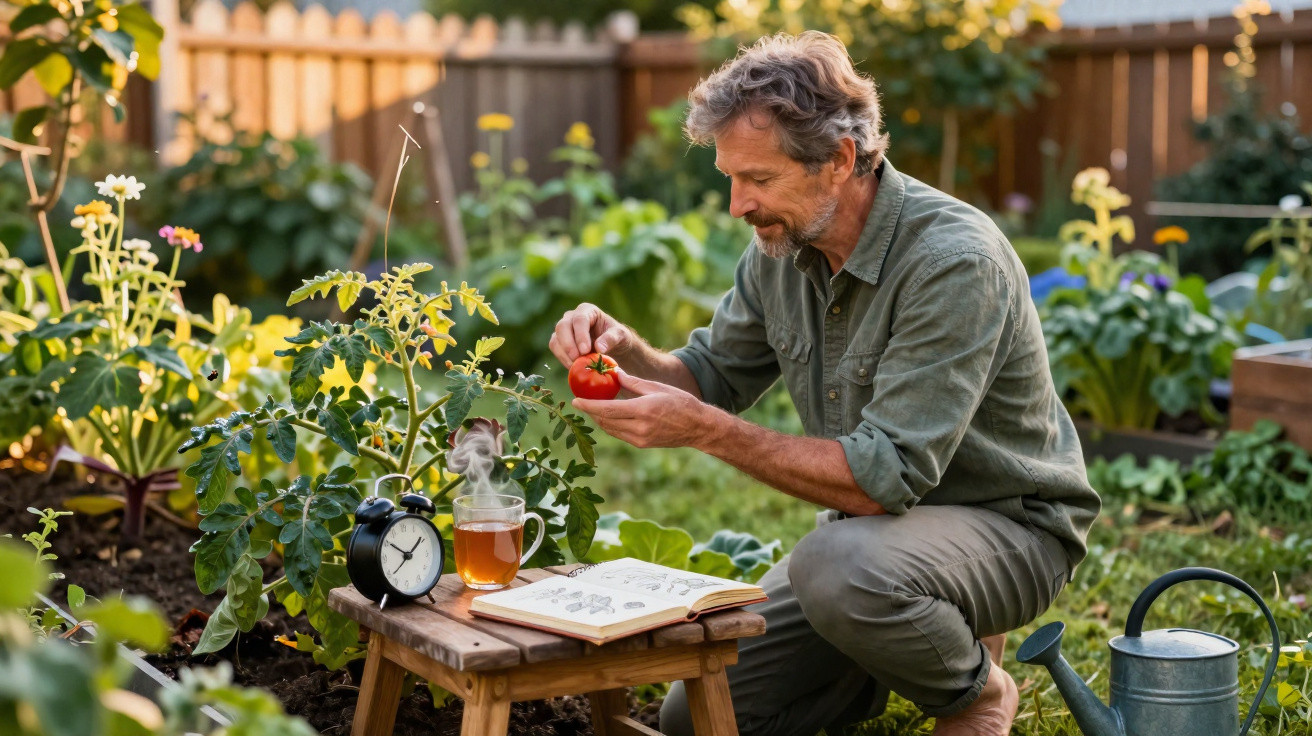
The hose sat in a slack coil across the path, still slick from a quick watering the night before. The birds seemed louder than they had been for days, and a light breeze nudged the bean plants just enough to flash their silvery undersides. At the far end of the garden, one tomato plant was plainly in a mood.
Its leaves hung low in a way no diary entry could have foreseen.
Coffee mug in hand, the gardener didn’t head straight for the timetable pinned to the shed door. Instead, they paused. They watched. They tested the soil with their fingertips. They pinched a leaf. They narrowed their eyes at a line of tiny insects clustered along a stem.
There was nothing “planned” for today-yet, out of that quiet attention, three small choices formed.
One of those choices would shape the entire season.
When you stop gardening by the clock
Stroll through two neighbouring gardens in late summer and the contrast often jumps out. One looks worn out: leaves turning yellow, lettuces bolting, soil sealed over like stale crust. The other feels strangely steady and full of life-beds that are uneven but flourishing, some plants cut back earlier than expected, others still powering on.
What usually separates them isn’t a more precise timetable. More often, it’s a gardener who lingers, someone who treats the plot like something to interpret rather than a list to tick off.
Plants don’t recognise that your watering reminder has just sounded. What they respond to is sun and shade, dryness and stress.
Speak with seasoned gardeners and you’ll hear a familiar admission. Sooner or later, they abandoned the “water on Tuesdays, fertilise on the 1st” routine and began with a walk-through instead-hands empty, tools left aside for a moment.
An urban gardener in Portland told me she once stuck to a strict app-driven schedule. The harvests were… fine. Then a heatwave arrived, and the app didn’t adapt quickly enough. Half of her salad bed scorched.
The following year, she ditched the calendar and replaced it with a twice-daily observation habit. Her overall harvest rose by almost a third, but what stayed with her most was this: “I finally felt like I was gardening with the weather, not fighting it.”
There’s an easy explanation for why this approach pays off. Schedules rely on averages, while gardens are built on exceptions. A south-facing bed dries out sooner than the shaded strip by the fence. Clay holds water like a sponge; sandy soil can lose it within an afternoon. One tomato variety sulks where another turns the same space into a jungle.
Watching closely picks up what dates can’t: curled leaves, early fungal marks, sudden bursts of growth, or the first signs of aphids beginning on the underside of a single rosebud.
When we lean less on dates and more on what the garden is showing us, we move from managing time to paying attention to life.
Turning observation into a quiet daily habit
This doesn’t require hours. It takes ten unhurried minutes of genuinely looking. Begin from the same place each day-perhaps the gate or the patio door-and follow the same short loop. Putting your hands behind your back can help if you tend to grab tools too quickly.
Scan the leaves from above, then drop to a knee once or twice to check beneath them. Push a finger into the soil near a few different plants. Take note of which patches stay damp the longest and which ones split first.
This is simply “the round”. Commercial growers do it-and home gardeners can as well.
Many people believe they already “check” their garden. In reality, they hurry out after work with a hose in one hand and a phone in the other, watering everything identically before dinner. Most of us know that feeling: half watering, half thinking about emails.
Swap the sequence. Day one: don’t water and don’t prune-just walk and notice. Day two: take the same loop, then water only where the soil is dry to a knuckle’s depth. Day three: repeat the walk again, but track colour-anything that looks paler, greyer, or more speckled than it did last week?
Before long, you start to spot patterns. And once a pattern is clear, you can respond early and lightly rather than resorting to last-minute rescues later.
And yes-no one truly manages this every single day. Life intervenes. Children need lifts. Meetings overrun. One wet Tuesday can become four. That’s fine. The aim isn’t perfection; it’s adopting a different way of thinking.
A market grower captured it in a single line I scribbled into a muddy notebook:
“Schedules are what you write in winter; observation is what saves you in July.”
During her round she keeps a small mental checklist-one you can copy and tape to your shed door:
- Look – leaves, colour, size, unexpected changes
- Touch – soil moisture, stem firmness, leaf texture
- Smell – mould, sweetness, anything “off” or sour
- Listen – insects, birds, the sound of dry versus damp soil underfoot
- Compare – this week versus last week, this bed versus that bed
From observer to partner of your garden
After a few weeks of moving at this slower pace, something quietly changes. You begin to notice when a plant looks “tired” a full three days before it actually wilts. You spot slugs on their first night, not only after your lettuce has been turned into lace. You soak one patch thoroughly and skip another entirely-without a flicker of guilt.
You might also find your own rhythm settling. Rather than feeling behind because you missed “fertiliser day”, you feel on track because your beans have shown you they’re hungry: lighter leaves, slower growth, fewer flowers.
This is the point where gardening feels less like a task list and more like a calm conversation.
| Key point | Detail | Value for the reader |
|---|---|---|
| Observation beats rigid schedules | Respond to real plant signals, not fixed dates | Healthier plants and fewer “surprise” problems |
| Short daily rounds are enough | 10-minute walk, same loop, senses fully engaged | Fits real life while improving results |
| Simple cues guide smart actions | Soil feel, leaf colour, pests spotted early | Lower costs, less waste, higher yields |
FAQ:
- Question 1 How often should I do a garden walk if I can’t manage it every day?
- Question 2 What early clues show a plant needs water, beyond sticking to a timetable?
- Question 3 Can beginners rely on observation, or do they need strict plans?
- Question 4 What simple tools help me observe more clearly without making it feel like work?
- Question 5 Does this method apply to balcony or indoor plants as well?
Comments
No comments yet. Be the first to comment!
Leave a Comment