
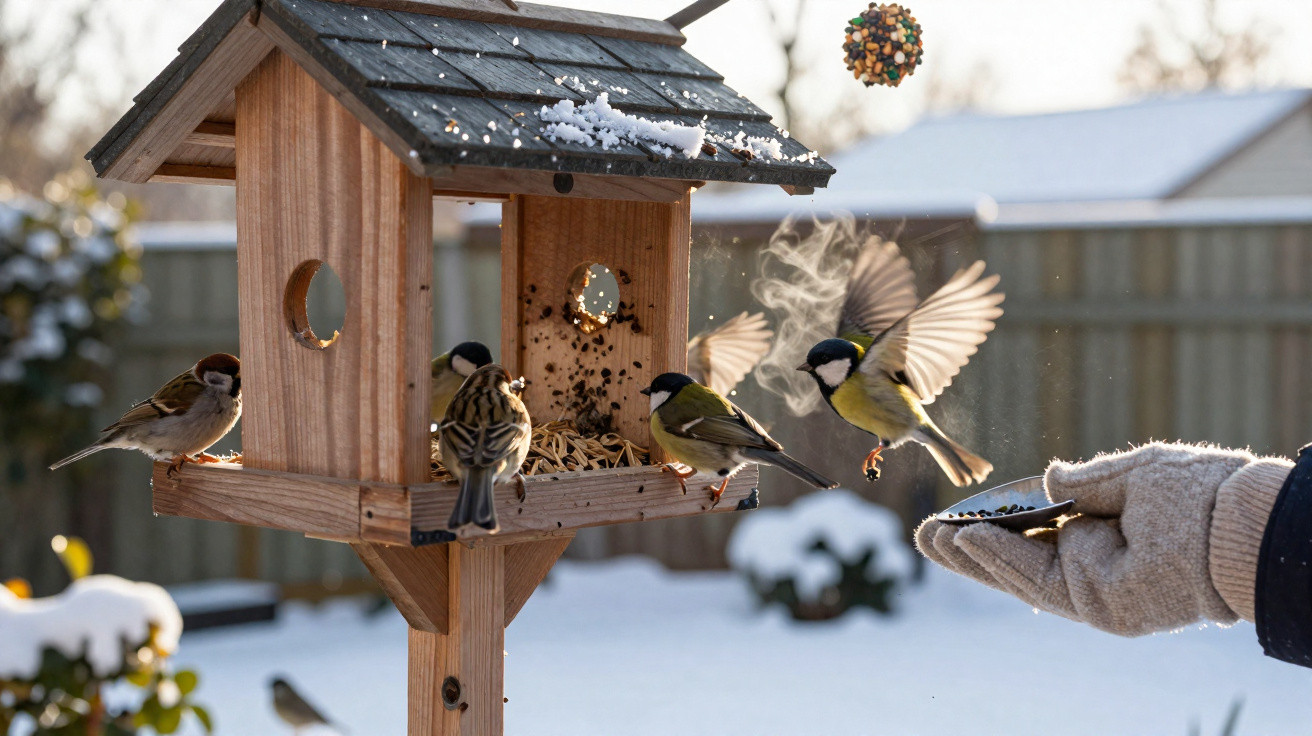
Through the colder months, millions of people set out seed to “help” garden birds. But one well-meaning winter routine, repeated year after year, can quietly turn feeders into dangerous traps.
When help turns harmful: how winter feeders go wrong
January and February can be unforgiving if you weigh less than a letter in the post. Small birds burn through their fat reserves at remarkable speed simply to keep warm, and a garden feeder can genuinely be the difference between survival and not making it.
That’s precisely why many of us fill feeders right to the top: fewer trips outside, and (in theory) a constant buffet for visiting birds. It sounds both kind and practical.
When seed stays outside for days in cold, wet weather, it stops being food and starts becoming a health hazard.
Rain, sleet, freezing fog and wet snow soak exposed seed much faster than most gardeners expect. The mix might look acceptable at a glance, but inside the feeder moisture works its way through layers of sunflower hearts, peanuts and mixed grains.
As soon as seed becomes damp, its value as fuel drops. Fats can turn rancid, carbohydrates start to degrade, and the vital calorie hit birds rely on to get through the night falls dramatically. So a feeder that appears full and generous is often a soggy, low-energy clump that doesn’t power birds properly.
The invisible threat: mould, bacteria and fatal infections
The most serious risk is often not what’s visible, but what’s happening out of sight. In winter, damp seed packed into a small space creates perfect conditions for fungi and bacteria to multiply.
Damp seed in winter is not just “a bit off” – it can become toxic for birds in a matter of days.
Moulds such as Aspergillus can quickly take hold in wet seed. Certain strains produce mycotoxins that harm birds’ lungs and digestive systems. Birds that are affected may look fluffed up, seem listless and avoid flying, then quietly vanish from the garden.
Bacteria are another concern. When birds gather at feeders, droppings end up on perches and in the food itself. Add moisture and you have a rich bacterial brew. Salmonella is a particular worry at winter feeding stations and has been linked to mass deaths in finches in both the UK and North America.
A bird already under strain from cold and short days has little capacity to fight infection. Once a contaminated feeder is used by one ill bird, disease can spread quickly through local flocks-especially in neighbourhoods where several gardens feed birds within a small area.
Frozen blocks of seed: when ice steals their last calories
Moisture doesn’t only spoil food. When temperatures drop overnight, it can freeze the contents of a feeder into a solid mass.
Imagine a robin or tit arriving at first light after burning most of its fat through the night. Food is there at last-except every seed is locked in ice.
Pecking at a frozen brick of seed costs birds energy they simply cannot afford to waste on a sub-zero morning.
Every jab of the beak and every short hop or flight around the feeder uses calories. If birds can’t actually extract the seed, they’re spending precious energy for no nutritional return. For already weakened individuals, that extra effort can be enough to push them past their limit before the day has properly started.
Even if the temperature lifts a little during the day, seed can freeze again overnight and thaw again the next day. That repeated cycle encourages more mould and rapidly turns a feeder into something closer to a petri dish than a pantry.
Choosing the right feeder: design that keeps seed dry
The encouraging news is that modest changes to feeder design and where you place it can cut risk significantly.
Dry food starts with the right hardware: feeders that shed water and let air circulate.
Practical choices include:
- Tubular “silo” feeders: Ideal for smaller seeds. Their upright design and small ports keep most food protected.
- Covered tray feeders: Open platforms need a substantial roof that overhangs the edges to block slanting rain and snow.
- Mesh peanut feeders: Use these only when they sit under a proper cover and can drain freely.
Drainage is as important as shelter. Trays and platforms should use mesh bases or small drainage holes so water runs away rather than collecting around the seed. A straightforward rule of thumb: if a flowerpot would waterlog in that location, your feeder will too.
Smart rationing: little and often beats the big winter refill
Design isn’t the whole answer. The way you top up feeders matters just as much.
Feed in small daily portions rather than stocking up for days. Empty space is safer than old, damp seed.
Treat the feeder as a café rather than a warehouse. Put out only what the local birds will finish within a day. For many gardens, that looks like a small morning refill, plus a quick mid-afternoon top-up if it’s needed.
This approach keeps seed turning over, reduces the time it can absorb moisture, and gives you regular opportunities to spot issues early. It also helps you avoid leaving feeders half full for a week “because they’re not empty yet”.
Hygiene rules every winter bird feeder should follow
A feeder that’s both clean and dry is your best defence against disease. Keeping the routine simple makes it easier to stick to.
| Action | How often in winter | Why it matters |
|---|---|---|
| Check feeders after heavy rain, snow or frost | Daily when weather is bad | Spots damp seed, ice and early mould |
| Discard clumped or smelly seed | Whenever noticed | Removes contaminated food before birds eat it |
| Wash feeders | Every 1–2 weeks | Reduces bacteria and mould build-up |
| Move feeders occasionally | Every few weeks | Prevents droppings and waste building up under one spot |
For most feeders, warm water with a splash of white vinegar is an effective cleaner. Scrub well, rinse, and allow everything to dry fully before refilling. Damp plastic or wood can carry microbes even when the seed you add is fresh.
Positioning feeders: small tweaks, big difference
Where you hang a feeder has a big impact on how wet it becomes.
Pick a position protected from prevailing winds-near a hedge or tree line can help break the weather without offering predators an easy perch. Steer clear of low, exposed hooks where rain is driven across the garden.
Moving a feeder a few metres, under the eaves of a shed or near a dense shrub, can dramatically reduce how often the seed gets soaked.
Also consider what’s happening on the ground below. Fallen seed mixed with mud and droppings can concentrate infection risk. Rake up old husks and rotate feeder sites so waste doesn’t build up in one patch.
What “wet seed kills birds” really means in practice
The phrase sounds blunt, but it captures a quiet chain of events that can unfold in winter gardens:
- Seed becomes damp, then starts to rot or freeze.
- Birds consume low-energy, contaminated food.
- Immune systems weaken as illness spreads through flocks.
- Some birds die directly from infection, while others succumb to exhaustion in the cold.
Most of these losses go unseen. A sick finch may simply stop appearing at the feeder next week. That makes the problem easy to miss, particularly when the feeder still looks busy each morning.
Helpful winter extras beyond seed
Seed isn’t the only thing that becomes risky when it stays wet. Water sources can also pass on disease if they’re not looked after. Bird baths should be scrubbed routinely and refilled with fresh water, rather than endlessly topped up.
As well as dry seed, you can put out fat balls (without netting), suet blocks and good-quality fat cakes. These cope better with brief spells of poor weather than loose seed, although they can still degrade if left soaking for days. During milder, wet periods, bringing suet in can reduce waste and limit mould.
Understanding a few useful terms and real-life scenarios
Two terms are frequently used in advice about feeding garden birds:
- Thermoregulation: the process that keeps a bird’s body temperature within a safe range. In winter, it demands a huge amount of energy.
- Feeding station: the combined area of feeders, perches and nearby branches where birds congregate, sometimes drawing individuals from several gardens.
Picture a typical cold snap. You go away for the weekend, having filled the feeders “to the max” on Friday. Steady drizzle turns into sleet. By Sunday, the seed at the bottom has been wet for 48 hours and compacted beneath fresh refills. A flock of finches and tits visits that feeder throughout daylight hours. By midweek, one or two birds look puffed up and linger longer on the perches. What you can see is only the tip of a problem that began with moisture you never noticed.
Now picture the same garden with a different habit: a smaller feeder, a quick morning check with a cup of tea, and a readiness to bin anything clumped or dull. Costs are similar. Bird traffic is much the same. But the hidden risk of infection drops markedly.
The difference between a life-saving winter feeder and a lethal one often comes down to a minute’s attention to damp seed each day.
Across Britain and North America, gardens already act as lifelines for struggling bird populations. When winter seed is kept dry, fresh and sensibly rationed, that good intention becomes real support for survival rather than an accidental trap.
Comments
No comments yet. Be the first to comment!
Leave a Comment