
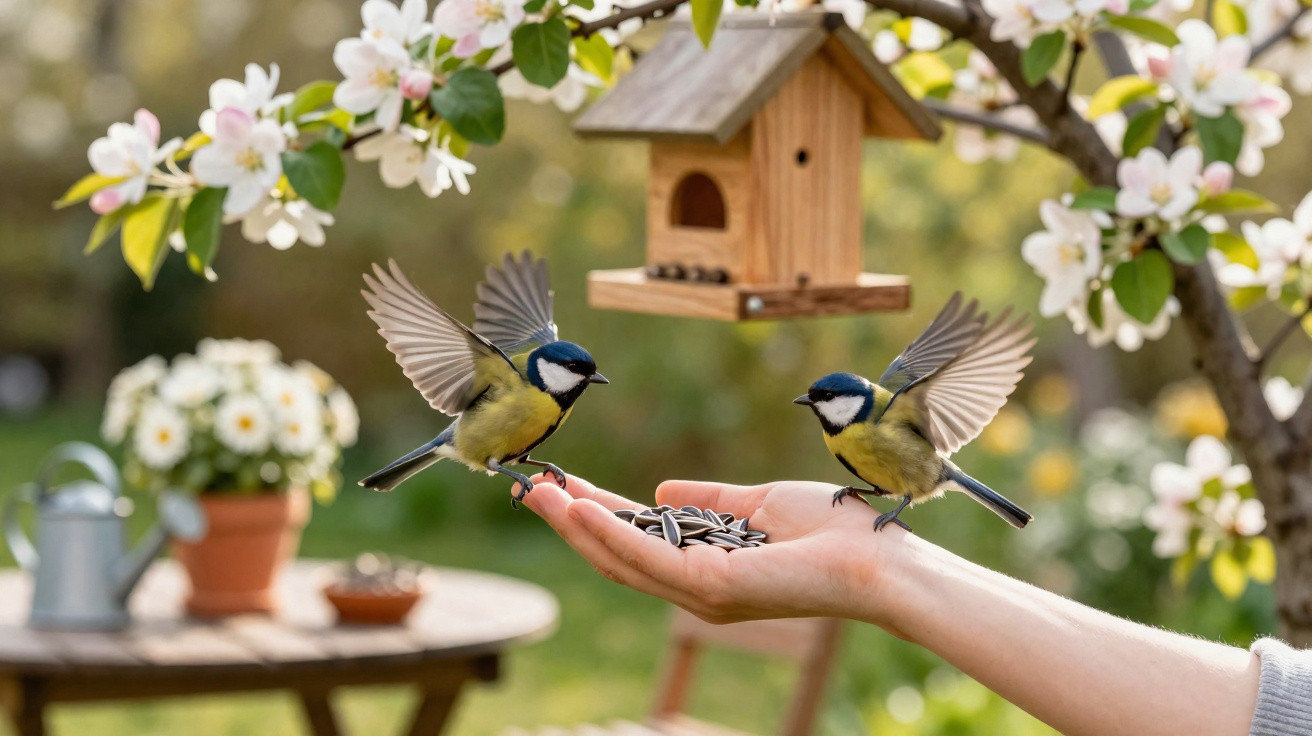
It could, however, be bursting with tits, birdsong and life.
Plenty of amateur gardeners dutifully put up a nest box in spring - then wonder why the cheerful flutter never arrives. The reason is simple: one box on its own is rarely enough to genuinely attract tits. If you want great tits and blue tits to settle in your garden for the long term, you need to think of the whole space as a small, living mini-woodland - with food, hiding places, dense planting and safe nesting options.
Why tits avoid your garden in the first place
Tits are inquisitive, quick and adaptable, yet they’re surprisingly picky about where they raise a brood. A closely mown lawn, a solitary tree, and otherwise just gravel and a line of conifers can feel less like a home and more like a desert. Above all, they look for three things: safety, food and variety.
"A garden only becomes interesting to tits when it works like a small ecosystem - not like a sterile showroom."
The more a plot appears meticulously “tidied”, the less appealing it tends to be for birds. Paved-over areas, gravel gardens, noisy robot mowers or hedges clipped into shape all year round rob tits of the calm and the structure they rely on. In that case, they’ll often choose older gardens instead - places with mature trees, ivy-covered walls, hedges and plenty of insects.
The overlooked trick: keep natural nesting sites
Nest boxes are useful, but they’re only one part of the picture. Bird conservation specialists repeatedly point out that the most important step is often not adding something new, but leaving in place what people are tempted to remove - cracks, gaps, old trees and weathered walls.
Where tits nest in the wild
- Hollows in old trees or dead branches
- Crevices in walls, beneath roof tiles or behind timber cladding
- Cavities in older fruit trees
- Dense hedges with sheltered interiors
Many homeowners renovate, insulate and seal up every joint in the house. It may look neat, but it takes away traditional nesting sites. If you deliberately keep a few niches during building work, or plan in purpose-made nesting bricks, you quickly earn “points” with tits, sparrows and swallows.
"Every crack, every tree hollow, every gap in a wall can be the difference for a tit between ‘I’ll stay here’ and ‘I’ll keep flying’."
Using nest boxes properly: position, height, direction
Even a well-intentioned nest box can achieve nothing if it’s put up in the wrong place. Tits are choosy about both location and set-up.
- Height: Around 2–4 metres above the ground is ideal, so cats, martens and children’s hands can’t reach it.
- Direction: A gentle east or south-east aspect helps protect against driving rain and fierce midday heat.
- Peace and quiet: Don’t place a box right by the patio or next to doors that are used constantly.
- Cover: Position it near shrubs or trees so fledglings can find shelter soon after leaving the nest.
- Cleaning: Empty it once a year in late summer to prevent parasites building up.
The entrance hole also needs to be the correct size. For great tits, a diameter of about 32 millimetres usually works well; for blue tits, closer to 28 millimetres. If the opening is too large, predators are effectively given an invitation.
No insects, no young tits
When people think of tits, they often picture sunflower hearts or fat balls. During breeding season, that won’t be enough. Parent birds need huge quantities of insects and larvae to raise their chicks. A single brood can get through thousands of tiny insects.
Which plants provide food for tits
The most effective “tit method” in the garden is therefore: choose plants that attract insects and later offer seeds. Native species are particularly valuable.
- Flowering wild perennials such as oxeye daisies, viper’s bugloss, knapweeds, wild marjoram
- Native shrubs such as hazel, elder, blackthorn, hawthorn, dog rose (rose hips)
- Flowering herbs such as thyme, oregano, sage, chives
- Meadow flowers instead of a uniform lawn, for example clover and bellflowers
"The more buzzing, crawling and fluttering there is in the border, the greater the chance that tits will stay and breed successfully."
Showy garden-centre plants with double flowers, or heavily bred cultivars, can look spectacular - yet they often provide little nectar or pollen for insects. That reduces the food supply birds depend on.
Hedges instead of fences: structure brings life
A bare lawn is still often seen as “low maintenance” - but to tits it’s simply uninteresting. They need layered structure at different heights: ground cover, perennials, shrubs and trees. Hedges, in particular, play a central role.
How to turn a hedge into a tit hotspot
- Mix different woody plants: for instance privet, hawthorn, cornelian cherry, rugosa-type rose hips.
- Avoid constant trimming: don’t keep it clipped tight; allow phases of denser, natural growth.
- Leave the interior alone: don’t “clean out” everything - leaves and small twigs inside offer shelter.
- Time pruning carefully: don’t do drastic cuts during the breeding period between March and August.
Berrying shrubs do several jobs at once: they provide food, create shade and offer safe cover in their branches. Even in winter, dried fruits can still be useful.
Weather protection and safety for small songbirds
Heavy downpours, storms and late frosts can be tough on tits. Dense, evergreen shrubs can therefore give a real advantage. Cherry laurel, yew (caution: highly poisonous to humans), holly or honeysuckles can provide cover throughout the year.
"A garden becomes a ‘four-season hotel’ for birds when there are still hidden, protected corners even in January."
Safety from cats and martens matters too. If you want to protect your tits, pay attention to:
- Barbed wire or smooth collars on trunk sections where nest boxes are mounted
- No bird feeding stations right beside dense shrubs that cats can use as a launch point
- Quiet areas without constant noise, party lighting or robot mowers running all the time
Think of the garden as a small ecosystem
The most surprisingly effective “method” for attracting more tits isn’t a clever gadget at all, but a change in mindset: away from a decorative garden and towards a living habitat. If you allow plant variety, leave some fallen leaves, and tolerate dead wood, you encourage beetles, spiders and larvae - and that naturally draws in tits.
Even a small area can be enough to begin with: a wilder corner by the fence, a less manicured perennial bed, or a tiny “mini-wood” with shrubs and a tree. Many birds use these pockets as stepping stones through built-up neighbourhoods.
How wild can you let the garden become?
Many people worry that a wildlife-friendly garden will look neglected or cause friction with neighbours. A middle way usually works well: keep tidy edges and clearly defined paths facing the street, and deliberately leave areas “wild” behind. The appearance stays orderly, while the benefit for tits and other species remains substantial.
If you’re unsure, contact local nature or wildlife groups. They often provide practical advice on which shrubs make sense in your area, and sometimes even run plant-swap events. Some councils now actively support nature-friendly gardens.
Practical additions for beginners
If you want to get going within the same spring, a few quick measures are ideal:
- Put up or reposition at least one species-appropriate nest box
- Stop mowing part of the lawn weekly and let it turn into a flowering meadow
- Plant one or two native berrying shrubs
- Create a small corner with a pile of wood or leaves as an insect refuge
- Avoid chemical pesticides so insect populations can recover
The impact comes from combining these steps: more insects, more shelter, more structure - and therefore a better chance that tits won’t just drop in briefly in spring, but genuinely stay and raise their young.



Comments
No comments yet. Be the first to comment!
Leave a Comment