
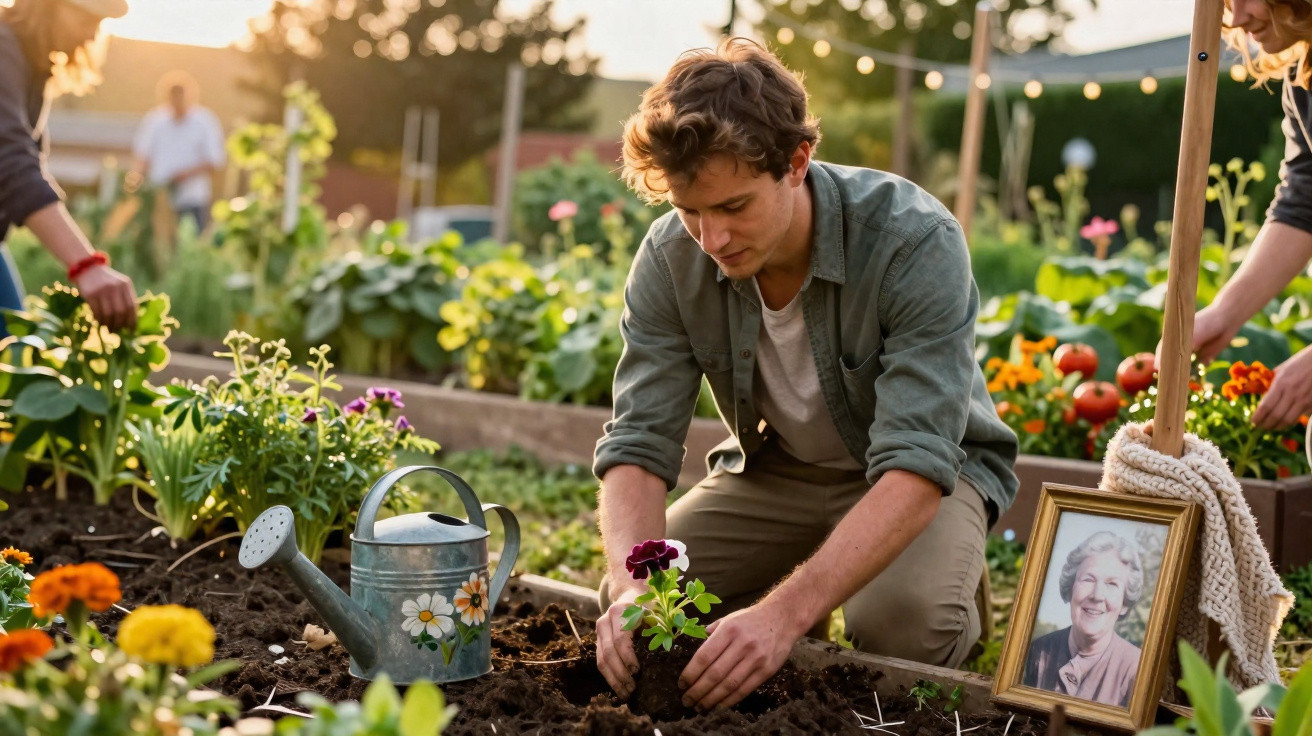
Not because a city planner put pen to paper, but because a boy in mud-splattered trainers couldn’t bear to see the space sitting unused any longer. He grips a plastic trowel in one hand; in his pocket is a folded photograph of an older woman smiling among rose bushes.
He’s only 11, yet his voice becomes unexpectedly solemn whenever he says her name. As neighbours walk past, they slow down - some simply curious, others touched enough to pause and ask whether they can lend a hand. A few turn up with seeds. One woman returns later with a bench.
He presses the soil flat, wipes his nose on his sleeve, and nods towards a bare strip by the fence: “That’s where Grandma’s corner will be.”
No one can quite tell yet how far this will go.
The day a vacant lot turned into a promise
The first time Ethan nudged open the chain-link gate, the place reeked of rust and damp cardboard. Weeds hid shards of broken glass that caught the light. It was a world away from the garden his grandmother had tended behind her small brick house.
He stood in the middle of it with a packet of supermarket seeds and a garden fork far too big for his hands. Cars rolled by behind him, dog walkers passed, and the rest of life carried on. The only thing that didn’t feel ready to move forward was the way he kept looking at the soil, as if he were waiting for her to reply.
What set everything in motion was a sentence no grown-up had prepared for: “Can I grow her favourites here?”
That one question ended up reshaping the whole street.
News travelled fast: an 11‑year‑old trying to create a community garden to honour his late grandmother. The story spread quicker than seeds on a gust of wind. First, neighbours appeared, leaning over the fence with hesitant smiles and spare tools. Soon after, the local school joined in, offering a Saturday of “volunteer hours” that felt less like duty and more like a dirt-streaked get-together.
A retired teacher showed up with marigold packets and a story about losing her own sister. A teenager who insisted he “hated plants” painted a sign that read “Grandma Rose’s Garden – Everyone Welcome”. By the end of the first month, the abandoned plot had raised beds, a compost corner, and a chalkboard where people left messages such as “Miss you, Nana” and “For Dad, who loved tomatoes.”
What began as one boy’s private grief turned into something that reflected everyone else’s too.
Landscape architects like to talk about “activating public space”. What Ethan did was more unfiltered - and much more human. He took a memory and made it somewhere you can physically stand. Rather than shutting his loss away, he laid it out on the soil and invited others to plant their own stories alongside it.
The garden gave shape to an emotion that normally stays behind closed curtains. It also offered something grief rarely provides: a straightforward action you can repeat. Put a seed in the ground. Water it. Let it grow in its own time. People weren’t merely “supporting a project”; they were taking back a piece of land and turning it into a shared archive of love stories.
And without intending to, a child created the very thing adults often talk about - and often struggle to build: a genuine community.
How one small ritual turned into a living memorial
Each Saturday starts the same way for Ethan. He pulls the creased photo of his grandmother from his pocket, sets it on the edge of a raised bed, and murmurs something only he can hear. It’s not theatrical. It takes three seconds. Then he puts on his gloves and gets on with the work.
That small ritual steadies the whole garden. It keeps his reason for being there close, and quietly signals to everyone else that this isn’t just a “green project”. It’s a conversation between what used to be and what might still be possible. If you’re considering making a memory garden yourself, it can begin right there: one simple, repeatable action that links you to the person you’re missing.
You don’t need marble plaques or grand speeches. You need a habit that feels truthful.
People who join Ethan often arrive with kind intentions - and a flicker of panic: “I don’t know anything about gardening.” He laughs, shrugs, and passes them a watering can. The biggest mistake newcomers make isn’t yanking out the wrong weed. It’s trying to make the place perfect on day one.
Plants don’t behave like that, and neither does grief. Some weeks, half the beds look weary, and the compost heap smells stronger than anyone would prefer. Some Saturdays the rain comes down so hard that nobody turns up. There are mornings when Ethan can’t face getting out of bed, and the soil goes untouched.
Let’s be honest: nobody truly keeps this up every single day.
Yet the garden doesn’t punish the gaps. Some things appear late - or not at all. Fresh seeds show up anyway. A child drops a sunflower packet by accident, and three months later the flowers are towering over everyone. The message is gentle: you don’t have to arrive perfectly, only often enough for life to have another chance.
As the beds fill out, people begin saying things they usually swallow down.
“I thought coming here would make me sadder,” one neighbour told me, pulling up a stubborn dandelion. “Instead, I feel like I can finally talk about her without choking.”
That’s the quiet strength of a place like this. It gives people a socially acceptable reason to be present “for the plants”, while their hands are occupied with something else altogether - their regrets, their love, their unfinished conversations.
- A corner for favourite flowers, each labelled with a name
- A plain notebook where visitors can write who they’re thinking of
- A shared shelf of gloves and tools, so nobody feels they’re “not equipped”
- At least one seat where it’s OK to just sit and not speak
You can’t design the emotions that will arrive, but you can make room for them to breathe.
What this garden quietly asks the rest of us
Stand by the gate of Grandma Rose’s Garden on a late-summer afternoon and you’ll hear an unusual soundtrack: children laughing as they weave between the rows; an elderly man explaining how his mother once grew beans on a balcony; a spade striking a stone, a sharp swear word, and then everyone laughing.
On a low wooden sign, someone has painted: “This garden is for anyone who’s ever missed someone at dinner.” It hits a nerve. On a hard day, it might make you swallow. On a lighter day, it might make you pick up a packet of seeds and stay a while.
On a screen, grief is often flattened into tidy quotations and soft-focus images. Here, it’s mixed with sweat, soil, and children asking whether worms have feelings. Online, community can look like a hashtag. Here, it looks like a boy trying to haul a watering can that’s obviously too heavy for him - and three people hurrying over to help, pretending they were heading that way anyway.
We all recognise that moment: you pass somewhere that mattered to someone you loved, and your chest tightens for no clear reason. Ethan’s garden takes that quiet ache and gives it something practical to do.
The question hanging over the beds isn’t “Isn’t this inspiring?” It’s blunter than that: What are you going to grow from what you’ve lost?
| Key point | Detail | Why it matters to the reader |
|---|---|---|
| A simple gesture | A discreet, repeated ritual gives the garden meaning | Offers a practical idea for honouring a loved one |
| A shared place | The garden becomes a space where stories meet | Helps you feel less alone in grief |
| A different sense of time | Plant cycles impose a slower rhythm | Makes it easier to live with pain without rushing it - or running from it |
FAQ:
- Can a child really start a community garden? Yes. Adults are needed for logistics and safety, but a child’s idea and drive can absolutely be the spark that rallies everyone.
- Do I need gardening experience to join something like this? No. Most community gardens happily teach beginners; simple tasks like watering, mulching, or labelling plants are always welcome.
- How can a garden help with grief? Tending plants provides a physical outlet for emotions, a sense of continuity, and a quiet place to remember without having to talk nonstop.
- What if I don’t have access to a vacant lot? You can start smaller: a shared courtyard bed, pots on a building staircase, or a school corner can all become symbolic spaces.
- How do I keep a memorial garden from feeling too heavy? Mix memory with life: add bright flowers, invite children, celebrate harvests, and let laughter coexist with tears.
Comments
No comments yet. Be the first to comment!
Leave a Comment