
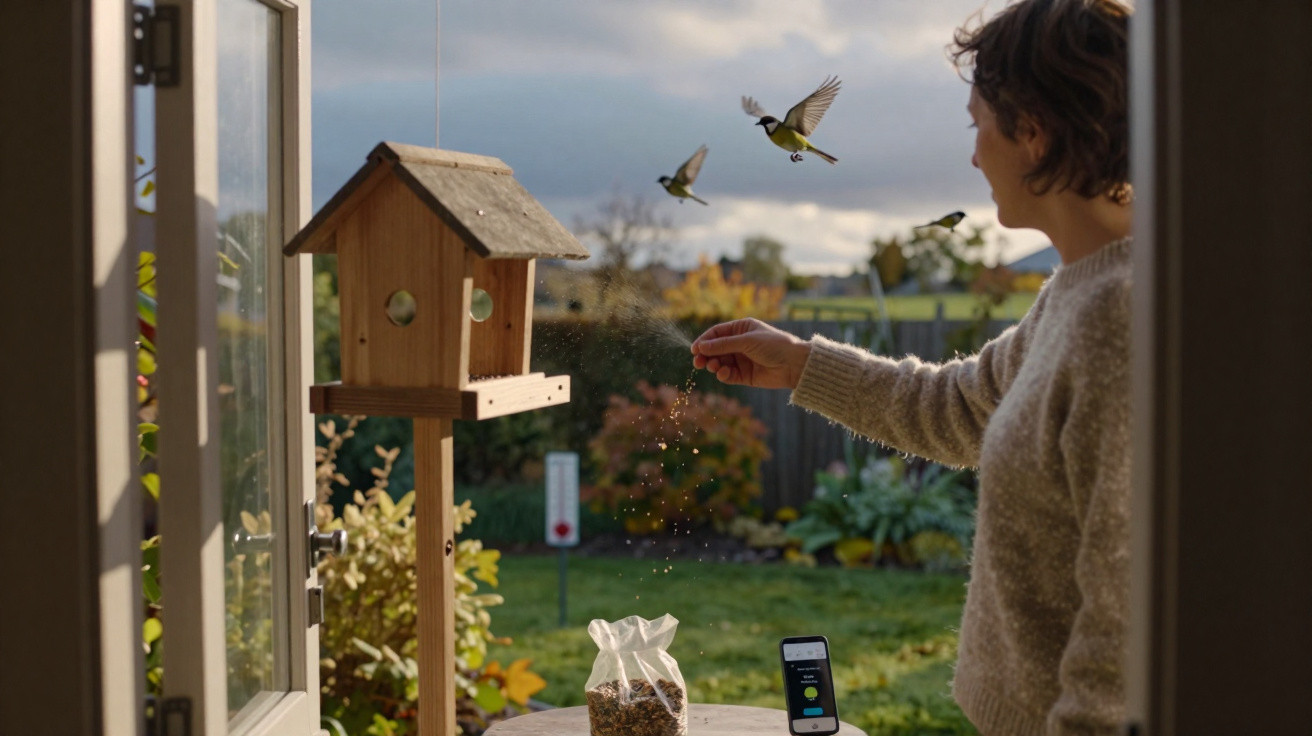
The seed feeder is still rocking gently from last night’s gusts, yet the branches around it look bare and the air feels strangely hollow. Only yesterday the lawn was busy: blackbirds squabbling, sparrows picking fights, and a robin holding its brave little stand-off near the patio. Today there’s nothing-no flutter of wings, no flash of colour-just the far-off drone of traffic and that sharp, cold edge hanging in the atmosphere.
You glance at the thermometer. The forecast says the temperature will fall later on. You start to wonder whether the birds have sensed it first. Perhaps they’ve disappeared because something’s off in your garden. Perhaps it’s something you’ve done.
And yet, any wildlife expert will tell you this kind of silence usually has a reason.
Why your garden feels “empty” hours before a cold snap
Spend time with birders who are outdoors in all weathers and you’ll hear the same point: garden birds are highly attuned to shifts in the weather. They don’t need an app-they read the sky. Well before frost reaches the ground, they pick up on falling pressure, changes in the feel of the air, and a wind that has nudged round by only a few degrees. Where we think, “It’s turning a bit chilly,” they register a warning.
That’s why a sudden lull at the feeders on an autumn afternoon that still looks mild is rarely coincidence. Many species deliberately drop out of sight. They melt into hedges, thick shrubs, belts of conifers, reedbeds, and old walls covered in ivy. A garden that felt like a bustling café half a day earlier can seem like a deserted street just before bad weather. That quiet is simply them pulling the shutters down.
On a small estate in southern England, a wildlife group ran a winter-long garden-bird survey. Volunteers recorded every bird at their feeders, hour by hour whenever they could. On settled days, gardens typically reached 10 to 15 species by mid-morning. When barometric pressure fell quickly ahead of a cold front, the count often dropped to about half within a couple of hours. Starlings that had been jostling over fat balls disappeared completely. Finches shifted up into tall trees. Robins-often fearless-slipped deep into bramble tangles.
To anyone indoors, nothing obvious had changed. The lawns looked the same. The feeders were in the same place. People were still in their kitchens making tea. But the records showed distinct surges and dips around each cold spell, like a tide drawing back and then returning. One pensioner involved in the survey scribbled in the margin of her logbook: “Garden feels lonely. Radio on to fill the quiet.”
There’s nothing mystical at work-just a body built for fine detail. Birds respond to barometric pressure, wind direction, humidity, and slight shifts in light. As pressure drops ahead of a cold front, insects alter their behaviour, seeds loosen from plants, and thermals change. Birds often react with a short burst of intense feeding, then retreat into safer cover to sit out the worst. Some species, such as tits and finches, travel in loose groups between gardens and nearby woodland, almost like commuters switching lines. Others conserve heat by hunkering down in dense vegetation, puffing up their feathers and moving as little as possible. From the window it can look as if they’ve “gone”. In reality, many are only a few metres away, waiting out the weather.
How experts say you can support birds before the temperature drops
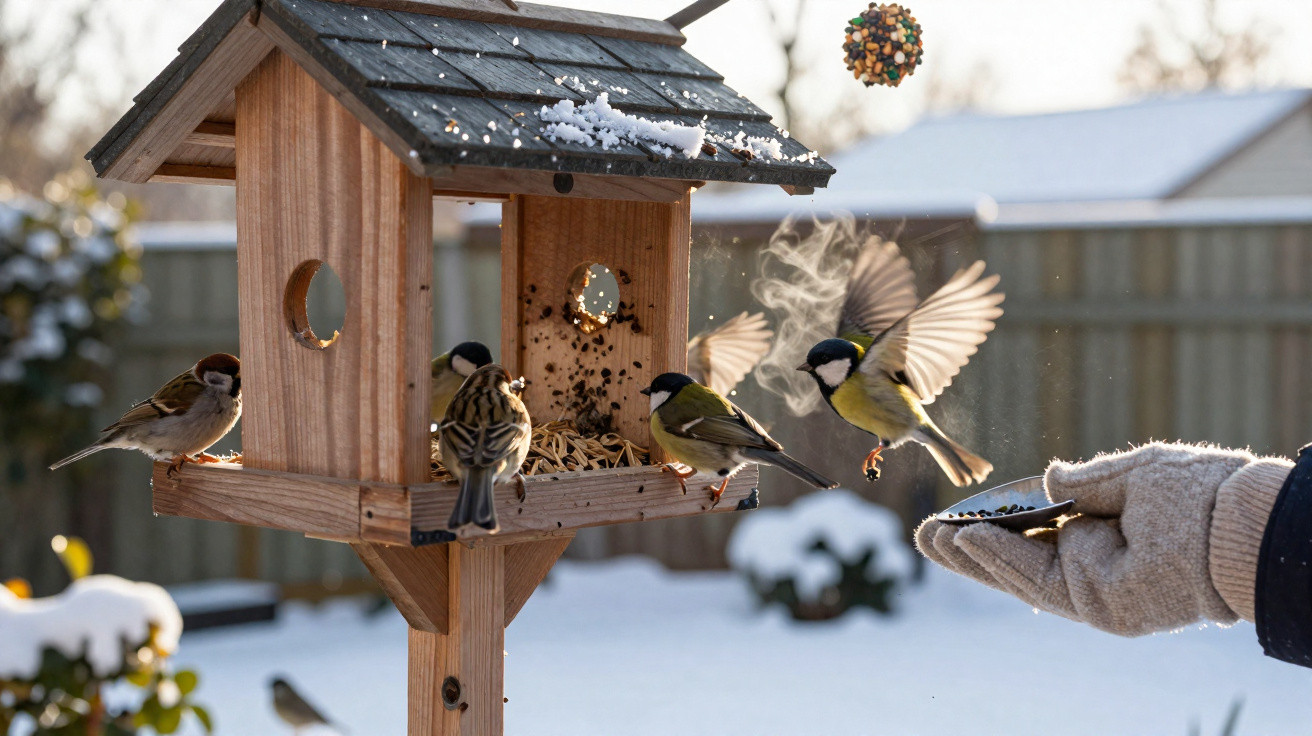
Wildlife experts who ring and track garden birds see the same cycle each winter: a rapid refuelling, followed by a sudden retreat. The most helpful thing you can do ahead of a cold snap is straightforward-make that busy feeding window worthwhile. In practice, that means prioritising calories, not only variety. High-fat choices such as suet blocks, fat balls without cheap nets, sunflower hearts, and peanuts in proper feeders can turn your garden into an emergency service station.
Put food out early, particularly when the sky feels heavy and the forecast starts muttering about “overnight frost”. Birds need to fill up quickly while there’s daylight. Water matters just as much: set out a shallow dish and refresh it before it freezes. It’s easy to overlook water when rain has been frequent and the soil looks damp, but once temperatures fall, natural puddles and containers can ice over well before a sheltered bird bath does.
When birds abruptly vanish, many people worry and immediately start shifting things around-moving feeders, adding bright gadgets, constantly reorganising. A wildlife expert will usually tell you, calmly, that consistency helps. Birds learn what is safe. They memorise escape routes to fences, hedges, and roofs. If possible, keep a familiar set-up: one main feeding area, a couple of smaller spots, and nearby cover. On a terraced street in Leeds, one family kept an old, scruffy pyracantha beside the feeder “because the robin likes it”. Over three winters of notes, that same bush repeatedly became a refuge for dunnocks, wrens, and goldfinches whenever the temperature dipped sharply.
Most of us do what we can-and then feel oddly snubbed when the garden goes quiet. It’s tempting to overanalyse it: swap seed brands weekly, clean compulsively, buy increasingly elaborate mixes. Cleanliness does matter, of course, but birds also require places where they can disappear. If your space is all bare fencing, clipped lawn, and hard edges, it’s like offering a service station with nowhere to park. They’ll still use it, but only when they feel they can land and leave fast.
This is where a slightly looser approach to gardening pays off. Keep a scruffy corner. Allow one shrub to grow thicker than you usually would. A tangled climber on a wall can become a small, warmer “city” when the temperature drops. Let’s be honest: hardly anyone manages this perfectly every day, but even one deliberately “untidy” patch can change how safe birds feel in your space. And if the feeders stay quiet for a few days, try not to take it personally. Often, your regular visitors are simply tracking a short-lived food source further along the street, then returning when the cold spell eases.
“When a cold front’s coming, garden birds don’t disappear,” explains British wildlife ecologist Dr Emma Cox. “They’re switching into survival mode. What looks like absence is often just a few feet of movement into safer cover. If your garden gives them food, water and somewhere to hide, they’ll remember it when the weather hits hardest.”
Experts like Cox often describe “three pillars”: food, water, shelter. It can sound almost too basic, yet it’s supported again and again. And for us there’s a fourth, quieter pillar: patience. Birds aren’t there to perform at the kitchen window each morning. They’re not ornaments; they’re running constant calculations about energy and risk. If you can accept that uneasy hush before a cold snap-and keep providing what they need-your garden becomes part of their internal map of reliable places.
- Keep at least one feeder topped up with high-fat food ahead of cold spells.
- Offer a shallow, ice-free water source in a sheltered spot.
- Leave or plant dense cover: hedges, shrubs, climbers, evergreen corners.
The hidden drama playing out beyond your window
On a flat grey January afternoon, a retired teacher in Norfolk filmed what she thought was an “empty” garden for a local wildlife group. The feeder stood unused; nothing moved on the lawn. Later, the group installed a motion-activated camera aimed at the same area, but framed wider to include the hedge, the neighbour’s apple tree, and the fence-top. The footage told a different story: blue tits moving along branches, a wren flicking through ivy leaves, and a blackbird sliding under a shrub like a shadow.
For us, the feeder is the stage. For them, the stage is the whole patchwork of gardens, hedgerows, and trees. That’s why the quiet before a temperature drop can feel so sudden and unsettling. The activity hasn’t ended-it has simply shifted off-centre, into the wings. For a while your garden becomes more of a corridor than a café. Once the harshest cold passes, if your space has helped them before, many will drift back as if nothing happened, ready to resume their arguments over the same scrap of ground.
Next time your garden falls silent ahead of a cold front, you may interpret it differently-not as rejection, not as “my birds are gone”, but as a wild set of calculations happening in hedges, fields, and woodland edges beyond the fence. It prompts a different question: what kind of stop do you want to be on that invisible map? A one-off snack bar, or a dependable place they can return to through strange winters, sharper frosts, and unpredictable storms?
| Key point | Detail | Why it matters to you |
|---|---|---|
| Birds “disappear” before the cold | They react to falling pressure and retreat into denser shelter. | Reassures you the garden itself may not be the problem. |
| A crucial feeding window | Before a cold front, birds briefly fill up on high-fat food. | Helps you adjust feeding so it genuinely supports them. |
| The vital role of plant cover | Hedges, shrubs, ivy and “scruffy” corners become survival zones. | Offers practical ideas for shaping a more bird-friendly garden. |
FAQ:
- Why do my garden birds vanish even when it still feels mild to me? They sense changes in barometric pressure, wind and light long before we notice. That early warning triggers them to feed fast, then move into safer cover or different feeding grounds before the real cold hits.
- Have my birds migrated, or are they just hiding nearby? Some species do migrate, but many common garden birds simply shift a short distance into hedges, woods or other gardens. They may be only tens of metres away, but no longer visible from your window.
- Should I move my feeders when the birds stop coming? Not immediately. Sudden changes can add stress. Keep feeders clean, stocked with high-energy food and close to cover. If the layout has worked before, birds are likely following a temporary food source or lying low from the cold.
- What kind of food helps them most before a cold snap? High-fat and high-energy options: suet, fat balls (without plastic nets), sunflower hearts and peanuts in secure feeders. Mixed seed is fine, but the concentrated calories really matter when temperatures drop.
- How can I make my small yard more attractive and safe for birds in winter? Even a tiny space can help: add one dense shrub or climber, place a feeder near that cover, and offer a shallow water dish that you break the ice on in the morning. Small, consistent gestures count more than a perfect, manicured setup.
Comments
No comments yet. Be the first to comment!
Leave a Comment