
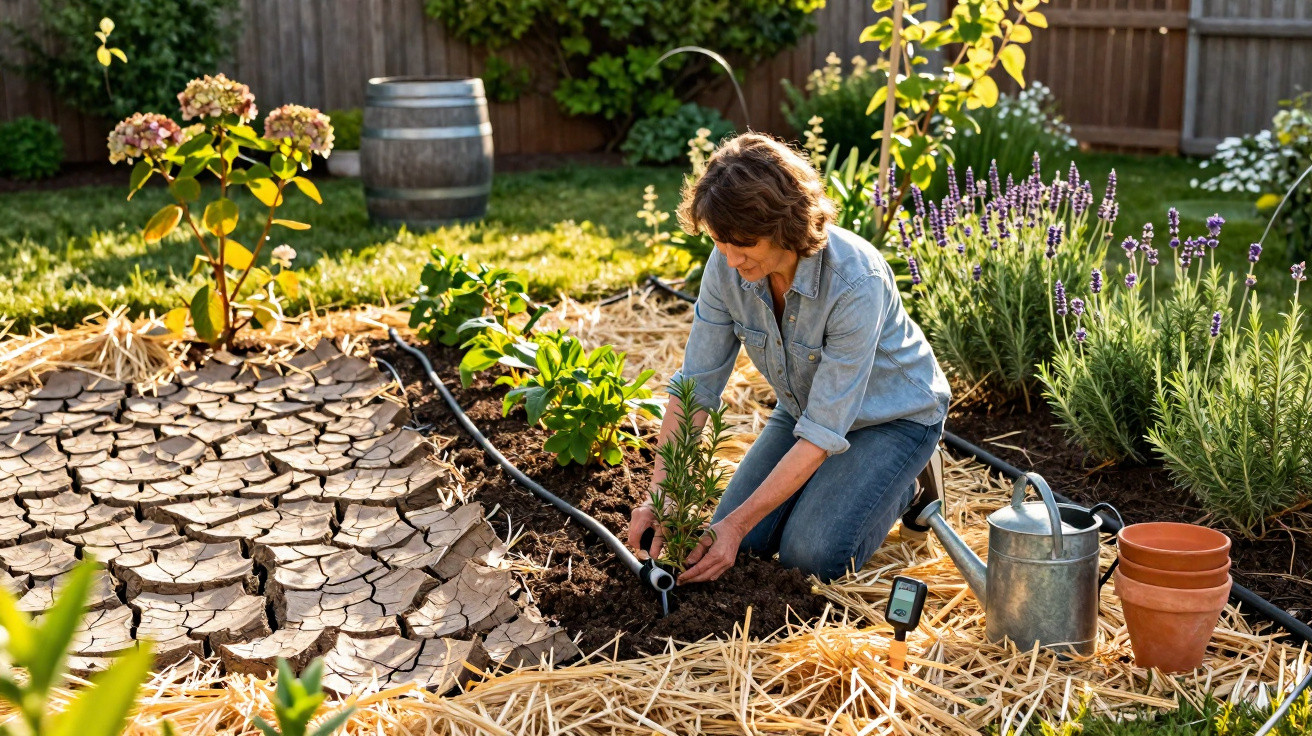
The lawn crackles under your flip-flops, brittle as straw.
The hosepipe that used to sweep across the garden in a lazy arc now sits for days against the wall, because the water bill has climbed and the rain has decided to take a holiday. In the border, the azalea leaves curl inwards, a quiet kind of self-defence. If you care about plants, you feel that tightening almost in your body: every yellowing leaf, every bud that never opens, arrives with a small sting of guilt. Beyond the gate, the whole neighbourhood looks washed out. Even so, here and there, one garden stays green-defying the cloudless blue sky and the drought warnings. You walk past, slow down, and wonder: what are they doing differently?
The silent impact of drought on the home garden
Most of us know the moment: you open the window in the morning, glance out at the back garden, and sense something has slipped out of balance. The vivid green has turned into a patchwork of browns; the thin lawn looks more like a worn rug; and the plants that used to make you proud are now asking for help without a sound. Drought rarely arrives with a bang-it creeps in. First come restrictions on water use, then a run of hard, bright days, and the hot afternoon wind. By the time you properly notice, it isn’t only the garden that’s dried out; a piece of your routine has dried up with it.
Across many Brazilian cities, the pattern repeats year after year: longer dry spells, heat above the average, reservoirs under strain. In 2023, for instance, several state capitals announced rota systems or formally asked residential areas to cut their water consumption. And the garden-oddly enough-becomes a kind of household barometer for that wider problem: without a plan, plants can collapse in a matter of weeks. In Sorocaba, one resident said she lost half her lawn in a single month during a harsher dry stretch. On the same street, a neighbour kept the back garden green using half the water they’d used before. The difference was down to approach, not luck.
There’s a clear logic behind the gardens that cope when the sky “turns off the tap”. It isn’t magic or a family secret. It’s about understanding how your soil holds water (or fails to), what roots do under stress, and how the sun hits each part of the plot. Deep-rooted plants manage longer without watering; covered soil loses less to evaporation; and watering at the right times makes each litre go further. Once you start treating the garden as a small ecosystem-rather than “some grass and a few pots”-your choices shift. The drought is still there, and that red warning ring in the weather app doesn’t disappear. But your garden stops being a casualty and starts becoming resilient.
Practical techniques to keep things green with little water
The biggest change starts at ground level: begin with the soil, not the hosepipe. Gardens that get through dry periods with any grace usually have a protective layer over the earth-mulch, or a dead organic cover. That can be shredded dry leaves, bark, finely cut lawn clippings that have already wilted, or light-coloured gravel. Think of it as a blanket: it slows evaporation, shields roots from direct heat, and helps keep the soil conditions steadier. If you try it on just one section of a bed, you’ll quickly notice the difference in moisture when you press a finger into the soil. Same watering, noticeably different outcome.
Another crucial shift is letting go of daily, shallow watering-the quick splash that dampens only the top couple of centimetres. Honestly, hardly anyone keeps that up with the patience it would require; it’s more an evening guilt ritual than a strategy. In drought conditions, the better method is to water less often but thoroughly, always early in the morning or later in the day when the sun is lower. That gives water time to soak in, encourages roots to grow downwards in search of moisture, and makes the plant tougher overall. If you only wet the surface, you train the plant into “lazy” shallow roots that struggle as soon as the hot days stack up.
“You don’t beat drought with more water-you beat it with smarter use of water,” an agronomist who advises small rural properties in the interior of Minas Gerais told me.
She usually boils her advice down to a handful of straightforward points:
- Cover the soil: dry leaves, bark, coarse sawdust, or pale gravel help trap moisture.
- Gradually replant with hardier species that are suited to your region’s climate.
- Swap the hosepipe for a watering can or drip irrigation in smaller areas, so you can truly control how much you’re using.
- Collect rainwater when it does arrive, using water butts or simple buckets-even on a small balcony.
- Watch the shade: a piece of shade cloth (shade netting) or simply moving a pot can greatly reduce water stress.
Common mistakes, tougher species, and a new way of seeing the garden
One of the most common drought mistakes is switching into panic mode and pouring on extra water “to save the plants”. It often backfires. Warm, waterlogged soil is an open invitation to fungi and root rot, especially in containers. A more effective approach is the gardener’s approach: feel the soil, notice its texture, look at the sheen and posture of the leaves. Some plants droop in the middle of the afternoon as a protective tactic and recover on their own overnight. Others shed leaves entirely-those are the ones signalling they’ve crossed the line. Once you learn the difference, you can direct water to what genuinely needs it, at the right moment.
Expectations matter as well. Many people try to maintain-right through a dry season-the catalogue-perfect image of an English-style garden with a golf-course lawn. Disappointment is almost guaranteed. Drought-adapted gardens have a different look: less of a single uniform carpet and more mixed textures; more areas finished with gravel, decking, or raised beds. That doesn’t mean giving up on beauty-it means changing the benchmark. Plants such as succulents, lantanas, ixoras, box (buxus), agapanthus, russelia, lavender, and clusia can cope well with less water once properly established. Batatais and Esmeralda lawn grasses, kept slightly longer when mowing, also tend to handle dry spells better than turf cut right down to the limit.
Dry weather can also hit the emotions of the person looking after the garden. Some feel embarrassed to show a struggling back garden, as if it’s a sign of neglect, when it’s really a shared challenge tied to climate and city infrastructure. The first step may be easing that self-pressure and accepting a garden “in progress” that adapts over time. People who share experiments with neighbours, local groups, or on social media often uncover practical, local fixes-from reusing washing-machine water (for specific uses, and filtered) to community workdays installing simple rain-capture systems. A drought-resilient garden can become a small community laboratory.
A new relationship with greenery in times of drought
When taps come under scrutiny and the news starts talking about water crisis, keeping a garden green can feel like an indulgence. Yet many people discover the opposite in practice: a living back garden becomes a refuge during extreme heat, helps lower the temperature around the home, adds a bit of humidity to the air, and reduces that stifling feeling. It isn’t only about looks-it’s everyday comfort. And that comfort can come from simple choices, like creating one shaded area with larger potted plants, mulching the soil, and replacing “all lawn” with a more thoughtful mosaic of species.
Drought may also force questions that used to be brushed under the green carpet. Why persist with plants that live on the garden’s “intensive care unit”, reliant on constant watering? What kind of garden truly fits the climate where we live, the water bill we pay, and the time we realistically have? Once those answers shape the plan, the design changes: the lawn can shrink a little; beds can be filled with tougher plants; climbing plants can cover a wall and shade part of the house. Small decisions, added together, redraw the map of your back garden.
It may be worth telling that story-showing before and after, what worked and what didn’t, and giving hope to someone staring at a scorched patch and thinking there’s nothing left but to rip it all out. Gardens that endure aren’t built on expensive tricks; they’re built on observation, trial, and patience. In a world where dry spells are likely to become more frequent, this stops being “plant enthusiast chat” and becomes a practical part of urban domestic life. Even a small garden can be a rehearsal for living with less water and more care-and that might be where green starts to feel meaningful again.
| Key point | Detail | Value for the reader |
|---|---|---|
| Soil covering | Using dry leaves, bark, cut grass, or gravel to reduce evaporation | Saves water and keeps the garden moist for longer |
| Deep, spaced watering | Less frequent watering, but water reaching the roots, always at cooler times | More resilient plants, stronger roots, and less waste |
| Choosing hardy species | Prioritising plants adapted to the local climate and tolerant of drought | A good-looking garden year-round, with less maintenance and cost |
FAQ:
- Question 1: Can I keep the same lawn during a drought?
It depends on the grass type and how willing you are to adjust your routine. Grasses such as Batatais and Esmeralda tolerate dry spells better if you keep them slightly longer and if the soil is covered. In extreme conditions, it may be worth replacing part of the area with planted beds, gravel, or tougher species.- Question 2: Does watering a little bit every day help or hinder?
It hinders. Shallow watering encourages shallow roots, which suffer more in heat. During drought, it’s better to water less often but let the water soak deeply, always at the coolest times of day.- Question 3: Can I use washing-machine water in the garden?
In some cases, yes-provided it’s rinse water, with mild detergent and no strong bleach. Even then, it’s best used on hardier plants and in the ground rather than in small pots. Start gradually and watch how the garden responds.- Question 4: Which plants cope best with dry periods?
Succulents in general, lavender, agapanthus, lantanas, russelia, clusia, box (buxus), some ornamental grasses, and native trees from your region. In pots, cacti and crotons also tend to adapt well to longer gaps between watering.- Question 5: Is putting a saucer of water under pots a good idea?
For drought conditions, it doesn’t help as much as it seems and it can also become a breeding spot for mosquitoes that can spread dengue. It’s safer to use pots with good drainage and add a covering on top of the compost, which reduces moisture loss more effectively.
Comments
No comments yet. Be the first to comment!
Leave a Comment