
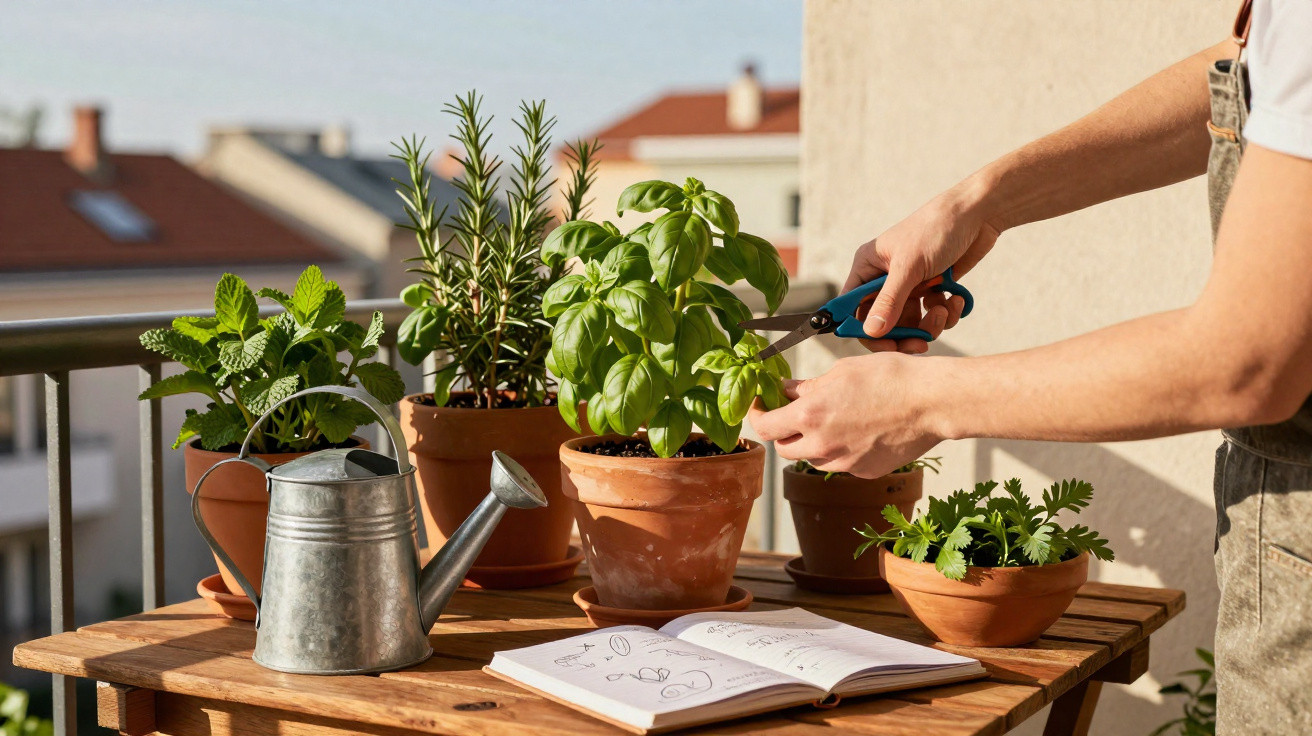
The basil gave up first. One day it was a thick, fragrant cushion along the balcony rail; the next it looked miserable-leaves tightening into curls, stems darkening at the base.
Not long after, the mint-supposedly “unkillable”, according to everyone-began to slump and spread in a tired way, and that crisp, icy scent faded when you ran your fingers through it.
The rosemary simply stayed put: rigid, slow, and oddly resigned, as if it had lost the will to cope in a plastic pot above a loud street.
So you try everything. You water. You turn the pots. You even speak to the plants once, and feel a bit daft doing it.
Still, your herbs never resemble those dreamy balcony photographs.
And then a single, small habit changes the whole picture.
The habit balcony gardeners almost always skip
Most people assume balcony herbs fail because of light levels or watering mistakes. Those factors do matter, but garden specialists repeatedly point to something even more fundamental: how often you harvest.
Not the occasional casual snip when you remember, but a steady, slightly brave cutting routine.
The one practice that consistently turns balcony herbs around is consistent, generous pruning.
That doesn’t mean once a month, and it doesn’t mean waiting until you suddenly need a handful of basil for pasta. It means a proper, planned “haircut” every week or every ten days-one that can feel oddly harsh at first.
Imagine two neighbours with the same small south-facing balcony. Same pots. Same shop-bought basil. Same bright-eyed start to spring.
Neighbour A becomes attached to the plant and hardly touches it. He removes one or two lower leaves, trying to “let it grow”. By July, his basil is tall and straggly: bare stem below, a small tuft of leaves at the top. It flowers early, the flavour turns bitter, and it dries out the moment he’s away for a weekend.
Neighbour B follows advice from a gardening friend. From the first few weeks, she cuts whole stems above a pair of leaves every Sunday-even when the plant still looks small. Her basil doesn’t flower. Instead, it thickens into a dense, two-level bush that spills over the pot, constantly pushing out dozens of soft new tips. Same balcony, almost absurdly different result.
Botanists describe the mechanism in straightforward terms. When you remove a herb’s growing tip, you stop its push upwards and trigger side branching. The plant shifts energy into dormant buds further down the stem, producing a fuller shape with more leaves positioned to catch the light.
On a balcony-where root space is tight and wind and heat can be unforgiving-that branching pattern is a survival advantage. A compact basil or thyme plant loses less moisture, stands up better to gusts, and photosynthesises more efficiently than a single thin stem stretching skywards.
The funny thing is that taking more, and taking it more often, usually brings you far more in return. That’s the quiet logic behind the weekly cut.
How to prune balcony herbs so they explode with growth
Garden specialists often refer to a “two-finger rule”. Each week, remove the top 5–7 cm of soft stems, pinching them off just above a healthy pair of leaves. Avoid picking single leaves from the middle of a stem; instead, take the tip so that two fresh shoots can replace it.
For basil, mint, oregano and marjoram, this cadence can feel almost miraculous. Begin once the plant has at least three full pairs of leaves, then pinch above the second pair. The small leaf joints that seem insignificant today can turn into sturdy branches within days.
Rosemary, sage and thyme prefer a lighter touch. Trim less, and only from soft, green growth-never from the old woody base. The idea stays the same: remove the tip and encourage the plant to split into two.
Where many balcony gardeners go wrong is with timing and nerves. They hold off until the herb looks “big enough” for a proper handful-something that rarely happens in a cramped pot. Or they hack at it in a rush once it’s already flowering and woody, by which point the plant has spent its best energy on seed production.
Most of us know that moment: staring at a drooping basil and thinking, “I killed another one, and I don’t even know why.”
What changes the story is steady, predictable action. Pick one day each week-Sunday morning coffee, Thursday evening, whatever suits your routine. On that day, step outside and cut, even if you’re not planning any special meal. Freeze what you take, dry it, or give it to a neighbour. The plant isn’t bothered what happens to the leaves; it reacts to the signal.
“People baby their herbs to death,” laughs balcony gardening coach Marta Leclerc. “They water, they stroke the leaves, they move the pot from one corner to another. What the plant needs is clarity: solid light, good drainage and a regular haircut. You almost have to be a little ruthless. That’s when the magic starts.”
- Cut above a pair of leaves – This awakens side buds and turns one stem into two.
- Prune before flowering – Once flowers appear, flavour drops and growth slows.
- Harvest in the morning – Essential oils are at their peak, herbs are more fragrant.
- Use clean scissors or fingers – Torn, dirty cuts can invite disease.
- Aim for little and often, not rare dramatic chops.
A balcony that behaves like a tiny herb farm
Once you commit to this single habit, something changes. Your balcony stops feeling like a line of decorative pots and starts operating like a small, ongoing herb farm. Each week, there’s something to harvest. Each week, the plants answer back with fresh growth. It becomes a rhythm, not a sequence of let-downs.
You also begin to notice details you previously missed: the way basil tilts its leaves towards the rail, how mint bounces back overnight after a scorching day, and how rosemary favours the drier corner close to the wall. You start to read what the plants are telling you through what happens after you prune.
And to be realistic, nobody keeps this up perfectly every single day. Life intervenes, holidays happen, and some weeks you simply forget. Even so, an imperfect routine beats the old cycle of neglect followed by guilt. That small act of consistency, repeated across the season, is what separates a struggling balcony from one that smells like summer every time you slide the door open.
| Key point | Detail | Value for the reader |
|---|---|---|
| Regular pruning habit | Weekly cutting of soft stem tips above a pair of leaves | Denser plants, more harvests, longer-lasting herbs |
| Start early, not late | Begin once herbs have 3 pairs of leaves, before flowering | Prevents legginess and bitterness, extends productive season |
| Think like a grower | Treat balcony as a mini-farm with a simple routine | Less frustration, more confidence, balcony becomes truly useful |
FAQ:
- Question 1 How often should I prune my balcony herbs?
Most specialists recommend every 7–10 days during active growth. In very hot weather, you can shorten that to lighter cuts every week so plants recover faster.- Question 2 Can I prune herbs that already started flowering?
Yes, but the result will be weaker. Cut back one third of the plant, removing all flower spikes, then resume regular pruning before new buds appear.- Question 3 Do I prune woody herbs like rosemary and thyme the same way as basil?
Not exactly. Stay on the green, flexible tips and prune less aggressively, a few centimetres at a time, two or three times per season.- Question 4 What if I don’t need that many herbs in the kitchen?
You can freeze chopped herbs in ice cube trays with a little water or oil, dry small bunches upside down, or simply share fresh sprigs with friends or neighbours.- Question 5 My basil keeps getting tall and bare. Is it too late to fix it?
You can cut it back hard, leaving two or three pairs of leaves on each stem. It may look brutal for a week, then usually comes back denser and greener if light and watering are right.
Comments
No comments yet. Be the first to comment!
Leave a Comment