
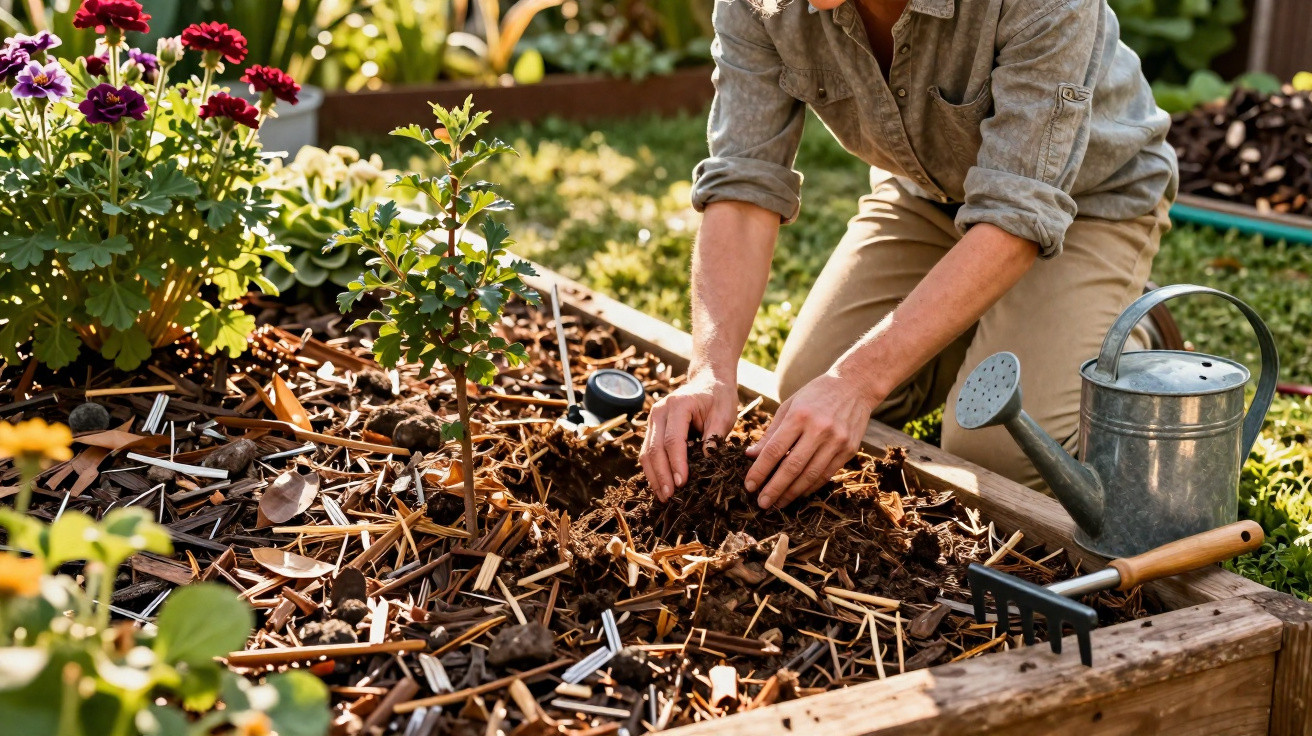
The first time I pushed my hand into the mulch at the base of my tomatoes in July, I knew something was off.
The sun was relentless and the air was baking, but beneath that soft brown layer the soil felt… cold and waterlogged.
The plants were clearly struggling: leaf edges curling, blossoms falling before they could set.
I’d piled the mulch up “to shield them from the heat”.
What I’d actually done was wrap them in a damp, airless duvet.
Then winter brought a different shock.
I swept aside the mulch I’d let thin out around my young fruit trees and saw roots sitting on the surface like veins - exposed and nipped by frost.
One season, too much.
The next, not enough.
That was the moment it clicked: the answer wasn’t simply more mulch or less mulch.
It was the right mulch thickness for the right season.
When mulch turns from friend to foe
Let’s begin with the reality nobody posts online: a bed that looks “perfectly mulched” and plants that are slumped and miserable.
At first I blamed watering, so I watered more.
The mulch stayed damp for days, the soil underneath turned sour, and the roots sat in a chilly soak.
Above ground, everything looked parched.
Below ground, it was closer to drowning.
That’s the mulch trap.
It looks like you’re doing the right thing.
But when the layer doesn’t match the conditions, it quietly interferes with root health.
One summer I followed the standard advice I kept seeing: “3–4 inches of mulch, everywhere, all the time.”
So I did - roses, veg, shrubs, even the herbs.
By mid-August, my basil was yellowing at the base.
The roses picked up fungal spotting.
The tomatoes stopped putting on growth and went an odd, dark green, as if time had slowed down.
When I pulled the mulch back, the soil under the deepest patches was cold and claggy.
Meanwhile, in an unmulched corner, the surface had baked and cracked - but at least the roots there stayed warm and active.
Same garden, same weather, completely different root behaviour, simply because the mulch thickness wasn’t the same.
That’s when the pattern became obvious.
Mulch isn’t only about “holding moisture” and “stopping weeds” like the bag promises.
A thick layer slows water getting into the soil, reduces air exchange, and dampens temperature swings.
Brilliant during heatwaves or harsh winters.
Awful in cool, wet spells, when roots need oxygen just as much as they need moisture.
Roots are fussy.
They prefer a fairly narrow temperature band, steady moisture, and air in the pore spaces of the soil.
Too much mulch in mild, rainy weather can smother them.
Too little mulch in extremes of heat or cold can jolt them.
What I needed wasn’t a single “correct” depth.
I needed to treat mulch like clothing: you wouldn’t wear the same jacket in July as you would in January.
My seasonal mulch “wardrobe” for calm, happy roots
Now I adjust mulch depth the way you’d change layers once you’ve finally learned what the weather is doing.
In late spring, as the soil starts warming (but before it’s really hot), I use a light covering: roughly 2–3 cm (1 inch) around vegetables, and 3–5 cm (1–2 inches) around shrubs and perennials.
When proper summer arrives and the soil is genuinely warm, I build it up.
Veg beds go to about 5 cm (2 inches).
Young trees and shrubs can take 7–8 cm (3 inches), particularly in full sun.
In autumn, I reverse course.
I pull mulch back from crowns and stems and leave only a thinner ring.
For winter, I restore a thicker layer only where it really matters - on plants that genuinely suffer in deep freezes or rapid temperature swings.
If that sounds like a faff, I understand.
We’ve all had that moment staring at the beds thinking, “I just want this done for the season.”
But here’s the quieter truth: seasonal mulch adjustment is less exhausting than trying to rescue stressed plants.
You don’t need to fuss with it weekly.
I properly deal with mulch just three times a year: late spring, midsummer, and late autumn.
The most common mistake I see when neighbours ask why their plants look miserable is this: they spread one thick blanket in May and never touch it again.
By September the soil underneath can be compacted, and sometimes the surface even turns hydrophobic.
Water then runs across the mulch rather than soaking through.
Roots end up stuck between stretches that are too wet and stretches that are too dry.
In reality, my “rule of thumb” became a simple seasonal routine.
It sounds more complicated than it is - but it keeps roots steady.
“Mulch is not a product, it’s a timing game,” an old gardener told me once as he kicked back a handful of wood chips with his boot.
He wasn’t talking about brands or materials at all.
He was talking about when to thicken and when to lighten the cover over the soil.
- Spring (soil waking up) – Keep it thin, 2–3 cm. Let sunshine warm the soil. Limit quick surface drying, but don’t lock in cold.
- High summer (heat waves) – Go medium to thick, 5–8 cm. Keep roots cooler, reduce evaporation, and ease weed pressure.
- Autumn (cool, often wet) – Thin it again. Give the soil a bit more airflow, allow surplus moisture to escape, and avoid saturated roots.
- Winter (real frost) – Only go thicker for vulnerable plants and young trees, and pull it slightly away from the trunk to prevent rot.
- Rainy spells, any season – If the soil stays wet for days, temporarily rake mulch back from plant bases so the ground can breathe.
To be fair, hardly anyone measures every centimetre with a ruler.
I don’t.
I use my hand as a quick guide.
One finger deep? A light cover.
Two fingers? Medium.
Three fingers and you’re in “winter coat” territory.
The key thing to hold onto is this simple truth: roots hate sudden changes.
Adjusting mulch by season is just a way to keep their ride through the year slow and gentle, no matter what the weather decides.
The part nobody teaches: watching your plants, not your calendar
After a few seasons of varying mulch depth, the whole garden changed.
The dramatic ups and downs eased off.
Tomatoes that used to sulk in late July carried on flowering right through to September.
Young trees that once pushed growth too early and then got caught by a late cold snap started breaking bud more evenly under a well-timed mulch “scarf”.
Beds that used to become a slug haven under heavy spring mulch felt fresher under a lighter cover, with the thicker layer saved for August heat.
I also began spotting more earthworms near the surface on summer mornings, instead of them disappearing deep down to avoid sudden temperature spikes.
That was my quiet clue the soil felt… steady.
The reality is that seasonal mulch thickness is less about rigid rules and more about paying attention.
If, in late May, the soil under your fingers stays cold and soggy, your mulch is too deep for that moment.
If, in July, the soil is hot and dusty at 5 cm depth, the mulch is too thin.
Written out, it sounds obvious - yet nobody explained it to me at the start.
All I heard was “mulch good, bare soil bad”.
The truth is more nuanced: small bare patches can help early warmth, and mulch is at its best when it’s used at the right time, at the right depth, in the right place.
Some years will catch you out.
A wet summer might mean thinning the mulch you assumed you’d need to thicken.
A dry spring might push you to add a little more, a little earlier.
The calendar is only a guide; the plants give the final judgement.
| Key point | Detail | Value for the reader |
|---|---|---|
| Adjust thickness by season | Light layer in spring/autumn, thicker in peak heat or deep frost | Reduces root shock and keeps growth more stable across the year |
| Watch soil feel, not just rules | Check with your hand: cold and soggy or hot and dusty means adjust mulch | Gives a simple, low-tech way to react before plants show stress |
| Think of mulch as “clothing” | Layer, remove, or shift mulch like seasonal outfits | Makes the whole strategy intuitive and easy to remember |
FAQ:
- Question 1 How thick should mulch be in summer to protect roots from heat?
- Answer 1 For most vegetables, aim for around 5 cm (2 inches) once the soil is already warm. For shrubs and young trees in full sun, 7–8 cm (about 3 inches) works well. Don’t heap it up against stems or trunks; leave a small gap so the base can dry out and breathe.
- Question 2 Should I remove mulch completely in spring?
- Answer 2 There’s no need to strip it back to bare soil. Simply reduce the depth. Pull it back with your hands or a rake until you’re closer to 2–3 cm (1 inch) around most plants. That allows gentle warming while still reducing evaporation and early weeds.
- Question 3 My plants look stressed-how do I know if mulch is the problem?
- Answer 3 Use your hand to scrape a small hole at the base of a plant. If the soil underneath is cold, sour-smelling, and soggy while the mulch surface is wet, the layer is likely too thick for the current weather. If, instead, it’s hot, dry, and hard just a few centimetres down, you probably need more mulch.
- Question 4 Can I use the same mulch material all year?
- Answer 4 Yes. The main trick isn’t swapping materials; it’s changing depth and timing. Wood chips, straw, shredded leaves - any of these can stay in place. Just vary the thickness by season and plant type, and occasionally loosen compacted areas so air and water can move through.
- Question 5 Do potted plants need seasonal mulch adjustments too?
- Answer 5 Yes, but more lightly. In summer, a thin layer (1–2 cm) of fine mulch or compost can help; when temperatures drop, reduce it again. Pots swing in temperature much faster than the ground, so keep layers modest and adjust as needed.



Comments
No comments yet. Be the first to comment!
Leave a Comment