
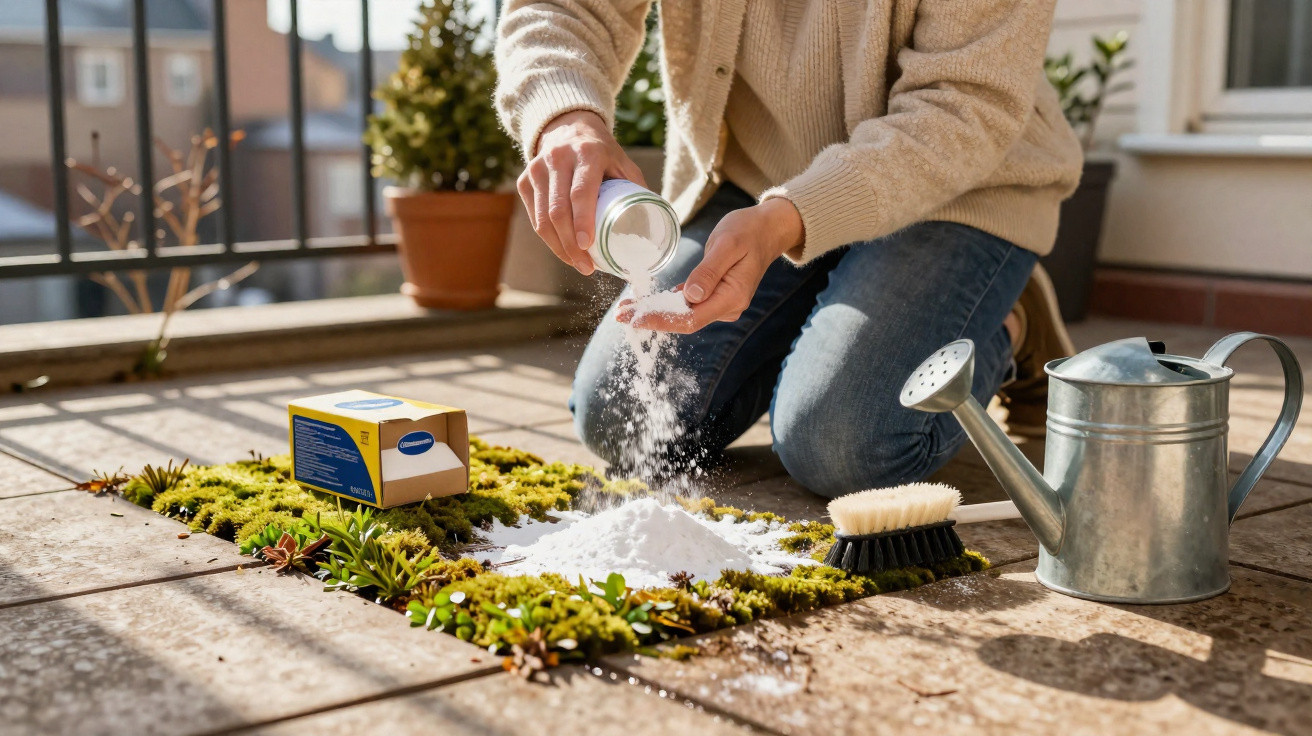
As soon as temperatures rise in spring, it starts again: moss pushes up through patio joints, weeds poke out between paving stones, and clumps appear along garage drives. Many people then reach for a joint brush, spend hours on their knees, or drag the pressure washer out of the garage. Much of that hard work can be avoided if you take action in winter - and use an inexpensive household staple properly: baking soda (sodium bicarbonate).
Why moss and weeds are especially vulnerable in winter
At first glance, December or January can look like everything is dormant. The patio stones are damp, often slightly green, and there seems to be little happening. Beneath the surface, however, it is a different picture. In the joints you will still find living roots, spores and seeds, largely protected from severe frost.
As soon as late winter or early spring brings a few mild days, these plants spring back into action and turn joints into slippery mini seedbeds. If you only respond then, you are fighting plants that are already growing strongly. It is far smarter to act in the depths of winter, when moss and weeds are weakened and barely putting on new growth.
"The trick: attack in winter, when the plants are in resting phases - then a light ‘jolt’ is enough to finish them off completely."
Professional garden and landscape contractors make use of exactly this window. Their helper is not a specialist poison, but a simple mineral: baking soda. At home it is known as a raising agent or cleaning product; on patios it works as a quiet but effective joint cleaner.
How baking soda works in joints
Baking soda is not a conventional chemical weedkiller. It is a salt that draws water out of plants. When the powder, or a water-based solution, reaches leaves and roots directly, it creates osmotic stress: the cells lose moisture and the tissue dries out.
At the same time, baking soda nudges the pH level in the joint area slightly towards alkaline. Many moss species and typical joint weeds do not cope well with that shift. They germinate less readily and regrow more slowly, reducing how quickly the joints are re-colonised.
- How it works: removes water from plant cells
- Target area: the upper parts of the plant and the root zone within the joint
- Side effect: a slightly raised pH level inhibits new seedlings
- Suitable surfaces: patio slabs, paving, paths, courtyards and driveways
Unlike boiling water - which can even encourage cracks in saturated slabs - baking soda is much gentler on stone. It also saves your knees in winter because there is far less scrubbing involved.
Dry scattering in winter: preparation without scrubbing
To keep joints tidy in spring, professionals often begin with a dry treatment. The method is straightforward and takes only a few minutes per patio.
Step-by-step guide for dry application
- Remove loose debris: sweep leaves, soil and thick moss pads off the surface with a broom.
- Measure the baking soda: allow about 20 grams per linear metre of joint - roughly a small handful.
- Scatter it: distribute the powder loosely over the joints, not just on the visible green growth.
- Brush it in: use a stiff broom or scrubbing brush to work the powder deeper into the cracks until it reaches the soil and roots.
- Do not rinse: do not pour water over it afterwards. Natural winter moisture - dew and light rain - slowly dissolves the baking soda and draws it down into the joint.
While you are indoors keeping warm, the salt continues to work in the background: it weakens roots, dries out fine moss growth, and takes the momentum out of many seeds before spring begins.
Liquid solution for already heavily greened-over areas
If you only notice the patio once it is already a solid green, you can mix a liquid solution. This is particularly useful for thick moss layers or strong grass clumps in joints.
Recipe for an effective baking soda solution
For one treatment, mix:
- around 950 millilitres of water (room temperature is fine)
- 2 to 3 tablespoons of baking soda, stirred in thoroughly
Ideally, apply the solution using a watering can with a rose or a pump sprayer. Choose a dry day that is as calm as possible, with no rain forecast, so the mixture stays in place long enough to do its job.
Accuracy pays off when applying it: do not pour it randomly across the whole area. Instead, target moss patches and weed tufts directly. Keep the focus on the joints, not the slabs themselves.
"After just one to two days, the green growth turns yellowish to brown, becomes brittle, and breaks up easily when swept."
To finish, a thorough sweep is usually enough, or a brief pass with a joint brush. Stubborn spots can be treated a second time after a few days using the same mix.
Key precautions: protect soil and edible plants
Even though baking soda is a household remedy, higher concentrations can still be harsh on soil. For that reason, it should always be used in a targeted way.
Where baking soda makes sense - and where it does not
- Suitable: concrete slabs, natural stone paving, paved driveways, gravel paths with a stable sub-base.
- Use with care: edges near ornamental beds - do not overdo it and pay attention to where runoff flows.
- Off-limits: vegetable gardens, herb beds, areas for berry bushes or fruit trees.
Water running off the patio should not flow directly into beds containing edible plants. If you have a sloping garden or areas that drain poorly, it is best to leave a border strip where no baking soda is applied.
Specialists advise treating no more than once or twice per year. Typically, that is enough if you time the winter application well and only touch up in spring where it is genuinely necessary.
How to make the effect work long-term
Baking soda is not a miracle cure that keeps patios permanently sterile. What it does provide is a clear head start. If you treat joints in January or February, by April you often only have a few remaining green patches to remove.
You can also improve the joint structure itself. Very loose joint fill made of sand or fine soil encourages growth. A jointing material with a higher mineral content - such as dedicated paving joint sand - gives moss and weeds far fewer opportunities. Combined with occasional baking soda treatments, this noticeably reduces ongoing maintenance.
Baking soda around the home: other practical uses in the garden
The same powder that helps on patios can also be useful elsewhere around the house - provided you dose it with a light touch.
- Garden furniture: a mild baking soda solution lifts green film from plastic and painted wood without heavy scrubbing.
- Plant pots: stubborn lime and algae deposits on terracotta pots can be loosened effectively with a baking soda-and-water mix.
- Odours: an open dish of baking soda in a shed or garage absorbs musty smells.
When using baking soda, keep one point in mind: the line between a helpful dose and overdoing it is narrow. Small amounts applied precisely deliver a solid result; large quantities spread carelessly can stress soil and damage ornamental plants.
Used correctly, this simple white powder becomes a practical ally against slippery joints - without spending hours battling growth in spring. A quick winter walk onto the patio, a little scattering and brushing, and the big clean-up in April feels far more manageable.
Comments
No comments yet. Be the first to comment!
Leave a Comment