
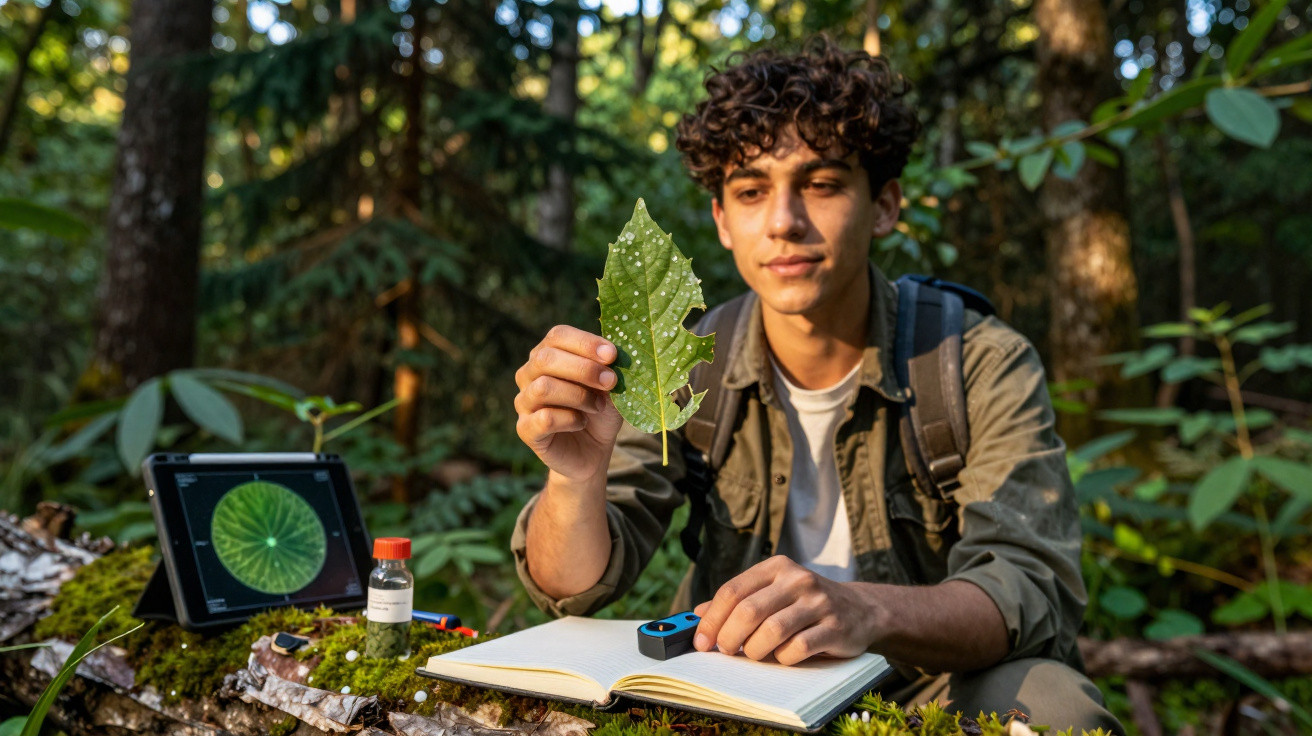
Leaf toughness is one of ecology’s most straightforward assumptions. The usual logic is that thick, leathery, fibrous leaves should take more effort for insects to chew, so trees that invest in tougher foliage ought to suffer less damage.
Fresh measurements spanning dozens of forest species in China put that idea to a direct test.
Instead of acting as a deterrent, the toughest leaves were the ones insects went for most often, while the strongest protection came from a far less obvious trait.
Surveying the damage
The study was led by Longxin Lu at the South China Botanical Garden (SCBG), part of the Chinese Academy of Sciences.
Lu and his colleagues assessed insect damage on 61 species of trees and shrubs across five forests, each representing a different climate.
For every species, they quantified how much leaf area had been eaten away by insects - known as leaf herbivory - and compared those losses with 11 measurable leaf traits.
Across all sites, the mean loss of leaf area was roughly six and a half per cent. Even before any single trait stood out, one broader pattern was clear.
When all variables were considered together, leaf traits explained herbivory better than either the climate or the local composition of insects.
When toughness backfires
Leaf strength delivered the biggest shock. Plants with hard, leathery leaves - the sort expected to blunt a hungry caterpillar’s efforts - experienced more herbivory rather than less, contradicting standard textbook expectations.
“The herbivory patterns were far from what we expected. Species with tougher leaves actually suffered more herbivory,” said Lu.
He interprets this as evidence of a continuing arms race, in which insects gradually evolve stronger mouthparts capable of overcoming mechanical defences.
This pattern is not limited to the forests surveyed here. Other work has reported the same direction of effect, including a study in plantation and natural forests where chewing damage increased as leaves became thicker.
Silicon as armor
If toughness was not providing protection, another feature was. Species whose leaves contained more silicon - a mineral taken up from the soil - consistently lost less leaf area to insects.
Silicon is believed to make leaf tissue more difficult to process, and the results suggest it can operate independently of a plant’s other defensive strategies.
One experiment on tropical tree seedlings showed that adding silicon reduced the amount of damage caterpillars could inflict.
Together, these findings point to a defensive mechanism that standard models often overlook. The authors argue that explanations of plant defence should explicitly include silicon, alongside the tougher tissues and bitter chemistry that ecologists more commonly measure.
The heat tolerance trap
A further twist involved how well plants cope with heat. Species with higher heat tolerance - better able to keep leaves functioning as temperatures rise - were eaten more heavily, not less.
“Surprisingly, species with higher heat tolerance experienced greater herbivory,” said study co-author Dr Hui Liu.
The most plausible reason is that vigorous, high-performing plants become more attractive targets.
A plant in good condition may also provide a more nutritious meal, which can draw insects in rather than deter them.
Heat tolerance, usually framed as a marker of resilience, therefore comes with a cost that existing models have not accounted for.
The evergreen penalty
Whether species were evergreen or deciduous also mattered.
Evergreen trees suffered greater damage than deciduous species, which drop their leaves in autumn and produce new ones in spring.
Because an evergreen leaf can remain on a branch for years, insects have repeated opportunities to attack it season after season. A deciduous leaf, by contrast, is shed and then replaced, effectively resetting exposure.
Over time that difference accumulates: a leaf available for several years provides far more feeding opportunities than one that lasts only a single growing season - small losses repeated year after year.
Climate plays a smaller role
Overall herbivory was higher in forests that were warmer and wetter, and that supported a greater diversity of insects, than in cooler, drier sites. Climate and insect communities clearly influenced the totals.
That fits broader evidence from other forest systems. Damage often increases as the local insect community becomes more diverse, something also documented by a study in subtropical China.
Even so, once the researchers evaluated all factors together, leaf traits still outperformed weather and insect mix in predicting how much damage plants sustained.
The environment shifts the numbers, but a plant’s own characteristics appear to do most of the deciding.
Broader implications of the study
Before this research, leaf toughness and overall growth strategy were central to explanations of why insects favour some leaves over others. Two outcomes from this work reshape that view.
Silicon emerges as a subtle yet meaningful shield. Heat tolerance, long treated as an unambiguous advantage, also acts as a hidden liability. Neither has typically been treated by ecologists as a primary driver.
As the climate warms and rainfall becomes less predictable, that distinction could help forecasters anticipate which forests will face the highest insect pressure and which tree species are most exposed.
It also gives plant breeders and conservationists another factor to consider - silicon - when deciding what to plant.


Comments
No comments yet. Be the first to comment!
Leave a Comment