
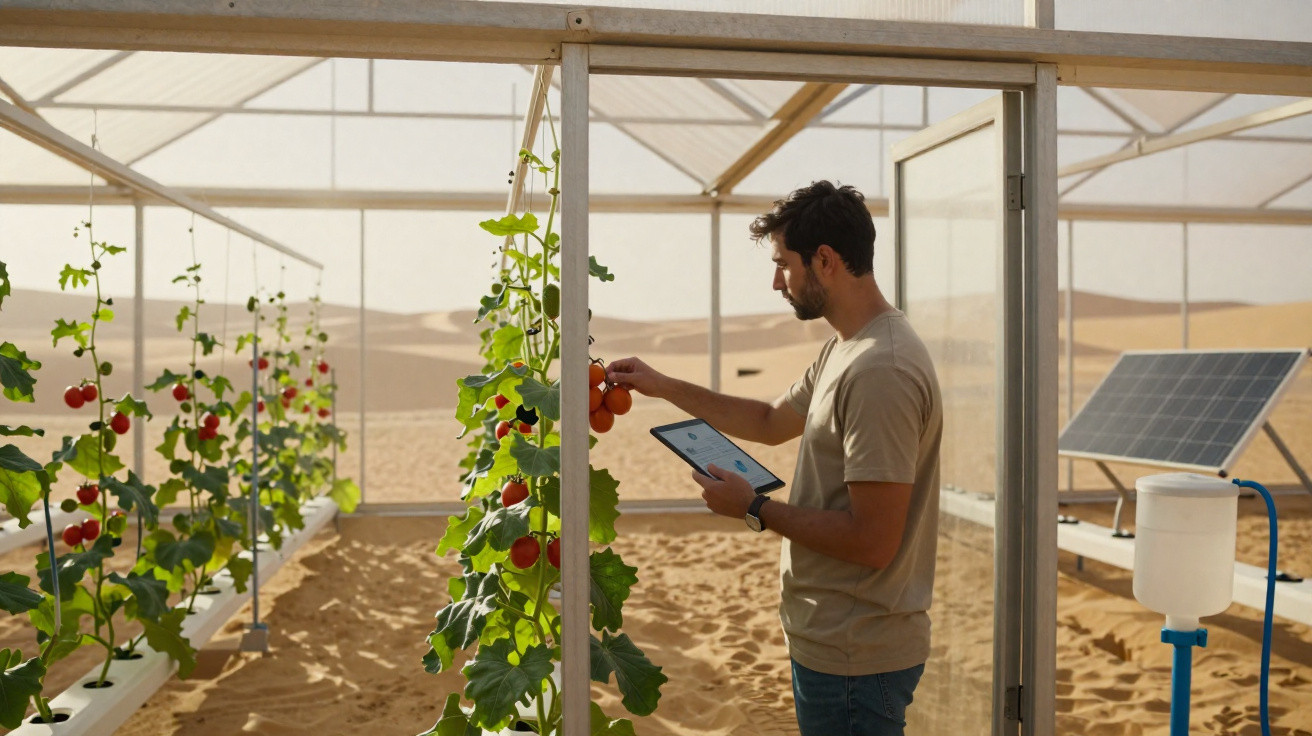
Closed-loop hydroponics has increasingly become the preferred option for farming in areas where water cannot be squandered.
Across arid regions, governments are paying to accelerate adoption on the premise that the technology effectively funds itself through resource savings. That logic sounds sensible, yet it only holds true in part.
A new study followed commercial farms producing real crops across the United Arab Emirates and showed that the system widely seen as the “obviously better” choice is not better in every case. The outcome hinges on what is being grown.
A desert farming puzzle
Across the Emirates, public support has been used to move growers on to newer systems. Farmers have been offered interest-free loans of up to about US$300,000 per farm, alongside training and assistance with marketing.
The intention is to shift producers from older-style greenhouses towards hydroponics, where plants are cultivated in nutrient-rich water rather than soil.
The central aim is lower water use. Eihab Fathelrahman at United Arab Emirates University (UAEU) headed a team that surveyed every farm participating in that conversion scheme.
In total there were 35 farms, located near Abu Dhabi. Some operated open systems, in which surplus nutrient solution is discarded after a single pass.
Using closed loops
Others ran closed-loop systems that collect the runoff, treat it, and return it to the crop.
The researchers went beyond water-use measurements. They combined cost information, production (yield) figures, and the financial risk borne by each farmer.
They then applied a suite of economic models to determine which arrangement truly pays under genuine desert conditions. The result was entirely crop-dependent.
Two crops, two answers
For cucumbers, recirculation came out on top. Closed-loop cucumber operations performed better for every level of caution a farmer might apply when deciding, offering stronger returns for the level of risk taken.
This aligns with other findings indicating that recirculation works well for thirsty, fast-turnover vine crops, and a separate cucumber study reported that reusing drainage reduced irrigation water by roughly a third.
Tomatoes told a different story. Open systems-often criticised as the more wasteful approach-proved to be the safer financial choice for tomato growers.
With recycling, the likelihood of a poor year was higher, and throughout the modelling the figures favoured the more straightforward, lower-cost set-up.
Cucumbers vs. tomatoes
The contrast comes down to how the plants behave. Cucumbers draw water and nutrients at a fairly constant rate, helping keep recycled solution chemically stable.
Tomatoes, however, take up water and nutrients less predictably as they progress through flowering and fruiting. That variability allows salts and stray ions to accumulate in recirculated water.
Unless someone monitors the tanks closely, that chemical drift can stress plants and cause yields to fluctuate.
Recycling clearly wins
The resource benefits of closed loops were genuine and, in certain cases, striking. On a per-plant basis, recirculating systems cut fertiliser use substantially-by about two-thirds for tomatoes and by 40 percent for cucumbers.
Reducing nutrient losses also lowers the amount of polluted runoff that can seep towards groundwater, a well-documented problem with open systems highlighted in earlier research.
Use of cooling water also fell, an important point given that Gulf greenhouses can consume very large volumes simply to stay cool enough for crops.
However, the pattern was not uniformly positive. Closed-loop cucumber systems used slightly more irrigation water per plant, with cucumbers close behind.
Beyond the fields
In a country where water often comes from energy-hungry desalination, those reductions matter beyond the farm itself.
One metric moved in the opposite direction. Closed-loop cucumbers, in fact, required a little more irrigation water per plant-around six percent more.
The researchers highlight this as a small but genuine trade-off for anyone considering the change. A closed-loop system does not automatically reduce every resource input.
The hidden energy bill
In desert settings, water savings are only part of the equation. Recirculating systems rely more heavily on pumps, filtration, and disinfection equipment, and overall they require more electricity.
In the Emirates, where much of the water supply is produced through energy-intensive desalination, power costs become particularly significant.
One assessment of farming with desalinated seawater put its energy cost at several times that of conventional freshwater sources.
There is, however, an important complication. Electricity in the UAE is strongly subsidised, meaning closed tomato farms appeared cheaper on paper despite using far more energy than open systems.
If that subsidy were removed, the economics could shift away from recycling, especially in tomato production.
That single factor reframes how the results should be read. A closed-loop design that adds up in Abu Dhabi could lose money in a country where electricity is charged at full cost. In other words, the business case depends as much on local energy pricing as it does on the plumbing.
Reading the risk
A key strength of this study is its focus on risk rather than averages alone. Many previous studies looked at yields or water use in controlled experimental plots.
Far fewer examined what happens to a commercial farmer’s profits when a bad season occurs, using evidence from working farms rather than a research greenhouse.
To put both systems on an even footing, the team calculated what economists call a certainty equivalent: the level of profit a risk-averse grower would require before accepting the riskier choice.
A lower certainty equivalent indicates the farmer would need a larger safety margin to justify taking on additional risk. For tomatoes under recycling, that margin was not worthwhile. For cucumbers, it was.
A straightforward risk comparison underscored the point. Closed-loop tomatoes dropped below acceptable return thresholds 38 percent of the time.
Closed-loop cucumbers, by contrast, delivered the strongest probability of a high return. The same technology led to opposing conclusions depending on the crop.
What growers can do
The findings challenge a common assumption embedded in agricultural policy: that recycling systems are simply superior and should be the default everywhere.
They are not, and treating them as universally best could push tomato growers into losses even as official budgets record apparent progress.
For growers and the public bodies supporting them, the practical step is to align the system with the crop.
Promote closed-loop systems for cucumbers, together with robust disinfection and back-up power.
For tomatoes, keep growers on open systems while improving runoff capture and precision feeding to reduce waste.
Future crop pathways
Fathelrahman and colleagues argue that this crop-by-crop approach should determine how subsidy funding is targeted.
Beyond the Emirates, other arid regions establishing similar schemes can run the same kind of risk-and-resource assessment before committing, then adjust the results to reflect their own climate and energy prices.
The broader method remains useful even when the precise figures change. A choice that looks obvious from a distance-as this one did-often turns out to be far more specific when examined up close.






Comments
No comments yet. Be the first to comment!
Leave a Comment