
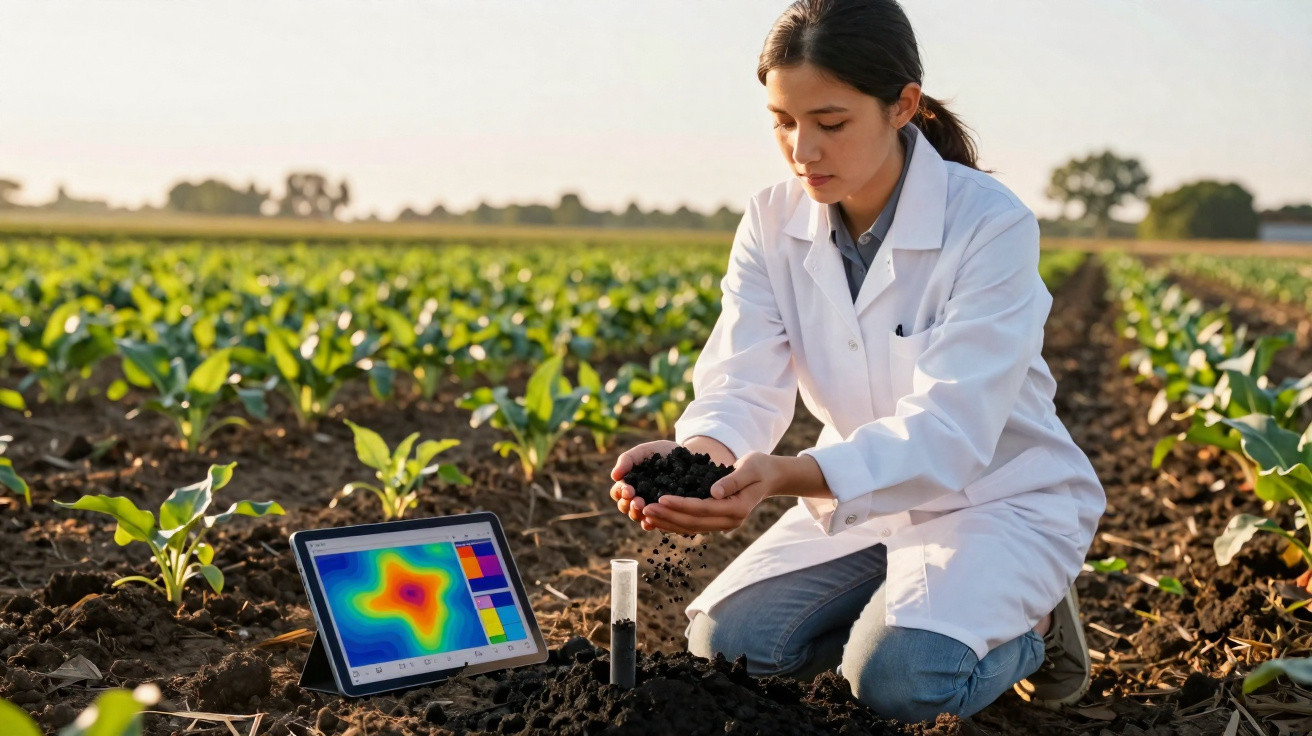
Biochar – charred plant material blended into agricultural soils – is increasingly viewed as an inexpensive way to improve soil quality and reduce wasted fertiliser.
In practice, growers usually apply it to make better use of the phosphorus already present in their fields.
The catch is that biochar has never delivered consistent results for phosphorus. Depending on the situation, it may unlock nutrients that were previously tied up, or it may unintentionally reduce access to them. Fresh research suggests that uncertainty could be reduced.
The hidden waste
Plants are far less efficient at absorbing applied phosphorus than many assume. In a typical season, only a small fraction is taken up by the crop, with common estimates around 15 to 20 percent.
What remains stays in the environment in less helpful ways. Some of it binds with iron, aluminium or calcium and becomes chemically immobilised, leaving it effectively unavailable to the crop overhead. Another portion is washed into ditches, streams and ponds, where it can drive algal growth and strip oxygen from the water.
This nutrient-driven pollution is known as eutrophication, and it can turn once-healthy waters green and depleted of life. For farmers, it creates a largely unseen double cost: fertiliser money that does not translate into yield, and downstream harm they never intended.
Adding to the frustration, phosphorus fertiliser originates from mined rock formed over millions of years. Because it is non-renewable, every lost kilogram feels more consequential.
Charcoal for soil
Biochar is one proposed remedy. It is a charcoal-like material produced by heating crop residues, wood or other plant matter with very little oxygen. The process leaves a porous, carbon-rich black solid that can be incorporated into farmland.
However, biochar’s reputation is mixed. In some soils it makes previously locked phosphorus more available to plants. In other cases it retains phosphorus in a form or location that roots cannot access-sometimes desirable for reducing pollution, but sometimes simply a setback for productivity.
That variability is the core problem. A farmer holding a bag of biochar generally cannot tell in advance whether it will benefit a particular field or hinder it, what application rate is appropriate, or which soil conditions will flip the outcome.
Predictions using AI
Yutao Peng of Sun Yat-Sen University in Shenzhen, China, and colleagues aimed to replace that trial-and-error approach with a more reliable method.
They compiled evidence from 32 earlier studies, creating a dataset of 534 measurements that tracked how soil phosphorus changed after biochar was applied.
Those records were analysed using three separate machine-learning systems designed to identify links between biochar properties, soil conditions and the resulting phosphorus behaviour. Across the models, 19 variables had to be considered at once-far beyond what is practical to evaluate manually.
One approach performed notably better than the others. The Random Forest model generates predictions by running the dataset through hundreds of individual decision paths and then averaging the outputs.
When tested on previously unseen data, it achieved an R² of roughly 0.91, accounting for most of the differences in how biochar influenced phosphorus.
Heat shapes biochar
When the researchers asked the model which input mattered most, one factor stood out: the temperature used to produce the biochar-its pyrolysis temperature-was more influential than any other variable.
Biochar produced at moderate temperatures appeared to strike a structural balance, likely forming enough fine pores and reactive surfaces to moderate phosphorus without pushing the system too far.
The model indicated a clear optimum. The strongest effects clustered around production temperatures of 460–482ºC (860–900ºF), paired with modest application rates.
Biochar created at higher temperatures tended to show the opposite pattern, with reduced phosphorus availability rather than increased. That behaviour can be useful when the priority is preventing phosphorus from leaving fields and entering nearby water bodies. In other words, heat functions like a control dial.
Soil conditions matter
Temperature was not the only driver. The second most important factor was how much biochar was added, followed by the soil’s acidity and its existing total phosphorus content.
Soil pH, in particular, strongly influenced the overall interaction. In acidic soils, phosphorus commonly binds with iron and aluminium, which makes it difficult for plants to access and leaves biochar with less capacity to improve availability.
By contrast, neutral to slightly alkaline soils offer more favourable conditions. With fewer reactive metal ions dominating the chemistry, any upward shift in pH caused by biochar can convert phosphorus into forms that plant roots can more readily use.
Crucially, these drivers did not behave in simple, linear ways. The model captured complex interactions that a straightforward equation would likely miss.
That goes some way towards explaining why a tool built for messy, non-linear relationships outperformed more traditional statistical approaches.
Simpler biochar works
One result challenges a common assumption in the field. Chemically modified biochar-altered in the laboratory to enhance performance-has often been treated as the superior option and the presumed gold standard.
The new findings suggest that such modification may not always be required. Under suitable conditions, plain, untreated biochar can equal or even outperform modified versions in regulating phosphorus.
The model also highlighted an unexpected implication: biochar’s advantage may be less about any phosphorus contained within the material itself, and more about how it changes the behaviour of phosphorus already present in the soil.
If so, the economics shift. Avoiding chemical treatment reduces costs and limits additional environmental burdens. The analysis also indicated that biochars made from crop residues or wood can require less energy to produce than manure-based biochars while delivering comparable results.
New tool for farming
Before this work, pairing a particular biochar with a particular field was mostly a matter of experimentation, with farmers often paying for incorrect choices. There was no dependable way to anticipate the outcome before application.
This study offers a route to forecasting performance. A data-driven model can estimate-before any biochar is spread-whether a given material is likely to release phosphorus for crop uptake or hold it back to protect a catchment.
Peng characterised the shift as moving biochar use from guesswork towards decisions informed by data.
For farmers and advisers, that could translate into less fertiliser wasted, fewer nutrients reaching local waters, and a stronger basis for deciding what to put into the soil.
The authors present the model as an initial framework rather than a final tool, and real-world fields will determine how robust its predictions are.
Even so, it points towards farming where a low-cost, carbon-rich product made from plant waste can be applied with something closer to precision than hope.



Comments
No comments yet. Be the first to comment!
Leave a Comment