
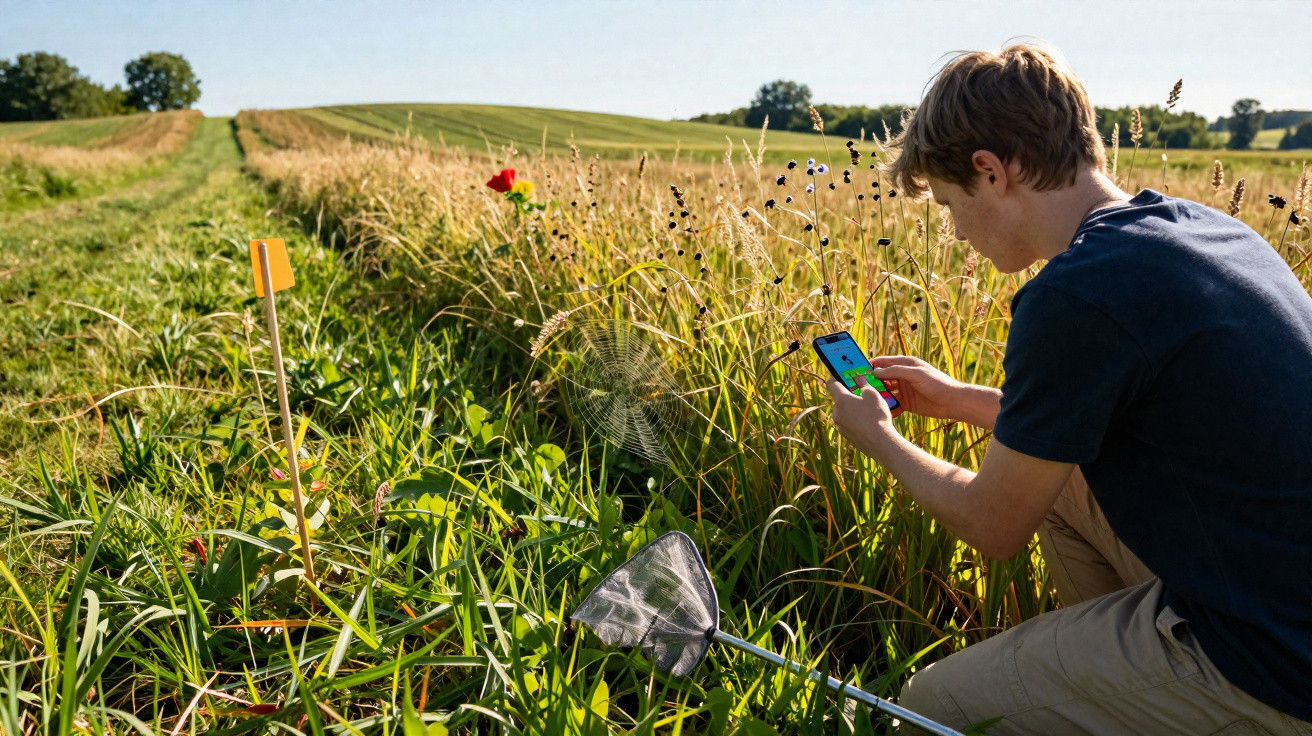
Hidden beneath wildflowers and tufts of grass, vast numbers of insects and spiders spend their lives feeding, breeding and underpinning healthy ecosystems.
Some of these small animals pollinate plants, while others recycle dead organic material or become prey for birds and small mammals. Yet few people ever witness what happens to this wildlife when a meadow is cut.
A new online tool aims to make those unseen impacts easier to grasp by translating scientific evidence into a form the public can use.
Rather than relying on rough assumptions, it estimates how many insects and spiders occupy a meadow and illustrates how different mowing approaches can change their numbers.
Its purpose is twofold: to support better choices in the management of green spaces, and to help people understand the biodiversity that is usually overlooked.
From research to everyday use
The web-based Insect Calculator estimates both the abundance and the variety of insects and spiders living in grassland habitats.
It also enables users to set different mowing scenarios side by side and instantly see how those decisions could alter local biodiversity.
Behind the tool is a formula derived from research that combines twelve separate variables to predict how many insects live in each square metre of meadow.
That equation is based on standardised field measurements gathered across multiple regions in Germany and Switzerland, and those same datasets drive the online calculator.
The calculator was created as part of the BioDivKultur project-an interdisciplinary initiative bringing together researchers from TU Darmstadt and field-based partners.
What the numbers reveal
The results show just how dramatically mowing can reshape meadow life. The team found that a single cut can reduce insect and spider numbers by up to 73 per cent.
Similar declines were observed across a range of groups-including cicadas, true bugs and grasshoppers-though the magnitude differed between them.
They also reported that grasslands in less isolated rural settings tend to hold higher densities of insects and spiders than urban green spaces encircled by heavily built-up areas.
The type of machinery used also played a role: mulchers were associated with steeper drops in insect populations than bar mowers.
In addition, mowing intervals, cutting height and several other management decisions were all shown to influence how many insects remain in a meadow.
Uncut grass makes a difference
Among the practical steps assessed, one stands out in the research: keeping some meadow sections uncut.
“One key finding is that whilst changes to mowing practices can have an effect – such as using mowers that are less harmful for insects or reducing the frequency of mowing – mowing itself has the greatest impact,” said study lead author Johanna Berger from the Technical University of Darmstadt.
“This highlights the importance of areas left unmown – so-called refuges. They are an effective measure for protecting insects and spiders, as they preserve resources and provide places for them to take refuge during or after mowing,”
Creating a refuge for insects
One method for providing these refuges is rotational mowing. Instead of cutting the entire meadow in one go, a portion is mown while another area is left standing and cut later.
This approach offers insects and spiders a place to persist while the rest of the habitat begins to recover.
The calculator offers an illustrative scenario using a meadow of about 100 square metres. If the whole site is cut, roughly 13,000 insects and spiders are left.
If 10 per cent of the meadow is left uncut, the estimate rises to 14,350. Leaving 20 per cent increases it to 15,700, and leaving 30 per cent lifts it to 17,050.
A meadow that is not mown at all supports about 26,500 insects and spiders.
A tool for everyone
The Insect Calculator provides a Walking Mode intended for the general public, alongside an Expert Mode aimed at those responsible for grassland management.
“For the Insect Calculator, we have compiled a comprehensive dataset from standardized one-square-meter samples of insects and spiders from Germany and Switzerland,” said Nico Blüthgen, project spokesperson for BioDivKultur.
“On this basis, it is possible to clearly demonstrate how various mowing parameters and the sealed area surrounding green spaces affect the number and diversity of insects and spiders.”
Addressing the biodiversity crisis
Co-author Margarita Hartlieb added that the tool also offers supplementary material, including links to sightings recorded through the iNaturalist citizen science project.
“Our understanding of the biodiversity crisis is growing, but there is still a lack of effective measures and action,” Berger said.
“A key solution for us in the scientific community is to link our findings to practical applications and communicate them more effectively, for example through digital and data-driven tools such as our Insect Calculator.”
The complete study appeared in Ecological Solutions and Evidence.





Comments
No comments yet. Be the first to comment!
Leave a Comment