
Nutsedge drives many home gardeners to distraction.
Known in English as “nutsedge”, it is not ordinary lawn grass but a highly persistent weed that hides small tubers beneath the soil surface. Simply pulling it out often makes the problem worse. With the right approach, a bit of patience and a clear plan, you can greatly reduce this pest - and, over time, push it out of lawns and beds.
What makes nutsedge so difficult
At first glance, nutsedge can look like a slightly paler tuft of grass in the lawn. On closer inspection, however, the typical signs become clear: the stems are triangular, the leaves form a V-shape, and it grows noticeably faster than the surrounding turf.
Nutsedge is a persistent weed with underground tubers that can survive for several years and repeatedly re-sprout.
Botanically, it is a sedge rather than a true grass. Two types in particular cause trouble: one with a more yellowish tone and another with a more reddish-purple tint. Both thrive in consistently damp, poorly drained soils - common hotspots include low patches in the lawn, compacted ground, or garden areas that are overwatered.
The real battle is underground. Along the roots, the plant produces small tubers (rhizomes and nutlets) that spread through the soil. A single plant can generate hundreds of these in one season. They can remain viable for three to five years - even if the visible growth has been removed long ago.
If you only tear off what’s above ground, you usually snap leaves and stems while leaving the tubers untouched. Those tubers then send up new growth even more vigorously. That’s why effective control usually requires a mix of correct technique, adjusted watering and, where necessary, targeted herbicide use.
How to identify nutsedge with confidence
Before you start, make sure you’re dealing with nutsedge rather than another fast-growing grass. Typical characteristics include:
- a triangular stem (you can feel it between your fingers)
- leaves that sit in a V-shape and feel stiffer than lawn grass
- a noticeably lighter, yellow-green to yellow-brown appearance
- faster, taller growth than the rest of the lawn
- a preference for damp, wet, or waterlogged spots
If you’re unsure, lift a small clump and examine the stem. If it turns between your fingers like a triangular pencil, you’re almost certainly looking at nutsedge.
Water and soil management: the most powerful lever
Nutsedge is often a sign that something is off in the soil. Standing water and compacted layers that hold moisture for too long are common causes. Change these conditions and you remove the weed’s favourite habitat.
If you want to tackle nutsedge, start by looking for the underlying cause in the soil: too much water, not enough aeration.
Adjust drainage and watering
A few straightforward steps can make a big difference:
- Water less often but more deeply: irrigate thoroughly and infrequently rather than “misting” the lawn daily.
- Aerate compacted areas with an aerator or a garden fork so water can drain away more effectively.
- In persistent problem zones (for example, low spots), install drainage lines or add gravel layers if needed.
- Thicken weak patches of turf with overseeding so there are fewer gaps for nutsedge to exploit.
A healthy, dense lawn gradually crowds out nutsedge by limiting light and space. Proper nutrition and correct mowing help enormously.
Lawn care as a natural defence
Consistent maintenance is what shifts the balance:
- Avoid mowing too low; in many cases 4–5 cm is ideal. Longer grass shades the soil and makes it harder for nutsedge to establish.
- Feed according to need to encourage dense growth without overloading the lawn.
- Reseed bare patches promptly so you don’t end up with pockets where nutsedge can take hold.
- Check areas where nutsedge has appeared before on a regular basis.
Mechanical removal: be thorough, not quick
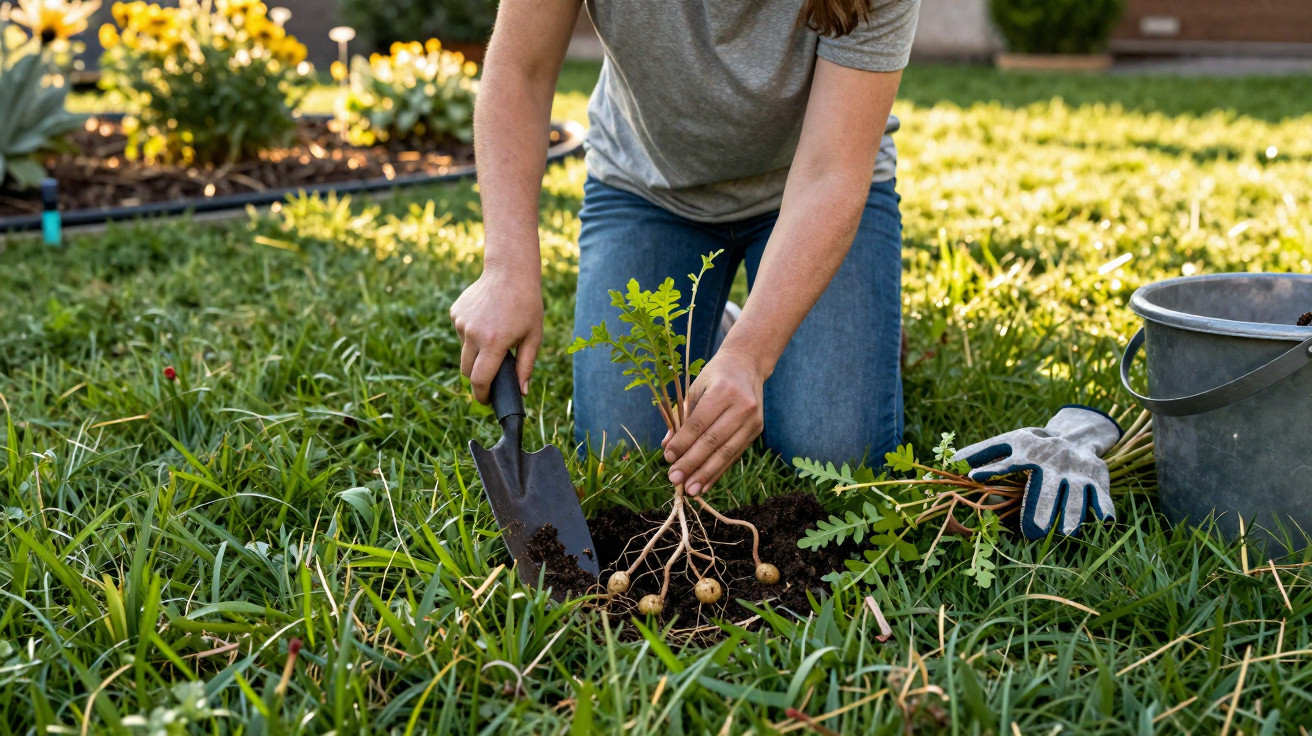
For small patches, manual removal can be worthwhile - provided you do it carefully. Simple pulling rarely works because the slender stems snap easily.
Proceed like this:
- Use a narrow spade, a weeding tool, or a hand trowel to cut around the nutsedge.
- Lift a plug of soil deep enough to bring the underground tubers with it.
- Break the soil apart gently and look for the small, knobbly tuber structures.
- Dispose of the plant and tubers in household waste, not on the compost heap.
Mechanical removal only has a real chance if the underground tubers come out too.
In vegetable beds and around sensitive ornamentals, this approach is often the best option, as chemical treatments may be undesirable there. A thick layer of mulch can also help.
Mulch as a protective barrier in beds
In beds without turf, organic mulch can slow nutsedge down significantly. Applying 3–4 cm of bark mulch, wood chippings or straw makes it harder for shoots to emerge, because they either can’t reach the light or come through badly weakened.
Especially between perennials, bulbs and shrubs, this creates an attractive surface layer that helps retain moisture while also suppressing nutsedge and other weeds.
Chemical control: when it makes sense
If you hit limits with hand work and soil improvement, you can consider herbicides formulated specifically for nutsedge. These are designed to target the weed while largely sparing the surrounding lawn.
| Active ingredient | Best time to apply | Interval before retreatment | Suitable lawn types |
|---|---|---|---|
| Sulfentrazone | early growth stage | 3–4 weeks | mainly warm-season turf species |
| Halosulfuron | mid-growth stage through to flowering | 5–7 weeks | many common lawn types |
| Imazaquin | during active growth | 4–6 weeks | certain warm-season varieties |
These products work best when nutsedge is growing strongly and has enough leaf area. In that state, the active ingredient can be absorbed through leaves and stems and transported down into the tubers.
A single treatment is rarely enough. Several passes are usually needed to catch tubers that sprout gradually over time.
Important: follow label instructions exactly, never increase doses “by feel”, and only spray in suitable conditions. In cool weather, during drought stress, or just before heavy rain, results drop sharply or the product may be washed off.
Radical option: total herbicide for extreme infestations
If nutsedge has spread across the lawn so widely that there are no islands of healthy turf left, some people consider starting over. Total herbicides containing glyphosate kill all green plants - including the existing lawn.
If you choose this route, work with great care: spray precisely, shield neighbouring plants with cardboard or spray guards, and avoid treating on windy days. Once the area has died back, you can rebuild the soil, improve drainage and then reseed or lay a new lawn.
Long-term strategy: persistence pays off
Nutsedge isn’t a one-weekend opponent; it’s typically a multi-year project. The tubers move, survive and return in waves. If you stay consistent, you can push infestations back step by step.
A sensible integrated approach includes:
- improving the soil and adjusting watering
- optimising lawn care and closing gaps
- digging out small patches consistently
- using targeted herbicides when required and planning repeat applications
- monitoring regularly, especially known problem areas
The deciding factor in the fight against nutsedge is persistence - not the intensity of any single measure.
Practical background information
Many gardeners are surprised that nutsedge often appears in a “well-maintained” lawn. The reason is commonly overwatering: daily watering in small amounts keeps the top layer of soil continually damp - ideal for nutsedge, but less suitable for lawn grasses that root more deeply.
Another misconception involves mowing. Cutting very short can look neat, but it weakens turf because it reduces leaf area for energy production. Nutsedge, on the other hand, tolerates frequent cutting better because it replaces leaves very quickly. Raising the mowing height slightly shifts the advantage back towards the lawn.
If you’re creating a new lawn or renovating an old one, you can reduce the risk in advance: choose turf varieties suited to the site conditions and use, loosen the soil deeply before sowing, work in organic material, and keep early watering consistent but not excessive. That makes it less likely that nutsedge will gain a foothold.
Completely avoiding contact with nutsedge is difficult - seeds and tubers can be introduced with soil, machinery, or even on shoes. But if you understand how the plant behaves, you can spot the first tufts early and act quickly. That way, nutsedge remains a minor nuisance rather than becoming the dominant problem in your garden.




Comments
No comments yet. Be the first to comment!
Leave a Comment