
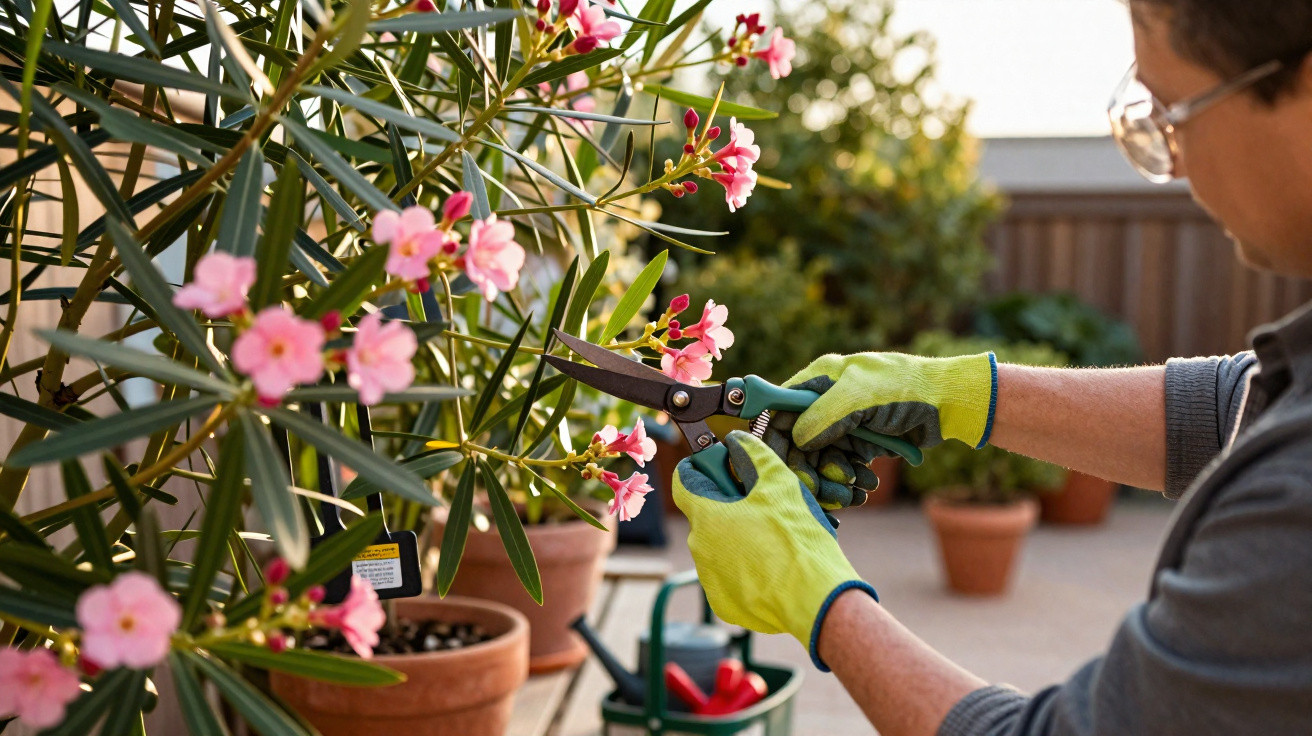
Oleander is often seen as an easy-going sun lover: it enjoys heat and feels at home on a terrace or balcony. Even so, one badly chosen pruning moment in spring can be the deciding factor between a shrub that’s overflowing with flowers in summer and one that stays almost bare. With a few straightforward rules, you can steer the display of blooms very precisely.
Why spring pruning determines summer flowering
Oleander sets up its flower buds very early. From late summer onwards, the shoot tips already form the beginnings of next year’s flowers. If you prune randomly or too hard in spring, you remove part of that stored “reserve” of blossom.
"The key is a moderate, well-timed cut that stimulates new growth without removing the buds that are already there."
Oleander flowers mainly on this year’s shoots that grow from established branches. The flower clusters sit at the tips. A gentle trim in late winter or very early spring encourages strong, well-lit young shoots. These then carry plentiful flowers from June through to September.
If you opt for the drastic approach and cut everything back heavily just before growth starts, the shrub simply lacks the structure it needs to form buds over the summer. The outcome is lots of leafy growth, with few flowers-or none at all.
The right time depending on your region
Oleander comes from warm climates and only tolerates frost to a limited extent. That’s why the best pruning window depends heavily on local conditions.
In mild regions where winter stays above freezing
In areas with comparatively mild winters-such as wine-growing regions, the Upper Rhine, or sheltered coastal locations-a suitable window is usually from mid-March through April. By then, the hardest frosts have typically passed and the plant is close to starting into growth.
- Only prune once no severe night frosts are forecast
- Choose overcast, frost-free days to keep stress down
- Shorten shoots lightly so enough flowering wood remains
If temperatures drop below about -5 °C, oleander can be damaged quickly. Freshly cut shoots are even more sensitive to cold, so if frost is predicted the secateurs should stay firmly in your pocket.
In cooler regions and inland areas
Where winters are harsher, it pays to wait longer. Many hobby gardeners don’t prune until late March or April, once the plant is clearly starting to wake up.
If you keep oleander in a pot and overwinter it frost-free, it’s simpler: you can prune straight after moving it back outside, as soon as temperatures are stably in double figures. At that point the shrub is active, responds quickly and puts on new growth fast.
"It’s better to schedule radical rejuvenation pruning for autumn-done in spring, it almost completely suppresses flowering."
How to prune oleander in spring, step by step
Safety first: oleander is highly poisonous
All parts of oleander contain toxic substances, including the milky sap. Even skin contact can irritate sensitive people. For pruning, follow clear protective measures:
- Always wear sturdy gardening gloves
- Long sleeves, ideally also safety glasses
- Clean tools after finishing
- Wash hands thoroughly with soap afterwards
Pets and children should not be close by while you work. Put prunings into general waste or an organic-waste bin (where permitted), not on an open pile where animals could chew them.
Prepare the right tools
A neat cut depends on sharp, robust tools. A good bypass hand pruner is enough for most shoots; for very thick branches, use long-handled loppers.
- Disinfect blades beforehand with alcohol or diluted bleach
- Sharpen dull edges to avoid crushing and tearing
- If you’re pruning several plants, clean tools again in between to reduce the risk of spreading disease
The perfect shape in three stages
It’s easiest if you prune in a clear sequence:
Remove dead and diseased wood
Anything black, brown, brittle or obviously frost-damaged should be cut back to healthy tissue. Healthy sections usually show a green layer just beneath the bark.Thin the crown
Take out shoots that cross, grow inwards or sit tightly on top of each other. This lets more light into the shrub and allows moisture to dry faster-helpful for reducing fungal problems.Shorten young shoots
Trim the remaining shoots back by around one third. Make the cut on a slight angle, a few millimetres above a pair of buds pointing outwards. That directs growth away from the centre from the outset and prevents an overly congested interior.
"Rule of thumb: two light cuts are better than one harsh cut-this keeps flowering reliable."
When a radical cutback makes sense
Sometimes a gentle approach is no longer realistic. Older oleanders that are bare at the base or badly damaged by frost can benefit from a decisive rejuvenation prune.
For this, you can reduce all main stems to about 30 to 50 centimetres above the ground. The shrub will then push strongly from dormant buds near the base. In the first year it will usually flower only sparsely, but it lays the groundwork for many more flowering seasons afterwards.
If you cut back that hard, aftercare matters: use humus-rich, free-draining compost, water regularly but avoid waterlogging, and from spring to late summer provide a balanced liquid feed in the watering can.
Typical oleander pruning mistakes-and how to avoid them
- Pruning too early when frost is still possible: new growth is easily killed, and the plant loses vigour.
- Cutting back too hard every year: the shrub puts energy into green growth and flowers poorly.
- Using blunt tools: crushed cuts heal badly and create entry points for fungal diseases.
- Skipping thinning: a completely congested shrub is more disease-prone and barely flowers on the inside.
Care after pruning: how to get the most flowers
After pruning, oleander needs a strong start to the season. The pot shouldn’t be too small, and standing water in the saucer is harmful. In spring it’s worth adding a fresh layer of quality container compost on top of the root ball, optionally supported with a little slow-release fertiliser.
A position in full sun boosts flowering significantly. If the shrub is too shaded, it produces long, soft shoots with few buds. Especially after a heavier cutback, the brightest possible spot pays off.
Background: why oleander can seem both delicate and tough
Oleander can feel contradictory: on the one hand it copes surprisingly well with drought and heat, yet on the other it reacts very sensitively to cold and waterlogging. The reason lies in its origin in Mediterranean river valleys, with hot summers and soils that are often only briefly moist.
Its leathery leaves reduce water loss. In wet, cold ground, however, the roots suffer quickly-and that in turn affects bud formation. That’s exactly why the abundance of flowers is so closely tied to the interplay of pruning, watering habits, temperature and nutrients.
More practical tips for hobby gardeners
- Carefully cut out spent flower clusters without damaging the new buds beneath them.
- If aphids are severe, act early-such as with a strong jet of water or approved plant-protection products.
- In winter, move potted oleander against a sheltered house wall to reduce frost damage to freshly pruned shoots.
If you follow these guidelines, there’s very little to do in summer. With a thoughtfully timed spring prune, oleander repays you with a long-lasting, almost Mediterranean firework of flowers-even on a small city balcony.



Comments
No comments yet. Be the first to comment!
Leave a Comment