
The first time you clock it, you’re not quite sure you’ve seen it properly.
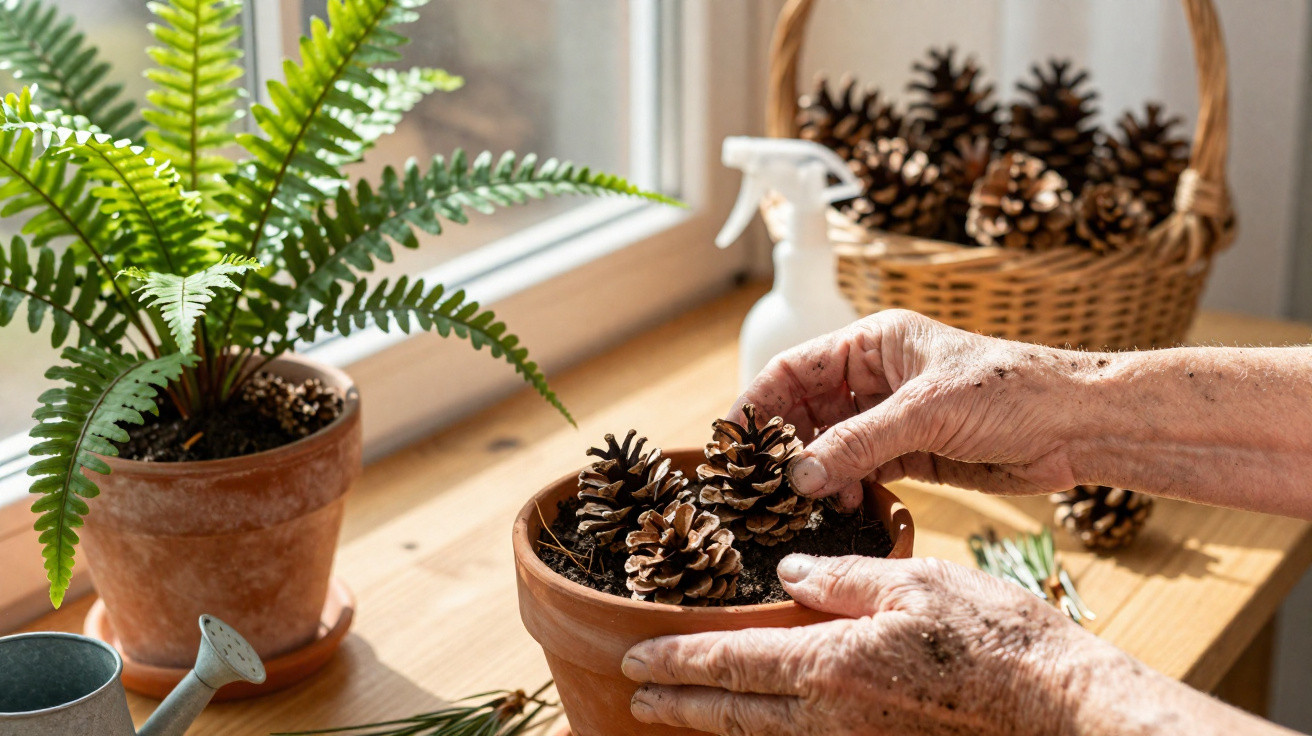
There, on the potting compost of a tired ficus or an old geranium on your grandmother’s windowsill, sits a neat brown pine cone-like a tiny piece of sculpture. Outside the light is dull and the sky is slate-grey; the radiators spit and hiss; the afternoons vanish quickly. Indoors, though, the plants look oddly composed, as if this little woodland relic is standing guard. You spot the same detail at your great-aunt’s, in an elderly neighbour’s flat, and at your parents’ place too-especially if they’re from the “we keep everything” generation.
No one announces it as a technique. The cone is simply there, as ordinary as a cuppa left on the table.
And, somehow, the houseplants often make it through winter.
So, why the pine cone on the soil?
Ask anyone in their seventies about it and you’ll often get a mild shrug: “We’ve always done that.”
At first glance it can look like a superstition-on the level of touching wood or tossing salt over your shoulder. The cone rests on the surface, its scales slightly parted, sometimes filmed with a bit of dust from age. People who grew up with this habit don’t usually dress it up in scientific language. You’ll hear plain explanations instead: “It stops it rotting,” “It prefers it dry,” “The pine smell’s good, it protects.”
Yet under that simple gesture, there’s a whole microclimate at work inside the pot.
Imagine a winter sitting room in a small flat: heating on, windows shut, air a little stale and heavy. Someone waters their spider plant “just in case” because the compost looks dark and a bit miserable. Two days later the surface is still wet, fungus gnats are hovering, and the leaves begin to yellow at the base.
Now picture the same setup, but with a pine cone placed on top of the compost. The person still overdoes the watering slightly, but the cone helps the surface breathe. Small air spaces form under and around it, moisture spreads less abruptly, and the top layer is less likely to sit wet and claggy. It’s a modest object, but the roots benefit quietly.
In practical terms, a dry pine cone works as both a tiny hygrometer and an air spacer. Its woody scales open in drier conditions and tighten when the air is more humid. On the compost, that means it subtly responds to what’s happening around the plant. It also reduces splashing when you water, breaks up that compacted surface crust, and encourages better evaporation at the top.
It’s useful in another, very down-to-earth way as well: like a miniature mulch. It softens sudden temperature swings at the top of the root ball and creates little shaded pockets where the compost isn’t constantly waterlogged. That’s exactly what delicate indoor roots need in winter, when plants are half-dormant and can’t take up water anything like as quickly as they do in June.
How older generations use pine cones on houseplants
If we’re calling it a “method”, it couldn’t be more straightforward.
During an autumn walk, they’ll pick up a dry pine cone, tuck it into a pocket, and take it home. Once the heating goes on and the days shorten, the cone quietly migrates from a hallway shelf to the pot of a ficus, a Christmas cactus, or a flagging geranium. It’s set on the compost, pressed in just enough to stop it wobbling, and then… ignored.
That’s the whole routine-no measuring, no timers, no kit. Just a small winter ritual.
It’s particularly helpful for people who water “by instinct”. Perhaps the plant is too near a radiator, too close to a cold pane of glass, or living in a room that suddenly turns very dry. A pine cone won’t resurrect a plant that’s being drowned every other day, but it does take the edge off human clumsiness.
Because let’s be realistic: hardly anyone checks moisture daily with monk-like discipline. Most of us water when we notice drooping leaves or when the surface looks dusty, not because a schedule says it’s time. The cone provides a tiny buffer against those impulses. Water spreads more gently across the surface, doesn’t hammer one spot, and the compost is less likely to set into a hard, lifeless crust.
There’s also a protective angle that older people don’t always explain outright. Anecdotally, plenty will tell you they see fewer fungus gnats when a cone sits on the compost. They’re not imagining it. By preventing the surface from staying continuously wet, the cone makes it harder for those tiny flies to breed.
Some gardeners even notice that the plant looks “less cold” with its little cone companion, as though the pot has pulled on a thin jumper for winter.
Within that unspoken habit is a kind of straightforward wisdom that modern how-to guides sometimes miss.
Why the pine cone trick actually works
From a purely physical point of view, a pine cone is brilliantly engineered. It’s built from overlapping, stiff scales rather than a flat surface like a stone. Put it on compost and it automatically creates gaps, pockets and channels beneath it and between the scales. When you water, moisture has to spread around those obstacles rather than repeatedly saturating one patch.
That disrupts the common pattern where the same area gets soaked, then compacted, which reduces oxygen and can suffocate roots. And roots, quite simply, need air.
Evaporation matters too. Winter heating dries the air, but-oddly enough-compost can stay wet for longer indoors, especially in deeper pots. The cone slightly lifts and roughens the surface, giving moisture more ways to escape. Instead of a single dark, flat layer, you get a tiny “landscape” where drying can happen unevenly and more naturally.
For the plant, that often means the first few centimetres dry sooner while the deeper compost remains comfortably damp. Many common houseplants-particularly those sold for indoor living-prefer exactly that pattern: dryish on top, steady moisture below.
Botanists are interested in pine cones for another reason as well: how they respond to humidity. In the wild, cones open to release seeds when conditions are dry and safer, then close again when it’s damp to protect what remains. The movement is passive, driven by woody tissues swelling and contracting.
On the surface of a houseplant pot, that same property lets the cone subtly react to the microclimate in your living room. It doesn’t “manage” the environment, but it becomes part of a fine balance between humidity, airflow and temperature at the compost surface-a small, clever bit of forest design, repurposed on a windowsill.
How to try the pine cone trick at home
The best part is that you don’t need any specialist gardening kit. Next time you’re out in a park or woodland, gather a few dry pine cones that are already fully open. Skip any fresh, sticky ones coated in resin. Back at home, brush off any dirt or insects, then leave them on a windowsill or near a radiator for a few days so they dry thoroughly.
When winter arrives, place one cone on the compost of each medium or large houseplant. Press it in lightly so it sits steady, but don’t bury it.
A common mistake is treating the cone like a magic force field and watering as though it’s still August. You still need to check moisture properly-slide a finger into the compost to see what it’s like below the surface. If the pot feels heavy and sodden, a pine cone won’t cure waterlogging deep down.
Another easy trap is to cover the entire surface with cones, stones and decorations until the plant all but disappears. A little helps; too much creates shade and stagnant damp. As a rule of thumb, aim for one cone in a medium pot and two in a very wide container. The point is to improve airflow at the surface, not to smother it under a craft display.
Older generations often add a quiet layer of observation to the habit. They pay attention to how the cone sits, how the plant behaves, and whether the compost gradually lightens or stays dark over several days.
“My mother always said: if the cone looks sad and closed for days, don’t water,” recalls Anne, 68, who keeps monstera and snake plants in her small city flat. “We didn’t have humidity meters, just eyes and habits. The cone was like a little messenger on the soil.”
- Choose dry, opened cones, not fresh resinous ones
- Place them on top of the soil, never buried
- Combine the trick with moderate winter watering
- Use it especially near radiators or drafty windows
- Remove or replace cones that stay moldy or damaged
A small object, a whole way of caring
That little pine cone also reflects a generational approach to keeping plants. People who grew up with less technology relied on small, repeatable tricks that cost nothing. A walk in the woods didn’t just clear your head-it stocked the home for the cold months ahead: kindling, cones, a little moss, sometimes a branch that would later become a plant stake.
A cone on the compost follows the same logic: use what the outdoors offers to improve the environment you’re creating indoors.
It can also carry a faint feeling of continuity. You place the same kind of cone your grandmother used, on a similar plant, beside the same sort of cold window. Your reasons may be more scientific; hers may have been more instinctive. Still, the gesture overlaps-like a quiet conversation across decades, tangible even without words.
There’s something unexpectedly reassuring about that: a tool that needs no Wi‑Fi, no subscription and no instructions, yet still makes day-to-day care a little easier.
Perhaps this winter you’ll look at your houseplants differently-not just as décor, but as living things that register every blast of radiator heat, every forgotten watering, every sudden draught when the window is opened.
A single pine cone on the soil won’t transform everything. But it might rescue a plant, pin a memory in place, and bring a small piece of forest know-how into your sitting room. That’s a lot for something you can pick up from the ground on a Sunday walk.
| Key point | Detail | Value for the reader |
|---|---|---|
| Natural “air spacer” | Pine cone creates gaps and tunnels on the soil surface | Helps avoid compacted, suffocating soil and root rot |
| Winter moisture buffer | Encourages top-layer drying while keeping deeper soil comfortable | Reduces overwatering damage in heated homes |
| Free, simple ritual | Just collect dry cones and place one per pot | Accessible, no-cost way to protect houseplants and feel more connected to them |
FAQ:
- Can a pine cone replace proper drainage holes? Not at all. Drainage holes and a saucer are still essential. The cone only improves conditions at the soil surface, it doesn’t remove excess water trapped at the bottom of the pot.
- Does the pine cone feed or fertilize the plant? No, or only extremely slowly over years. Its main role is structural and microclimatic, not nutritional. You still need occasional fertilizer during the active growing season.
- Can I use other things instead of a pine cone? You can use bark, pebbles, or decorative gravel, but they don’t react to humidity the same way. A dry pine cone is lighter, more breathable, and easier to move or remove.
- Is there a risk of bringing insects or mold with cones? Yes, if you bring them in fresh from a wet forest. Let them dry thoroughly indoors and brush them off before placing them in pots. Remove any cone that molds or crumbles.
- Should I leave the cone year-round? You can, but it’s most useful in winter. In spring and summer, when the plant grows faster and light is stronger, you can keep it as decoration or remove it if you prefer a bare soil surface.

Comments
No comments yet. Be the first to comment!
Leave a Comment