
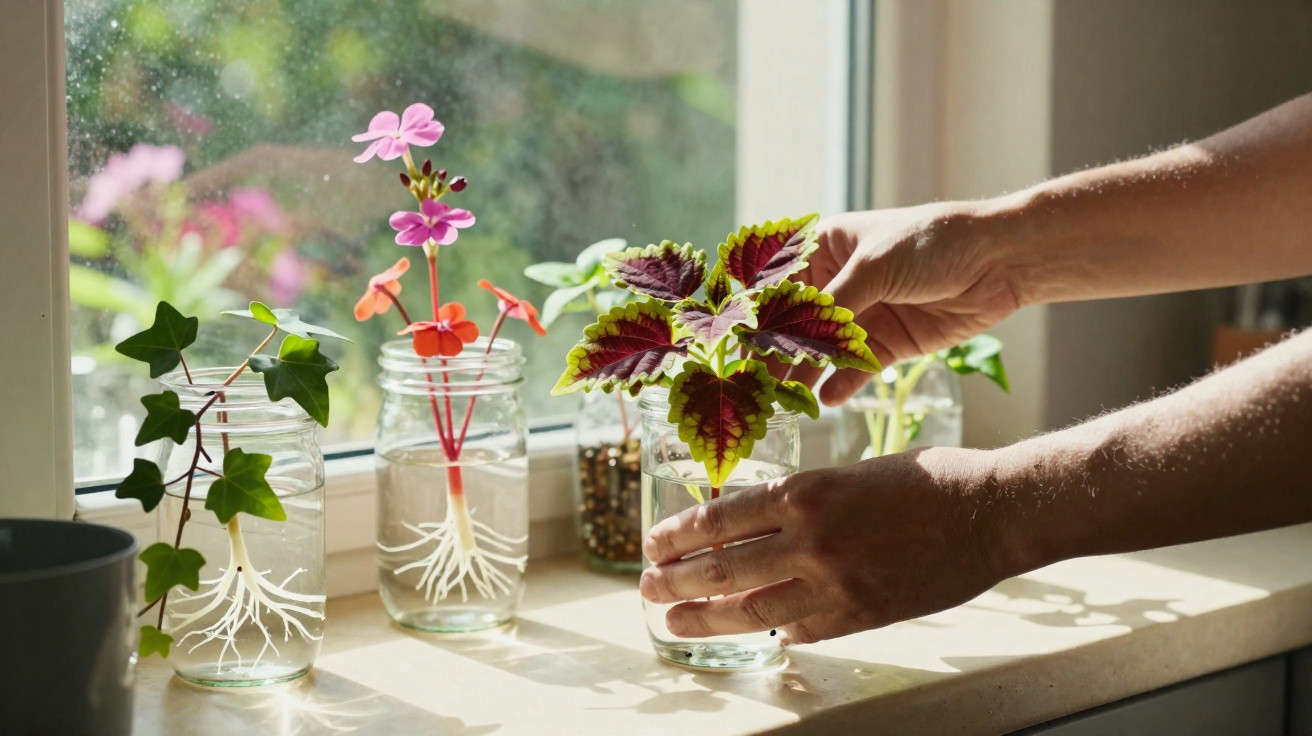
In early summer, a quick look around the garden often reveals the same thing: the beds still look a bit bare, yet the money set aside for new plants has nearly gone. This is exactly where a near-miraculous trick helps-some plants root so readily in ordinary tap water that, with just a few simple steps, you can fill beds and balcony containers for free.
Why right now is the best time to root cuttings in water
From spring through to late summer, many ornamental plants can be propagated. June is particularly favourable. At this point, plants are in strong growth, the shoots are still soft, and temperatures commonly sit around 20 to 25 degrees.
"Warm days, young shoots and plenty of sap pressure in the tissue mean cut surfaces seal quickly and new roots form fast."
If you take cuttings now, you can expect well-rooted young plants after around one to four weeks, depending on the species. They can then be moved straight into pots or planted out to plug gaps-without needing to buy more stock from the garden centre.
These three plants root especially well in a glass of water
Not every plant is equally suited to rooting in water. However, three classics are about as reliable as it gets:
- Ivy – perfect for walls, trellises and hanging baskets
- Coleus (Coleus) – show-stopping foliage in countless colours
- Busy lizzie (Impatiens) – a flowering favourite for shady corners
All three tend to root quickly in a glass of water and without any specialist kit. If you take several shoots from each parent plant, you can have a whole “mini nursery” lined up on the window sill in no time.
Basic kit: what you actually need for water propagation
This approach uses items most households already have. Expensive professional tools aren’t required-what matters is cleanliness and light.
- Cutting tool: clean, sharp secateurs or a knife
- Containers: small glasses, jam jars or clear cups
- Water: tap water that’s been left to stand for a few hours
- Position: bright, but out of direct midday sun
"As long as the water stays clear, the tool is clean and the cuttings get enough light, the success rate is surprisingly high."
Rooting hormone can be useful, but for these three plants it is usually unnecessary. They are straightforward candidates that naturally produce new roots quickly.
General step-by-step method for rooting cuttings in water
The basic technique is virtually identical for all three plants. The main differences are the ideal shoot length and how often you need to change the water.
- Choose a healthy shoot – no pests and no wilted leaves.
- Decide the length – depending on the plant, around 7 to 15 centimetres.
- Make the cut – directly below a leaf node (the point where a leaf or side shoot emerges).
- Remove the lower leaves – any that would sit in the water should be cleanly taken off.
- Place the cutting in a glass of water – 1 to 2 nodes should be submerged.
- Change the water regularly – every two to five days, before it turns cloudy.
- Pot on – once roots are between 2.5 and 5 centimetres long.
For compost, a loose, moist potful-or a container filled with multipurpose compost plus a little sand-is sufficient. Avoid waterlogging, otherwise the young roots can rot quickly.
Ivy in a glass of water: dense greenery in just a few weeks
Ivy is a tireless performer in gardens and on balconies. Rooting it in water lets you make use of its vigour in a controlled way-without allowing it to smother everything in sight.
How to succeed with ivy cuttings
- Shoot length: around 10 to 15 centimetres
- Several leaf nodes should be present
- Cut: directly under a node
- Remove the lower leaves from about half the shoot length
The bare nodes go into the water. After roughly two to four weeks, sturdy roots usually appear. Once these are about 5 centimetres long, the ivy can be moved into a pot.
"Ivy does well in the loose substrate of a pot – it stays manageable there and won’t rampage unchecked through the garden."
Containers with a small support or hanging baskets are ideal. This makes it easy to train ivy decoratively, rather than having to remove it later from walls or trees.
Coleus: a burst of colour from a single parent pot
Coleus is the quiet star of many balcony planters. Its leaves can shimmer from lime green to deep violet, often with multi-coloured patterns. In a glass of water, it can be multiplied quickly.
Step by step for coleus
- Select shoots 8 to 12 centimetres long
- Don’t use flowering tips; pinch out any budding flowers instead
- Leave two to three leaves at the top and remove the rest
- Change the water every three to five days
With these conditions, coleus often shows its first root tips after just one week. After one to two weeks, the roots usually reach the required 2.5 to 5 centimetres.
"With just a few parent plants, you can raise enough young plants in a month to design whole balcony planters around one colour scheme."
To encourage strong foliage, it’s worth snipping the tips of newly potted coleus from time to time. This promotes branching and keeps the plants more compact and bushy.
Busy lizzie: a flowering carpet for shady spots
Busy lizzie suits semi-shade through to full shade. Even better, it’s one of the plants that forms roots very quickly in a glass of water.
Using busy lizzie to fill gaps fast
- Take cuttings 7 to 10 centimetres long
- Don’t leave buds or flowers on the shoot
- Remove the lower leaves, leaving the top pair in place
- Refresh the water every two to three days
After one to two weeks, roots are commonly 2.5 to 3 centimetres long. That is enough for them to establish well in window boxes and along bed edges. Groups made up of several colours-propagated from just a few original plants-can look especially attractive.
"If you cut and plant now, you can enjoy dense, flowering cushions in shady patios and entrances all summer long."
Common mistakes with water propagation – and how to avoid them
Although the method is simple, a few pitfalls can cause failures. Most are easy to prevent with small tweaks.
- Water turns slimy: it hasn’t been changed often enough and stems start to rot. Fix: change it more frequently and rinse the glasses.
- Leaves sitting in the water: they decay and spoil the water. Fix: remove all leaves that would be below the waterline.
- A draughty window sill: cuttings can dry out easily. Fix: choose a bright, sheltered spot.
- Direct sun: the glass can act like a magnifying lens and the water overheats. Fix: provide bright, indirect light only.
If you check the cuttings regularly, you’ll spot issues early and can react before the entire batch is lost.
When is the perfect moment to pot them on?
Many hobby gardeners leave it too late because the roots look so appealing in the glass. Once in a pot or bed, the plant then has to adapt again, which can slow it down.
| Plant | Recommended root length | Typical time in water |
|---|---|---|
| Ivy | around 5 cm | 2 to 4 weeks |
| Coleus | 2.5 to 5 cm | 1 to 2 weeks |
| Busy lizzie | 2.5 to 3 cm | 1 to 2 weeks |
After potting on, keep the compost evenly moist without saturating it. A semi-shaded spot for the first few days helps reduce stress while the roots branch out into the new growing medium.
Why rooting cuttings in water suits small budgets and limited time
Many garden plans fall apart because everything is bought and planted in one go. Using glasses of water spreads the effort out. First, there are quiet weeks while you wait for roots; afterwards, planting happens in manageable bursts.
If you plan a portion of your spring planting as “parent plants”, you can save a significant amount of money in high summer. With coleus and busy lizzies in particular, there’s no need to haul home extra trays from the garden centre.
Practical ways to use your new plants
These free young plants open up plenty of design options:
- Ivy for green privacy screens on a balcony or as a neat surround for wheelie bins
- Coleus as colourful highlights among more understated summer flowers
- Busy lizzies as groundcover beneath shrubs where only bare soil used to show
- Small gifts: home-grown young plants in a decorative glass as a present
Once you start experimenting with rooting in water, you’ll often try additional species. Many herbs and ornamental plants respond well to this approach too. The three classics described here are ideal for beginners because they are dependable and deliver quick results.
Comments
No comments yet. Be the first to comment!
Leave a Comment