
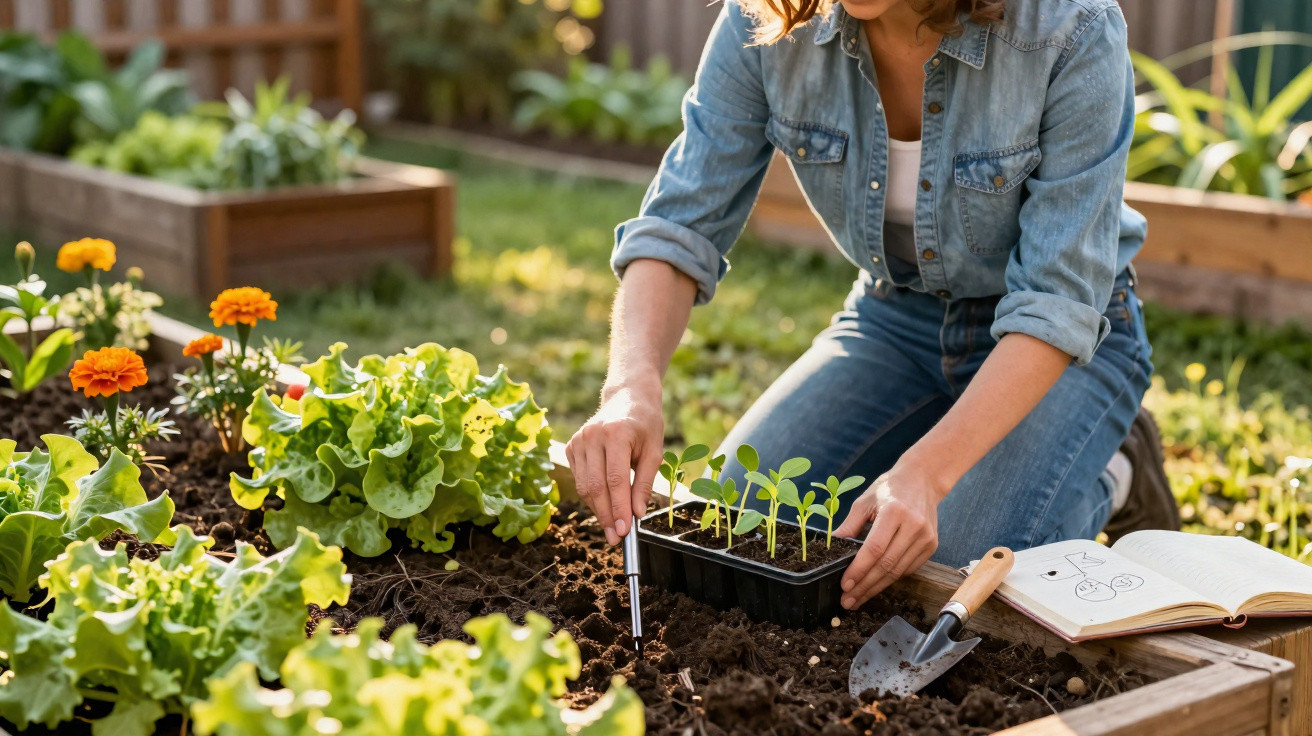
The first time I watched Emma crouch in her veg patch with a kitchen thermometer, I genuinely wondered if she’d finally snapped. You could still see our breath in the air, yet there she was-beaming, sleeves rolled up, elbows in the mud-peering at the little display as if it might announce she’d won the jackpot. Along the fence line, neighbours were already tucking tomato seedlings into the ground, buoyed by the first mild weekend and a bit of brave sunshine. Emma simply shook her head, jotted a figure into a tiny notebook, and gently covered the soil again.
Two months later, their tomatoes were finished.
Hers looked like a jungle.
Why soil temperature quietly decides your harvest
Walk into any garden centre in spring and you’ll see the same ritual: trolleys loaded with seedlings, people eager to “get a head start”, and hardly anyone mentioning the first thing roots actually experience. Not the air. The soil.
Your phone can say it’s 20°C (68°F) and still be wildly misleading. Where seeds and young roots sit, the ground can feel like winter. Treat seeds as if they’re on a beach break when they’re really in a cold cellar, and they often sulk, rot, or simply stop. The difference between gardeners who watch soil temperature and those who don’t often begins in that unseen layer a few centimetres down.
There’s a straightforward reason this matters so much. Germination and early root growth are biological processes, and their speed is governed by the warmth in the soil-not the sunshine on your face. Cool ground tells a seed to pause. Consistently warm ground tells it to get on with it.
Last April, a small community garden in Ohio tried a simple test. Half the plots went in “by feel” on the first pleasant weekend. The rest followed one rule only: the soil, at roughly 5–8 cm (2–3 inches) deep, had to be in the right temperature band for each crop. Sweetcorn waited for about 16°C (60°F), beans for around 18°C (65°F), and tomatoes for roughly 16°C (60°F) and climbing.
By midsummer, the contrast was harsh. The “by feel” beds had uneven germination, rows that needed re-sowing, and plants that stayed stunted and never really recovered. The thermometer-planted beds? Solid stands, fewer bare patches, far fewer do-overs, and harvests that began sooner and ran on longer. Nobody switched seed brands. Nobody changed fertiliser. They only changed when they planted.
When gardeners ignore soil temperature, they end up wrestling nature all season: replacing seedlings, coaxing along stressed plants, and puzzling over why a neighbour’s peppers are thriving while theirs remain runty. When they pay attention to it, the whole thing feels calmer. Less drama, more growth. It isn’t magic-it’s basic biology and a £10 thermometer.
How to actually track soil temperature without going crazy
The approach that works is almost comically simple. Use a basic soil thermometer or a waterproof kitchen probe, push it about 5–8 cm (2–3 inches) into the bed early in the morning, and give it a minute. That’s your real reading. Take it in a few places, especially where sun and shade split the bed. Note it down or tap it into your phone.
For cool-season crops such as peas, spinach, and lettuce, you’re usually safe once soil is around 4–7°C (40–45°F). For beans, squash, cucumbers, and sweetcorn, you’re looking nearer 16°C (60°F). For tomatoes and peppers, treat about 16°C (60°F) as a starting line-provided it’s trending warmer-because that’s often the difference between plants that sit and sulk and plants that settle in strongly. One small habit can set up a completely different season.
Here’s where most people trip up: they measure once, feel quietly pleased with themselves, and then go straight back to planting according to weekends, diary space, and good intentions. In reality, almost nobody checks every single day-and that’s perfectly fine. What you need isn’t daily spreadsheets; it’s a sense of the pattern.
Two or three readings per week in spring will show you when the soil stops yo-yoing and starts holding steady. That’s your moment. The big mistake is letting one freakishly warm day tempt you into planting heat-lovers into ground that drops back into fridge mode three days later. Your calendar doesn’t grow the plants. The soil does.
"We’ve all been there, that moment when you kneel down over a row of seeds that never came up and wonder if the packet was bad, if you watered wrong, if you “just don’t have a green thumb.” Most of the time, the seed was fine. The timing wasn’t."
- Tool: A simple soil thermometer or digital probe
- Habit: Measure at about 5–8 cm (2–3 inches), in the morning, a few times per week
- Thresholds: around 4–7°C (40–45°F) for cool crops, about 13–16°C (55–60°F) for roots, about 16°C+ (60°F+) for warmth lovers
- Trigger: Plant when readings stay in range for at least three consecutive days
- Result: Fewer failures, stronger starts, more confident decisions
Beyond the numbers: a quieter, more confident way to garden
Something subtle changes when you begin tracking soil temperature. You stop sparring with the forecast and start working with what’s happening in your own back garden. Instead of thinking, “Are people planting yet?”, you start asking, “What’s my soil doing this week?” That small shift breaks the social pressure of spring and puts you back into a relationship with your place.
The garden starts to feel less like an exam and more like a conversation. You see how raised beds heat up sooner than in-ground rows, how dark mulch keeps warmth through the night, and how a cold snap hangs around longer behind the shed. You start experiencing the garden as a living, layered space, rather than a flat square on a calendar labelled ‘Plant things’.
| Key point | Detail | Value for the reader |
|---|---|---|
| Soil, not air, drives germination | Seeds and roots respond to temperature a few centimetres down | Reduces failed sowings and weak seedlings |
| Simple, repeatable habit | Measure 2–3 times a week early in the morning | Gives clear, calm planting decisions |
| Crop-specific thresholds | Cool crops start near 4–7°C (40–45°F), warm crops closer to about 16°C+ (60°F+) | Optimises timing for better yields and fewer losses |
FAQ:
- Do I really need a dedicated soil thermometer? Not necessarily; any waterproof probe that reaches about 5–8 cm (2–3 inches) will do, although garden thermometers are easier to read and made for outdoor use.
- When is the best time of day to measure soil temperature? Early morning tends to give a cooler, steadier reading that reflects what seeds experience overnight and at first light.
- How deep should I insert the thermometer? For most vegetables, around 5–8 cm (2–3 inches) is ideal; go a little deeper (about 10 cm / 4 inches) if you’re checking conditions for larger transplants like tomatoes.
- What if my soil warms, then a cold snap hits? If a brief cold spell drops the soil a few degrees for a day or two, established seedlings usually cope, but hold off sowing warmth-loving crops until temperatures settle again.
- Can mulch help keep soil temperature stable? Yes. A light layer can soften day–night swings, keeping soil slightly cooler during hot spells and slightly warmer overnight in early spring.
Comments
No comments yet. Be the first to comment!
Leave a Comment