
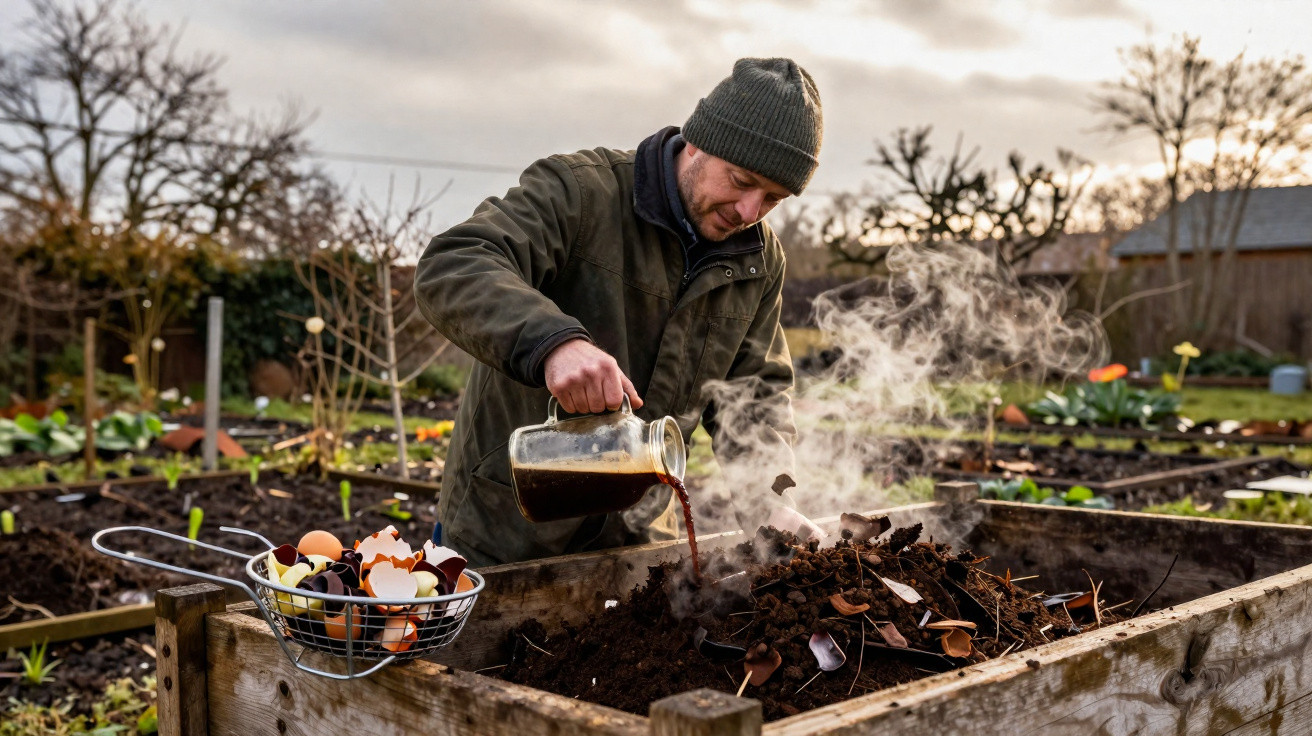
Every gardener has a winter that almost finishes them off. For me, it was the season my carefully tended compost heap set solid into a miserable, silent slab behind the shed. I’d trudge over the crunchy, frosted lawn with a caddy of peelings, flip the lid… and find nothing. No warmth, no earthy scent, no faint sign that anything was happening. Only cold, sticky scraps sitting there, as if to taunt me. I can still hear myself thinking, “So that’s it then. Months of effort, dead till spring.”
Not long after, an older neighbour - the sort whose roses make passers-by slow to stare - leaned over the fence and casually overturned my whole approach. He told me about a homemade “kick-starter” he’d relied on for years whenever a heap refused to move. A basic blend from the kitchen and cupboard, he said, like rousing compost with a strong cup of coffee. I gave it a go once, and the change over the next fortnight still feels like sleight of hand.
The winter compost heartbreak no one talks about
If you’ve ever started a heap in autumn with the best intentions, you’ll recognise the particular winter let-down. You stack up crisp leaves, grass clippings, coffee grounds and vegetable peelings - a lasagne of optimism - and picture dark, crumbly compost ready to feed next year’s beans. Then the cold snaps arrive, the heap loses its heat, and it simply… stalls. You turn it and there’s no steam, the pile doesn’t shrink, and nothing suggests there’s any life inside doing the work.
Most of us have had the same moment: you push a gloved hand into the heap and meet only icy, soggy disappointment. The issue is that the microbes responsible for composting behave a lot like we do - when they’re cold and miserable, they slow right down. Winter rain saturates the heap, nutrients leach away, and kitchen scraps can go slimy and compressed. It’s easy to start worrying you’ve created a luxury hideout for rats rather than a little factory for soil. The dream of “closing the loop” can quickly start to feel like a damp bin liner.
And, realistically, hardly anyone is heading out every day in January to happily fork the heap over in a drizzle. More often it’s a sheepish dash to the compost bin, a quick tip-in of peelings, and a sprint back indoors. The heap then gets ignored until that sharp, bright afternoon in late February when you finally check - and discover there’s been no progress at all. That’s where this odd homemade activator has a role. It won’t replace solid composting habits, but it can feel like giving nature a gentle shove instead of relying on luck.
The neighbour’s secret: a homemade “shot of espresso” for the heap
When I first heard about this winter activator, my neighbour Ken ambled over holding a scuffed old jam jar, smiling like he knew something I didn’t. “Your heap’s sulking,” he said, tipping his chin towards the frozen mound by my fence. “Needs feeding properly.” The jar held a cloudy brown liquid with a mildly sweet, yeasty smell - like weak beer abandoned overnight. It didn’t exactly shout “miracle”. Even so, his compost heaps had a reputation, so I paid attention.
What gardeners are actually mixing
Over the past few years, I’ve realised Ken is far from the only one. Gardeners across the country swear by their own version of a winter activator when the heap goes dormant. The principle stays the same: add a quick dose of readily available nutrients plus fresh microbes to nudge the system back into motion. The most common recipe that gets quietly shared along allotment paths is almost laughably straightforward.
People typically combine a bucket of warm water with a hearty splash of unsulphured black treacle or molasses, then add a handful of garden soil or finished compost, and - the part that often makes eyebrows lift - a glug of non-toxic liquid from live yoghurt, kefir, or even a little beer or bread yeast. You mix it until it resembles an unsettling mug of hot chocolate, then pour it slowly over the heap, aiming particularly at the cold, claggy areas. That’s all. No shop-bought activators, no mystery powders - just a cupboard experiment.
The explanation you’ll hear over the fence is delightfully low-tech: “It gives the microbes something exciting to eat.” Sugars in the treacle or molasses work like an energy drink, while the live cultures and the soil introduce bacteria and fungi to reseed the pile. The warm water gives the temperature a gentle lift. You’re not bringing a dead heap back from the grave so much as tempting a sleepy one out of bed with the smell of breakfast. There’s something oddly personal about tending to that slow, unseen world beneath a lid propped on old pallets.
What actually happens inside the heap
You don’t need a biology degree to spot a change. A few days after my first “dose”, I came back with a fork and eased it into the heap’s centre. A thin breath of steam drifted into the cold air, along with that reassuring scent of damp woodland. The feel of it had shifted too - less slick and slimy, more crumbly in places - as though the heap had finally remembered what it was meant to be doing. It wasn’t theatrical, but it was clear. The heap was awake.
The small miracle is driven by a very ordinary mechanism. The added sugars and living microbes give the existing compost community a rapid boost of energy. They get back to feeding on whatever carbon and nitrogen you’ve already added - shredded cardboard, coffee grounds, kitchen scraps. As they eat, they reproduce; as they reproduce, they generate heat. In winter, even a modest rise of a few degrees inside the heap can be enough to keep the whole process moving, rather than locking up solid.
The quiet satisfaction of a living pile
There’s a particular, private pleasure in finding the middle of your compost heap warmer than your gloved hand on a frosty morning. It’s proof that, even when the garden looks lifeless - bare beds, collapsed stems, a birdbath skinned with ice - something is still happening beneath the surface. Life doesn’t stop; it slows down, curls in on itself, and waits. When your heap stirs, you feel oddly woven into that rhythm, as if you’ve kept a small fire going while everything else has dimmed.
Many gardeners I’ve spoken with describe the same understated pride. Not the showy, Instagram version with flawless raised beds and curated seed packets, but a quiet satisfaction you keep to yourself: last week’s onion skins and a torn cardboard box are already on their way to becoming next spring’s tomatoes. That homemade activator becomes less of a “hack” and more of a ritual – a way of saying, “I haven’t given up on this yet,” even when your fingers are numb and your boots are muddy.
How people actually use it in real, messy gardens
If you only read glossy gardening books, you might think everyone builds compost like a textbook lasagne, checks temperatures, turns weekly, and logs everything in a notebook. In reality, most of us add things when we remember, sometimes don’t bother shredding cardboard, and only turn the heap when the guilt becomes unbearable. That’s why this winter activator has travelled mostly through murmured advice and personal stories rather than tidy diagrams. It matches real life: hurried evenings and wet Sundays.
Most gardeners I meet keep the method loose rather than precise. An allotment holder in Leeds told me she simply fills a watering can with warm water, squeezes in a big dollop of cheap black treacle, tips in a mug of last year’s crumbly compost, stirs with whatever comes to hand, and pours. A bloke from Kent insists a splash of flat beer from the night before “gets things going faster than anything on the shelf”. Someone else admitted she uses the run-off from her kefir grains and calls it “compost tonic”. Different tweaks, same impulse.
The routine is usually gentle and forgiving. People tend to add a dose every three or four weeks during the coldest spells, often after dropping in a decent new layer of material. If you can, you turn the heap; if not, you at least jab a fork in to create channels for the liquid to travel. Then you leave it alone and let time work. No one is out there with a stopwatch and a thermometer; they’re just paying a bit more attention and giving their compost a helping hand when it starts sulking.
The small, ordinary scenes that make it stick
One of my favourite winter memories comes from a friend’s tiny city garden. On an icy afternoon she hauled me outside to “meet her compost”, wearing an oversized jumper, a steaming mug of tea in one hand, and mismatched wellies on the wrong feet. She popped the lid, tipped in her strange, sweet mixture, and we both leaned over, watching absolutely nothing happen. We ended up laughing at ourselves - two adults peering into a plastic bin as if it might suddenly break into song.
A fortnight later she sent me a photo: a forkful of dark, steaming, half-finished compost and a triumphant caption, “IT’S ALIVE”. That’s what keeps people doing it. Not the theory, not the science, but those small, slightly ridiculous flashes of satisfaction - when something you’d nearly written off quietly turns a corner and shows it was working all along, just at its own stubborn speed.
What this little ritual gives back in spring
When spring finally arrives, the difference can be difficult to miss. Heaps that got those winter activator “treatments” are often noticeably further on: darker, more crumbly, and easier to dig into beds. Not flawless, not finished throughout, but clearly active. The material at the bottom starts to look like something you’d genuinely trust around seedlings, rather than anonymous old waste. For gardeners, that’s treasure - literal black gold, crumbling through your fingers while birds shout from the fence.
There’s something quietly affecting about planting into compost you’ve coaxed through the cold months. You spread it beneath rose bushes that looked dead only weeks ago. You work it into pots where scruffy tomato plants will soon sulk - and then explode with fruit. You rub a pinch between finger and thumb and catch that rich, earthy smell: unapologetically alive. The memory of standing in the cold, pouring that strange warm mixture over a stubborn heap, comes back – and suddenly it feels worth every muddy boot and numb fingertip.
A small act of faith in the grey months
What I value most about this homemade compost activator isn’t simply that it’s clever, inexpensive, or satisfyingly DIY (though it is all of those). It’s that it asks you to keep believing in the garden when it looks as though nothing will ever grow again. You stand in the grey drizzle, mixing warm water, treacle, a bit of soil, maybe a splash of yoghurt or beer, then pour it over a heap most people would call rubbish - and walk away trusting something you can’t see to wake up.
It won’t turn every heap into a miracle. Some piles stay sluggish, some winters are too brutal, and some mixes work better than others. Even so, once you’ve watched a cold, lifeless heap gradually come back after a dose or two of that homemade brew, it’s hard to return to simply hoping the weather sorts it out. You begin to see that, even in the quietest months, the garden is paying attention. And with a bucket, a spoon and a little bit of faith, you can whisper, “Not yet. We’re not done here.”


Comments
No comments yet. Be the first to comment!
Leave a Comment