
As winter starts to ease, eager gardeners dig out the seed packets again - and, without realising, many repeat the same small error.
On plots and in back gardens, neat drills of carrots are sown with care, then covered with fleece or tucked under tunnels while everyone waits with fingers crossed. A few weeks on, those carefully marked lines can still look empty, and the cause is often sitting just a few millimetres below the surface.
Carrot rows that never show up
Spend a few minutes at any gardening club and the familiar refrains appear: “My carrot seed must be bad”, “the cold killed them”, or “it’s the wrong moon phase”. Carrots have earned a reputation for being fussy, even among seasoned growers.
Germination is typically slow, often uneven, and regularly underwhelming. You can end up with a thick clump of seedlings in one patch and a blank stretch only a few centimetres away. That mottled result usually has a reason - and it is not simply chance.
Most failed early carrot sowings are not due to cold or dodgy seed, but to a basic depth error at sowing time.
Carrot seed is tiny and light, with very little stored energy. It holds just enough reserve to sprout and lift a fine shoot towards daylight. Make it struggle through too much soil and it runs out of fuel before it ever breaks the surface.
Why February failures aren’t always the weather’s fault
February soil is commonly chilly, sticky, and sometimes saturated, so blaming the weather feels sensible. Even so, many early carrot varieties will cope with low soil temperatures perfectly well when sheltered by a cloche, tunnel, or fleece.
More often, the issue is the seedbed - that thin skin of soil the seed sits in during its first days. If that layer is lumpy, tacky, or compacted, it can behave like a slab of wet concrete over a seed the size of a breadcrumb.
As the first root and shoot begin, they need fine, crumbly particles to thread through. When they meet a set crust instead, the delicate stem can kink, snap, or rot. From above, nothing appears, and it is easy to assume the seed never started at all.
Cold slows carrots; heavy soil stops them entirely.
The golden rule of half a centimetre
Commercial growers come back to the same principle: depth makes the difference. With carrots, that “difference” is only a few millimetres.
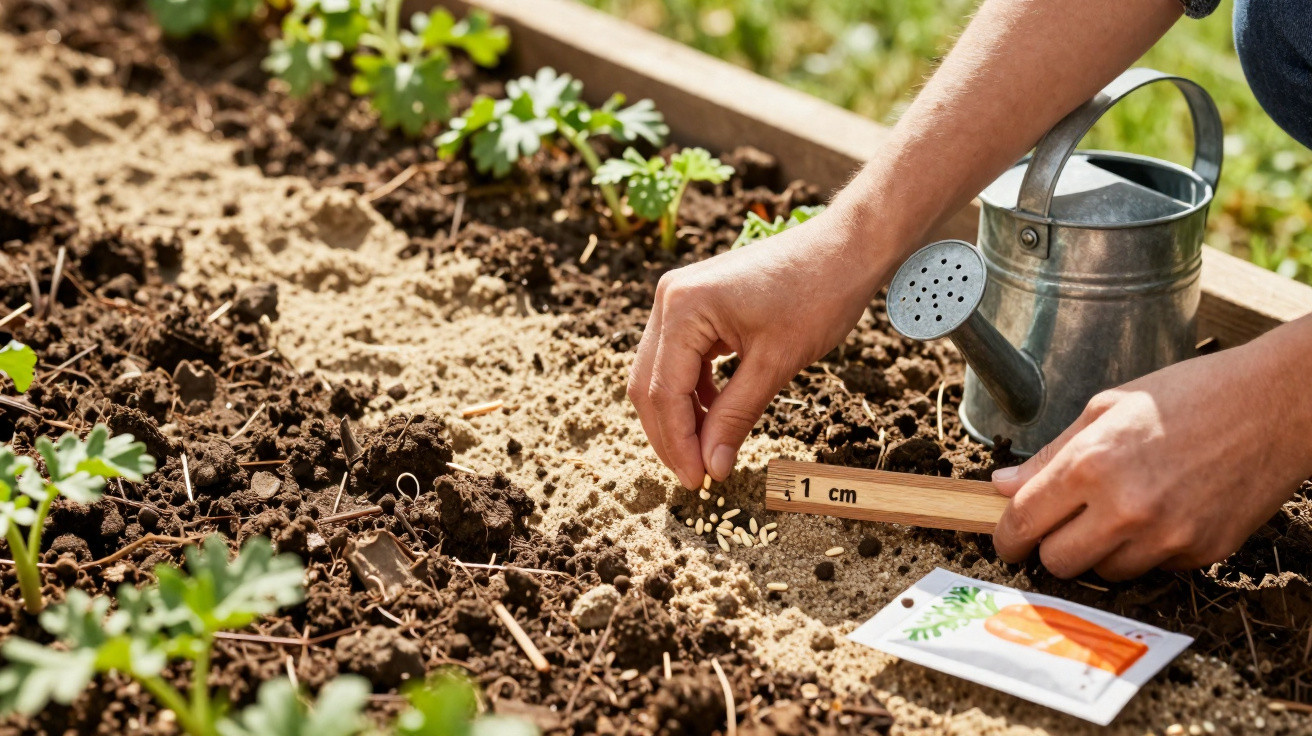
For reliable emergence, sow at roughly 0.5 to 1 cm - and no deeper. Think of it as a light veil of soil: enough to keep the seed damp and protected, but not enough to weigh it down.
Put carrot seed 2 or 3 cm down and most will still germinate, but they burn through their limited reserves forcing a shoot upwards. Plenty never reach daylight; those that do can appear thin and weak.
Leave seed on the surface and you swing to the other extreme: it dries quickly in sun or wind, and birds or ants may remove it.
For carrot seed, the “life zone” sits between 5 and 10 millimetres under a fine, loose cover.
How to actually hit that one centimetre
In the real world, many gardeners estimate depth and accidentally go too deep. A quick scrape with a hoe, seed dropped in, then soil raked back over the top… and several extra centimetres can appear without you noticing.
- Make a shallow drill using the edge of a trowel or a stick, no more than about 1 cm deep.
- Sow sparingly, aiming for roughly one seed per centimetre.
- Cover back over with only very light material, bringing the drill up to level with the surrounding soil.
That tiny margin - a few millimetres either way - goes a long way towards explaining why one row can look textbook while the next, apparently sown “the same”, barely shows.
Why gardeners should cover seeds with sand, not clods
Depth is only part of the equation. What you use as a cover is just as important. Ordinary garden soil - particularly when it is clay-heavy - can be harsh on tiny seedlings at this time of year.
After rain, heavy soils often set into a hard cap as the surface dries. For a carrot seedling, that cap might as well be a wall.
Never cover carrot seeds with raw, lumpy garden soil; use fine-textured material instead.
A straightforward solution is to keep a small supply of fine seed compost or horticultural sand near the bed. Once the seed is in the drill, dust this lighter material over the top.
Why sand works so well
| Cover material | Effect on seedlings |
|---|---|
| Clayey garden soil | Crusts over, blocks emergence, holds water around the seed |
| Fine seed compost | Stays loose, retains moisture, gentle on young roots |
| River sand | Drains well, never crusts, easy for shoots to push through |
Sand brings two further benefits: it clearly highlights the row, making weeding simpler, and it warms up faster in early spring, giving germination a modest but worthwhile lift.
Watering: soft rain, not a power hose
Even with correct depth and the right cover, watering can still undo the work. A hard blast from a hose - or even a heavy watering-can rose - can shift seed sideways or push it deeper than intended.
Think of early watering as misting a sheet of paper, not soaking a flowerbed.
Use a watering can with a fine rose held high so it falls as a gentle shower, or a handheld mister for small patches. The aim is to moisten the top centimetre without disturbing it.
Do not let the surface dry out completely before germination. With February sowings, that can mean brief, frequent watering under a cloche, particularly when wind is stripping moisture away.
Timeline: what to expect from a perfectly sown row
Even when depth, soil texture, and moisture are all right, carrots still demand patience. In cool soils, seed may take two to four weeks to appear.
During that period, the seed is working but nothing is visible. Many people start investigating after ten days and accidentally disrupt the fine, emerging root. Resisting the urge to prod improves the chances.
Once the first delicate green “hairs” show, growth usually accelerates. Under protection, a properly sown drill often becomes an even ribbon of foliage, with far less tedious thinning later.
What this one-centimetre rule means for other crops
This focus on shallow sowing is not exclusive to carrots. Other seeds with small energy reserves behave similarly. Radishes, lettuce, and parsnips all benefit from a shallow, well-prepared drill and a fine covering.
Bigger seeds - peas and beans, for example - handle deeper sowing because they contain more stored food beneath the seed coat. A common professional rule of thumb is to sow at around two to three times the seed’s diameter, unless crop-specific guidance says otherwise.
Two common scenarios that ruin carrot sowings
Two familiar situations crop up time and again:
- The enthusiastic digger. You double-dig the bed, it looks beautifully open, you sow, then you lightly tread the row to “firm it in”. For carrot seed sitting near the surface, that gentle pressure can compress the top layer into a barrier.
- The heavy rain. You sow at the right depth and top with fine compost, then a downpour arrives. Splash-back from the sides of the drill can throw soil onto the row, adding extra millimetres of cover you never intended.
In both cases, a cloche or fleece helps, and that cap of sand or seed compost limits the harm. The lighter topping softens the impact of raindrops and helps keep seed where you placed it.
Some jargon gardeners quietly use
Two terms often appear in professional sowing guidance:
Seedbed. This is not the entire vegetable bed; it is the top couple of centimetres where seed sits, takes up water, and begins growth. A good seedbed is level, fine-textured, and free of stones and large clods.
Crusting. This is the hard skin that forms when fine soil particles are hammered down by rain or heavy watering and then dry out. Crusting is especially unforgiving for carrots, onions, and lettuce, which all send up very slender shoots.
Beyond carrots: building habits that pay off
Once you adopt the “one centimetre, no more” approach, small routines change almost automatically. You spend longer raking to a finer tilth. A bucket of sand becomes a permanent fixture by the vegetable bed. Watering cans get fitted with gentler roses.
The knock-on benefit is not limited to carrots. Early salads stand more evenly, radishes stop disappearing from half the drill, and fewer seed packets are dismissed as “no good”. A modest adjustment in depth and surface texture, repeated across spring sowings, can reshape the season’s harvest.
Comments
No comments yet. Be the first to comment!
Leave a Comment