
If you planted it to brighten up your garden, you may have just committed an offence punishable by three years in prison. Sosnowski's hogweed, attractive for its beauty and its towering, architectural shape, is on the European Union’s blacklist and is completely prohibited in France. On paper it looks like the ideal ornamental plant-yet it can harm you both legally and medically.
Sosnowski's hogweed (Heracleum sosnowskyi) was first described during the Second World War, in 1944, by the Soviet botanist Ida Panovna Mandenova, after she found it in the Caucasus Mountains in Georgia. She named it in honour of her thesis supervisor, the researcher Dmitri Sosnowsky. It is a perennial herb and a giant umbellifer in the Apiaceae family; it is loosely related to wild carrot, but on an XXL scale.
This plant can reach between 3 and 5 metres in height. Its tough, upright stem, mottled with purple, can be 10 cm thick, and it carries large white umbels at the top alongside long, deeply cut leaves up to 1 metre in length. It is hard to miss-and its striking, elegant look has made it popular with gardening enthusiasts drawn to its ornamental appeal.
Sosnowski's hogweed in France: total ban and heavy penalties
However, in France, as reported by Le Figaro, “you simply cannot possess it, plant it, grow it, sell it, or intentionally introduce it into a natural environment”. Listed under the decree of 14 February 2018 intended to prevent the arrival and spread of invasive plants, it is one of 14 prohibited species in Annex I-1, which covers “vascular plants”. If you break the rules, French law is uncompromising: three years in prison and a €150,000 fine-an unusually severe criminal penalty for anyone who only wanted to add a touch of the exotic to the back of the garden. For an ornamental plant, the punishment is harsh, but the story behind it explains why the authorities take it so seriously.
Sosnowski's hogweed: a toxic plant born of a state blunder
Native to Asia and the Caucasus, Sosnowski's hogweed gradually appeared in gardens and natural areas from the 19th century through to the mid-20th century. Yet it was a decision taken in Moscow in 1947 that truly sped up its spread. The USSR was emerging shattered from war: millions had died, many major cities were ruined, livestock numbers had collapsed, and the surviving animals lacked feed. Collective farms (kolkhozes) were therefore looking for a cheap, high-yield fodder plant that could grow on poor soils to replace barley, oats and rye-crops that were in desperately short supply after the fighting.
They turned to H. sosnowskyi. It was not being farmed at the time, but it looked like the perfect solution to a looming feed crisis. Exceptionally tough, it can grow in almost any ground, tolerates frost, develops very quickly, and its protein yield rivals maize silage or lucerne. On the face of it, it seemed like the ideal candidate for feeding dairy cattle, pigs and sheep-and for restarting agricultural production.
So, from 1947, it was introduced into central and northern Russia, first as a trial at the Polar-Alpine Botanical Garden in Kirovsk, before being rolled out widely from 1948 onwards. During the 1950s and 1960s it spread across agricultural land in European Russia, Ukraine, Belarus and the Baltic states. Two cultivars, “Uspekh” and “Severzhanin”, were even bred to maximise its productivity.
That decision backfired badly. Animals fed with hogweed suffered serious skin burns when exposed to its sap, and their milk became disgusting. Its strong bitterness was in fact linked to contamination by the plant’s toxic compounds-furocoumarins-which not only spoiled the taste but also severely damaged fertility in the animals and harmed the health of calves.
Those same substances are dangerous to human skin too, with one feature that makes them particularly treacherous: the plant does not seem threatening at first. Clear and painless on contact, the sap triggers no immediate reaction. Only after exposure to the Sun’s UV rays-sometimes hours later-does the inflammation begin. Blisters the size of a potato can form where the sap touched, and dark marks may linger for several years. If the sap reaches the eyes, the outcome can be catastrophic, with complete blindness in the worst cases.
Even when the Soviet authorities abandoned the crop, the damage had already been done. From the late 1980s, taking advantage of the disorder that followed the collapse of the Soviet bloc, the plant escaped cultivation and began occupying wasteland, embankments, woodland edges and riverbanks. Since then, Eastern Europe has been overwhelmed by it, and in former Soviet-bloc countries it acquired a grim nickname: “Stalin’s revenge” (“Zemsta Stalina”).
This is why it appears on the EU list of invasive alien species of Union concern, drawn up under Regulation No 1143/2014, and on the French 2018 decree. It is not alone: two close relatives-Heracleum mantegazzianum (giant hogweed) and Heracleum persicum (Persian hogweed)-are subject to the same prohibitions. Three species from the same genus, brought into Europe as ornamentals, all of which became unmanageable thanks to an exceptional capacity to reproduce.
What should you do if it is in your garden?
Confirming you really have Sosnowski's hogweed
Start by making sure it truly is Sosnowski's hogweed, as it is easy to confuse with other plants such as common hogweed (Heracleum sphondylium) or wild angelica (Angelica sylvestris). If you are not confident in your botany, use technology: AI models such as Gemini, Claude or ChatGPT can help with identification if you provide clear photos.
Be cautious, though: they can still make mistakes, so it is always wiser to cross-check. The PlantNet app, available free on the Google Play Store and the App Store, is far more dependable than general-purpose AI models for assessing the fine details of an umbel or stem and can help you confirm what you are looking at.
Removing it safely (and when to act)
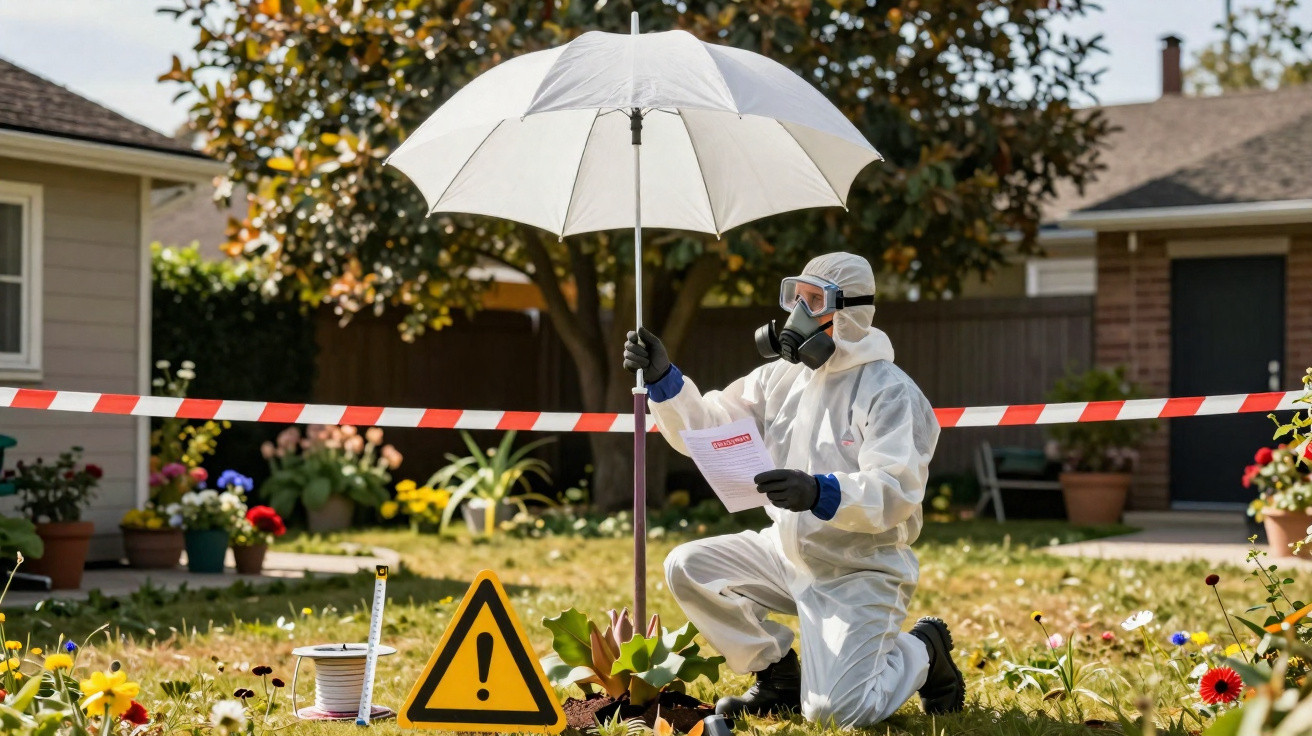
If, unfortunately, it is Sosnowski's hogweed, do not even think about touching it-or cutting it down with secateurs as you would with nettles. If you decide to tackle it yourself, you must protect yourself: a full waterproof coverall, sealed protective goggles, and thick gloves are essential.
To get rid of it, favour digging it out or cutting below the crown at a depth of 20–25 cm, ideally in late April or early May when the plant is still young and not deeply rooted. Choose overcast weather if possible, and avoid a brushcutter at all costs, as it sprays sap droplets everywhere. If the plant has already produced umbels, they must be bagged in a sealed sack and sent to an incinerator-no exceptions. Do not expect a one-off job: buried seeds can remain able to germinate for nearly ten years.
Getting help from your local authority
For that reason, it is worth contacting your local council to arrange secure eradication. In some areas, councils organise free interventions in partnership with specialist networks such as FREDON (Regional Federation for the Defence against Harmful Organisms). Regular eradication campaigns are run, enabling trained teams to come to your property if you have reported the plant.
Unfortunately, this is not available everywhere; in that case you will need to hire a specialist company that removes invasive species. To find out whether you can access a public scheme, visit the FREDON France website or the French Office for Biodiversity portal to contact environmental officers or locate local support organisations. Better to make a quick call to the council than end up at the dermatologist-or worse, in front of a judge.

Comments
No comments yet. Be the first to comment!
Leave a Comment