
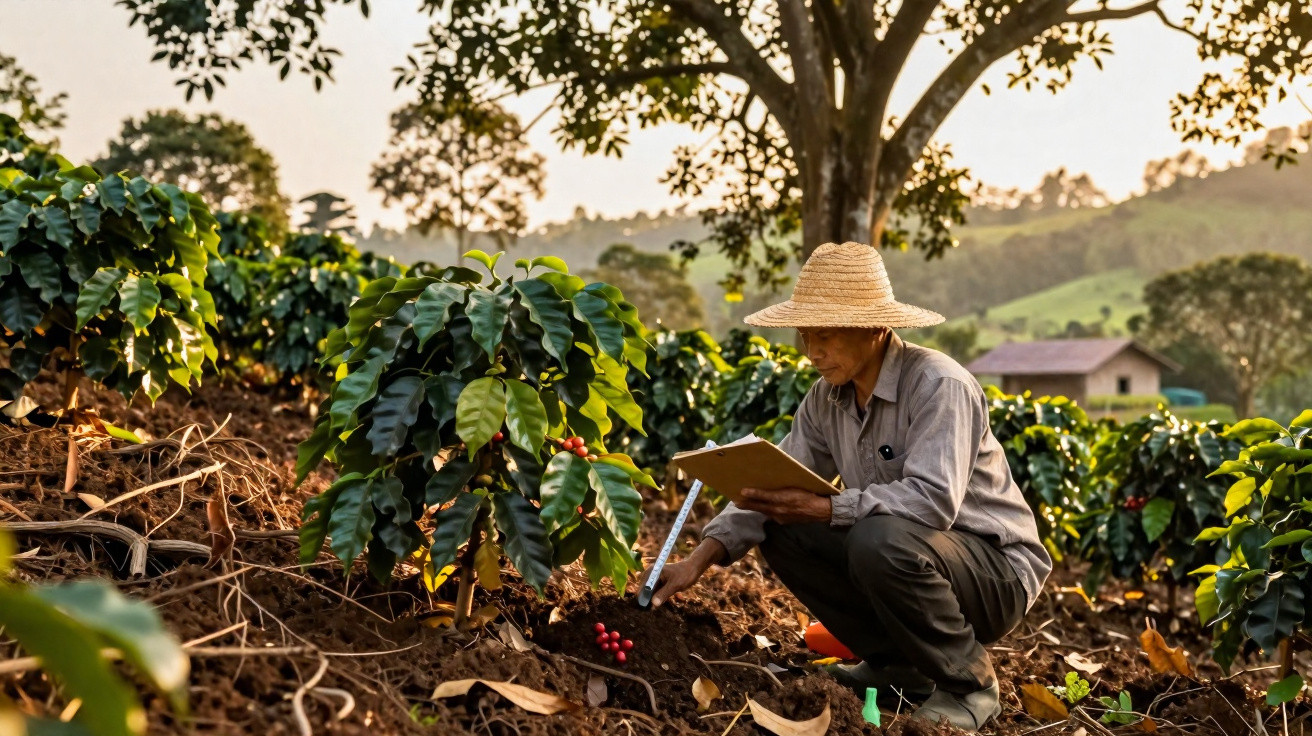
Shade-grown coffee has been marketed for years as the greener option.
The idea is straightforward: if coffee is cultivated beneath a tree canopy, farms should provide habitat for wildlife, safeguard soils, and cope better with shocks.
A new review set out to check how well those promises stand up. Using decades of evidence, it concluded that several headline environmental gains from shade coffee are strongly supported.
At the same time, the analysis shows that other benefits are less clear-cut than the label implies.
Under growing pressure
Coffee underpins the livelihoods of more than 25 million smallholder families, typically farming small plots in tropical regions, and recent research has highlighted how sensitive the crop is to rising temperatures.
Across many growing areas, the conditions coffee relies on are deteriorating: hotter seasons, unpredictable rain, and longer dry periods.
Those hotter seasons, erratic rainfall, and extended dry spells also help create the kind of ground conditions that increase erosion in coffee landscapes.
When harvests fail, the impact is most severe for growers with the least financial buffer.
Agroforestry is one response that is gaining traction. Instead of planting coffee in open sun, farmers maintain shade trees above it - and that shift changes how the whole farm functions.
To pin down what shade means for coffee systems, a group led by Altyeb Ali Abaker Omer of Puer University in Puer, China, compiled results from 46 field studies published between 2006 and 2025.
Where the carbon hides
Across most of the 46 studies, carbon accounting focused on two main pools: above-ground woody material (trees and shrubs) and the carbon stored in the soil beneath.
What emerged runs against the intuitive picture. In many cases, the soil - not the trees - contained the bulk of the carbon, commonly around 60 to 90 per cent of the total. The canopy is what you see, but the ground often holds more.
Other components were harder to quantify. Roots and deeper soil layers were frequently estimated rather than measured directly.
It also becomes tricky to compare results between farms when sampling depths differ from one study to another.
Tree and carbon size
Shade clearly changed the balance. Compared with coffee grown in full sun, shaded coffee systems held roughly two to four times more carbon, adding about 1.2 to over 7.4 tonnes per hectare each year.
The more striking point was not the number of species present, but how large the trees became - the effect was driven by size rather than diversity.
A small number of big, older trees could store more carbon than many smaller ones, a distinction that coffee-focused work had often obscured until this synthesis.
Farm management tended to pull in the opposite direction: removing shade, thinning trees, or re-establishing coffee without tree cover consistently reduced stored carbon.
Yet heavy shade can also reduce yields, implying that a moderate canopy is often the best compromise between production and carbon storage.
Buffer against extremes
The same canopy that increases carbon storage also alters the microclimate beneath it. Shade lowers air temperatures under the trees.
It reduces evaporation and helps soils retain moisture during dry spells, which has been associated with more stable yields.
Some of the clearest evidence came from places recovering from extreme events. In Puerto Rico, farms hit by hurricanes saw shaded plots bounce back more quickly than sun-grown plots, while also retaining more carbon.
In Ethiopia, systems with more shade showed higher carbon stocks and more robust tree cover than nearby farms where shade had been stripped away. There, soil played two roles at once.
Carbon stored in these systems often coincided with improved soil structure and stronger water-holding capacity - features that are likely to help farms endure drought.
Put simply, the soil tends to become healthier, not merely more carbon-rich.
What remains unproven
Here the review draws a boundary that earlier work often blurred. The ways climate change harms coffee are well documented, and one review has catalogued shrinking suitable growing areas alongside rising pest pressure.
The protective side of the argument is supported less convincingly. Only a small number of studies directly tested how high-carbon farms performed during an actual drought or heatwave.
Instead, many papers leaned on proxies such as canopy cover or leaf litter rather than measuring responses in the coffee plants themselves. The link between carbon and survival appears credible, but it remains largely unverified.
The evidence base is also geographically uneven. Most studies come from Latin America, East Africa, and parts of Asia, leaving significant coffee-growing regions with limited data.
That means a pattern observed in Ethiopia may not hold in areas with different soils and rainfall regimes.
The money question
For farmers weighing up whether to keep trees on their land, the economics often decide the issue.
Carbon credits - payments intended to reward landholders for storing carbon - have been hoped for as a key incentive, but returns so far appear modest.
In one of the few studies that calculated this directly, carbon payments amounted to less than one per cent of a farm’s income.
Shade trees contributed financially in other, more tangible ways. Fruit, firewood, timber, and the more reliable harvests associated with mixed planting provided greater support for households.
That difference matters for how benefits are communicated. The evidence that diversified, shaded farms spread risk is relatively strong.
By contrast, proof that carbon storage alone substantially lifts farm earnings is still limited, so promoting shade chiefly as a carbon windfall could set unrealistic expectations.
What this could change
The review helps clarify where coffee’s carbon is concentrated: in large, long-lived trees and in the soils those trees protect - functioning together.
It is also the first coffee-specific assessment to consider carbon storage, resilience, and livelihoods in one synthesis.
That has practical implications. Farmers and the programmes advising them have a clear rationale to conserve mature shade trees and manage for a moderate canopy, rather than clearing trees for a quick increase in yield.
For designers of carbon schemes, the findings also underline that payments on their own are unlikely to sustain a farm.
What remains is to move from inference to direct measurement, by tracking how carbon-rich coffee systems actually fare through droughts, heat, and difficult years.
If future studies confirm these patterns, the trees above coffee plants could become a well-documented line of defence against climate stress - for farms and, ultimately, for the coffee in the cup.




Comments
No comments yet. Be the first to comment!
Leave a Comment