
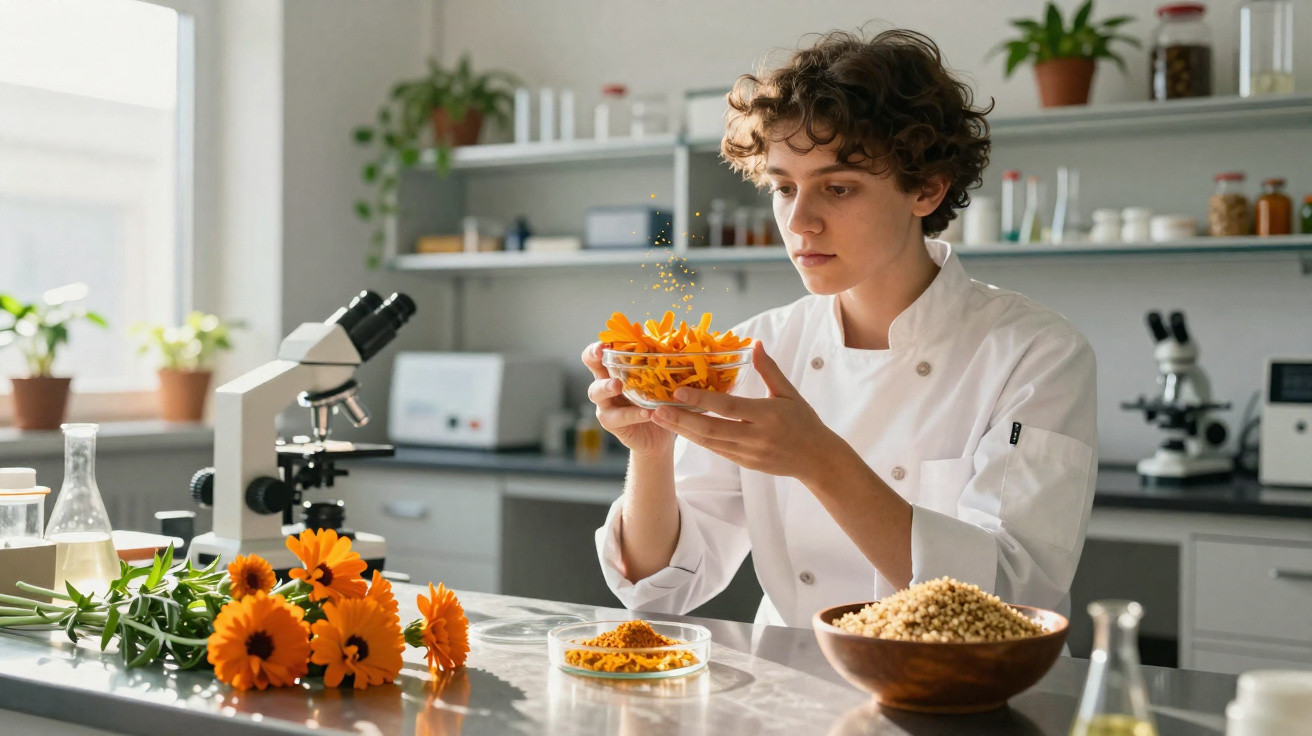
Marigolds are everywhere: in borders and beds, strung into festival garlands, and woven into wedding displays. Yet very few people think of them as something you might eat.
That assumption may need updating. Researchers at the University of Georgia examined the common marigold in detail and found that its petals contain far more value than most of us would guess.
Wasted flowers hold value
Most people underestimate how serious floral waste has become.
In India, almost 40 per cent of the marigolds produced each year end up being discarded, and the floral industry in the United States generates its own vast piles of unwanted blooms.
It was precisely that scale of waste that prompted the team’s questions.
Study co-author Anand Mohan is an associate professor in the College of Agricultural and Environmental Sciences (CAES).
“Billions of dollars of flowers are thrown away each year,” said Mohan. “Can you imagine if we were able to take those flowers and use them for food instead?”
He acknowledged that achieving this is not straightforward, adding that research like this represents an essential first step.
Marigold protein rivals quinoa
Marigold petals are more than decorative extras. Measured on a dry-weight basis, they contain close to 10 per cent protein.
That places them alongside familiar plant-based sources such as quinoa, oats, and wheat. For a flower that is typically ignored as an ingredient, it is a notable figure.
Rather than treating marigold protein as a single material, the researchers divided it into four fractions, each released during extraction using a different liquid.
Albumin accounted for the largest portion at about 65 per cent. It also turned out to be the strongest performer overall, topping the others for water-holding capacity, oil-holding capacity, and emulsifying ability.
Heat tolerance of marigold protein
One finding will stand out to anyone who cooks or bakes: marigold albumin remained stable up to roughly 105 °C, only then beginning to lose its structure.
That level of heat resilience is greater than what is seen in chickpea and pea protein. In practical terms, it matters for breads, snacks, and other foods made using high-temperature processing.
More than one marigold protein fraction showed good emulsifying performance-the feature that keeps oil and water from separating in products such as salad dressings.
Once again, albumin led the group, retaining more oil and water than the other fractions.
The albumin fraction also contained many small, low-molecular-weight protein fragments. These can move quickly to the boundary between oil and water, helping the emulsion stay intact.
Flavor, antioxidants, and minerals
The petals may contribute to taste as well as function. Albumin, glutelin, and globulin contained high levels of glutamic acid and aspartic acid.
These amino acids are associated with savoury, umami flavours, meaning marigold protein could bring depth to foods rather than serving purely as a filler.
Beyond protein, the flowers contained other useful components. Albumin and glutelin produced the highest antioxidant activity, which can slow the spoilage of fats in food.
The petals also provide fibre and substantial mineral content. Calcium, potassium, and iron were all present in notable amounts.
Rethinking what flowers can do
“What excites me most about this research is that it challenges how we think about flowers,” said Fidele Benimana, first author of the study.
“Most people see marigolds as ornamental plants, but they also contain proteins with unique functional properties that could be useful in food formulation.”
Overall, the results indicate that edible flowers could become practical ingredients by offering nutrition alongside texture, stability, and other performance traits demanded in modern food products.
Not every marigold is safe
A clear warning applies before anyone starts picking from the garden: not all marigolds are suitable to eat.
The safe options include pot marigold (also known as Calendula) and the true marigolds within the Tagetes group.
This study used Calendula officinalis, the common marigold. The proteins were extracted from the petals, as the stems and leaves have a bitter taste.
Looking beyond the bloom
“I don’t know if the marigold is a super flower. But to me, I feel like maybe all these beautiful flowers are super flowers. You’d be surprised by how little we actually know about the flowers growing in our yards,” said Mohan.
“Mother Nature still holds a lot of truth that we don’t know yet. We must look around and uncover it.”
The researchers say the next stage is to test how marigold protein performs in real food products and on industrial processing lines.
If discarded blooms can be turned into ingredients, it could reduce waste while also creating a new source of plant protein.



Comments
No comments yet. Be the first to comment!
Leave a Comment